

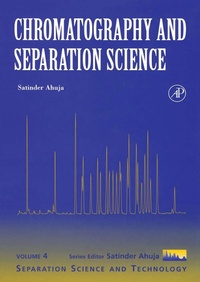
Chromatography and Separation Science
Published on 11. January 2003
262 pages
978-0-08-050112-3 (ISBN)
Description

The basic objectives of this book are to: provide basic information on chromatography and separation science; show how simple extraction and partition processes provide the basis for development of chromatography and separation science; describe the role of chromatography and separation science in various fields; discuss the role of chromatography and separation science in development of new methodology; and present new evolving methods and how to select an optimum method.· The book covers the fundamental physical and chemical phenomena involved in separations· Provides a concise overview of the basics of transport phenomena and thermodynamics· Shows the importance of chromatography within separation science
More details
Other editions
Additional editions
Satinder Ahuja
Chromatography and Separation Science: Volume 4
Book
01/2003
Academic Press
€129.99
Withdrawn from sale
Person
Satinder Ahuja is a leading expert on water quality improvement. He earned his PhD in analytical chemistry from the University of the Sciences in Philadelphia. He worked for Novartis Corp. in various leadership positions for over 25 years and taught as an adjunct professor at Pace University for over 10 years. As president of Ahuja Consulting, he advises on water quality issues relating to chemicals and pharmaceuticals. A member of the executive committee of the Rivers of the World Foundation (ROW), Dr. Ahuja has organized numerous global symposia on improving water quality, including presentations for the American Chemical Society and UNESCO. Dr. Ahuja has published numerous papers and more than 25 books. His latest books are Contaminants in Our Water (ACS, 2020); Evaluating Water Quality to Prevent Future Disasters (Elsevier, 2019); Advances in Water Purification Techniques (Elsevier, 2019); and Chemistry and Water (Elsevier, 2017).
Content
- Cover
- Contents
- Preface
- Chapter 1. Relating Chromatography to Separations
- I. Defining Separation
- II. Evolution of Chromatography
- III. Separations in Everyday Life
- IV. Basis of Separations
- V. Modes of Chromatography
- VI. Unified Separation Science
- VII. Selectivity and Detectability
- References
- Questions for Review
- Chapter 2. Simple Separation Methods
- I. Evaporation
- II. Precipitation
- III. Crystallization
- IV. Filtration
- V. Membrane Separations
- VI. Distillation
- VII. Extraction
- References
- Questions for Review
- Chapter 3. Equilibrium Processes in Separations
- I. Molecular Interactions
- II. Separation Thermodynamics
- References
- Questions for Review
- Chapter 4. The Molecular Basis of Separation
- I. Molecular Interactions
- II. Solubility Parameter Theory
- III. Group Interactions
- References
- Questions for Review
- Chapter 5. MassTransport and Separation
- I. Types of Diffusion
- II. Modeling Diffusion
- III. Chromatographic Implications
- IV. Diffusion Rates in Various Media
- V. Mass Transfer
- References
- Questions for Review
- Chapter 6. Chromatographic Methods
- I. General Classification of Chromatographic Methods
- II. Classification Based on Retention Mode
- III. Classification Based on Sample Introduction
- IV. Separation Characteristics of Chromatographic Methods
- V. Basic Chromatographic Theory
- References
- Questions for Review
- Chapter 7. Paper Chromatography
- I. Chromatography Paper
- II. Sample Preparation
- III. Sample Cleanup
- IV. Derivatization
- V. Mobile Phases and Stationary Phases
- VI. Development of Chromatograms
- VII. Detection
- VIII. Quantitation
- References
- Questions for Review
- Chapter 8. Thin-Layer Chromatography
- I. Stationary Phases for TLC
- II. TLC of Enantiomeric Compounds
- III. Sample Application
- IV. Mobile Phases
- V. Development of Chromatograms
- VI. Detection and Quantitation
- VII. Applications
- References
- Questions for Review
- Chapter 9. Gas Chromatography
- I. Equipment
- II. Separation Process
- III. Columns
- IV. Gas Chromatographic Detectors
- V. Recording and Analysis
- VI. Resolution
- VII. Selection of a Stationary Phase
- References
- Questions for Review
- Chapter 10. High-Pressure Liquid Chromatography
- I. Evolution of HPLC
- II. Advantages over Gas Chromatography (GC)
- III. Separation Process
- IV. Retention Parameters in HPLC
- V. Resolution and Retention Time
- VI. Equipment
- VII. Separation Mechanism in HPLC
- VIII. Stationary Phase Effects
- IX. A Case Study of Retention Mechanism Investigations
- X. Molecular Probes/Retention Index
- XI. Mobile Phase Selection and Optimization
- References
- Questions for Review
- Chapter 11. Evolving Methods and Method Selection
- I. Evolving Methodologies
- II. Selection of a Separation Method
- III. Chiral Separations
- IV. Comparison of GC, SFC, HPLC, and CEC for a Selective Separation
- References
- Questions for Review
- Index
