

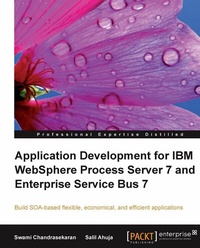
Application Development for IBM WebSphere Process Server 7 and Enterprise Service Bus 7
A Service Oriented Architecture approach has many benefits for your applications, including flexibility, reusability, and increased revenue. You can exploit those benefits to the fullest by following this step-by-step tutorial for WPS and WESB.
Published on 13. January 2025
548 pages
978-1-84719-829-7 (ISBN)
Description

A Service Oriented Architecture approach has many benefits for your applications, including flexibility, reusability, and increased revenue. You can exploit those benefits to the fullest by following this step-by-step tutorial for WPS and WESB.
Key Features
Develop SOA applications using the WebSphere Process Server (WPS) and WebSphere Enterprise Service Bus (WESB)
Analyze business requirements and rationalize your thoughts to see if an SOA approach is appropriate for your project
Quickly build an SOA-based Order Management application by using some fundamental concepts and functions of WPS and WESB
Do a top-down decomposition of the Order Management application to identify use cases, business processes, and services/components
Book DescriptionBy adopting an SOA approach in Business Process Management (BPM), you can make your application flexible, reusable, and adaptable to new developments. The SOA approach also gives you the potential to lower costs (from reuse), and increase revenue (from adaptability and flexibility). However, integrating basic SOA constructs (such as Process, Business Services, and Components) and core building blocks of BPM (such as Process Modeling and Enterprise Service Bus) in a real-world application can be challenging.This book introduces basic concepts of Business Integration, SOA Fundamentals, and SOA Programming Model and implements them in numerous examples. It guides you to building an Order Management application from scratch using the principles of Business Process Management and Service Oriented Architecture and using WebSphere Process Server (WPS) and WebSphere Enterprise Service Bus (WESB). The various detailed aspects, features, and capabilities of the product are conveyed through examplesWe begin with essential concepts on Business Integration, SOA Fundamentals and SOA Programming Model. Then we set up the development environment to build your first Hello Process and Hello Mediation applications.Gradually, we build an SOA-based Order Management Application. We cover important aspects and functions of WPS and WESB with numerous practical examples. We show how to analyze your application's business requirements and check if an SOA approach is appropriate for your project. Then you do a top-down decomposition of your application and identify its use cases, business processes, and services. Having built the SOA Application, we introduce you to various non-functional topics, including: Administration, Governance, Management, Monitoring, and Security. We also discuss deployment topologies for WPS and WESB, performance tuning, and recommended practices.What you will learn
IBM s BPM platform and key products that make it up
Understand fundamentals behind Service Component Architecture, Service Data Objects, WS-BPEL, and how they relate to BPM and SOA
Business Process Choreography and mediation flow fundamentals including business rules, state machine, human tasks, and CEI
Deliver a BPM enabled by SOA solutions using WPS
WESB'AEos smart approach to SOA by enabling integration, connectivity, and messaging capabilities
Install and fundamentals behind working with WID including integration solution, assembly diagram, working with modules and libraries, unit test environment
Build and deploy your first module project in WID and test business process applications
Understand basic concepts of mediation flows including message filter, XSLT transformation, and service invoke primitive while building a mediation module
Architect, design, and implement an "Order Management'AEusolution using WID, WPS, and WESB
Identify components necessary for the order management solution and map them to the IBM SOA reference architecture
Identify SOA business services, create shared libraries, and leverage existing application interfaces
Build the business process flows, business services and access services, integrate with back end applications and perform end-to-end integration tests
Integrate this business process with existing applications using various capabilities provided by WID including JDBC and File adapters, JMS imports, and Web Service imports
Explore topologies and deploy gold topology
Fundamentals behind using and customizing Business Space
Manage, monitor, secure, and administer your modules with the tools provided by WPS, WESB, and Business Space
Numerous references, tips, and pointers for advanced and related topics
Who this book is forThis book is for SOA architects, designers, and developers who have a basic understanding of SOA concepts and would like to learn more about building solutions and applications using IBM WebSphere Process Server and WebSphere Enterprise Service Bus.
Key Features
Develop SOA applications using the WebSphere Process Server (WPS) and WebSphere Enterprise Service Bus (WESB)
Analyze business requirements and rationalize your thoughts to see if an SOA approach is appropriate for your project
Quickly build an SOA-based Order Management application by using some fundamental concepts and functions of WPS and WESB
Do a top-down decomposition of the Order Management application to identify use cases, business processes, and services/components
Book DescriptionBy adopting an SOA approach in Business Process Management (BPM), you can make your application flexible, reusable, and adaptable to new developments. The SOA approach also gives you the potential to lower costs (from reuse), and increase revenue (from adaptability and flexibility). However, integrating basic SOA constructs (such as Process, Business Services, and Components) and core building blocks of BPM (such as Process Modeling and Enterprise Service Bus) in a real-world application can be challenging.This book introduces basic concepts of Business Integration, SOA Fundamentals, and SOA Programming Model and implements them in numerous examples. It guides you to building an Order Management application from scratch using the principles of Business Process Management and Service Oriented Architecture and using WebSphere Process Server (WPS) and WebSphere Enterprise Service Bus (WESB). The various detailed aspects, features, and capabilities of the product are conveyed through examplesWe begin with essential concepts on Business Integration, SOA Fundamentals and SOA Programming Model. Then we set up the development environment to build your first Hello Process and Hello Mediation applications.Gradually, we build an SOA-based Order Management Application. We cover important aspects and functions of WPS and WESB with numerous practical examples. We show how to analyze your application's business requirements and check if an SOA approach is appropriate for your project. Then you do a top-down decomposition of your application and identify its use cases, business processes, and services. Having built the SOA Application, we introduce you to various non-functional topics, including: Administration, Governance, Management, Monitoring, and Security. We also discuss deployment topologies for WPS and WESB, performance tuning, and recommended practices.What you will learn
IBM s BPM platform and key products that make it up
Understand fundamentals behind Service Component Architecture, Service Data Objects, WS-BPEL, and how they relate to BPM and SOA
Business Process Choreography and mediation flow fundamentals including business rules, state machine, human tasks, and CEI
Deliver a BPM enabled by SOA solutions using WPS
WESB'AEos smart approach to SOA by enabling integration, connectivity, and messaging capabilities
Install and fundamentals behind working with WID including integration solution, assembly diagram, working with modules and libraries, unit test environment
Build and deploy your first module project in WID and test business process applications
Understand basic concepts of mediation flows including message filter, XSLT transformation, and service invoke primitive while building a mediation module
Architect, design, and implement an "Order Management'AEusolution using WID, WPS, and WESB
Identify components necessary for the order management solution and map them to the IBM SOA reference architecture
Identify SOA business services, create shared libraries, and leverage existing application interfaces
Build the business process flows, business services and access services, integrate with back end applications and perform end-to-end integration tests
Integrate this business process with existing applications using various capabilities provided by WID including JDBC and File adapters, JMS imports, and Web Service imports
Explore topologies and deploy gold topology
Fundamentals behind using and customizing Business Space
Manage, monitor, secure, and administer your modules with the tools provided by WPS, WESB, and Business Space
Numerous references, tips, and pointers for advanced and related topics
Who this book is forThis book is for SOA architects, designers, and developers who have a basic understanding of SOA concepts and would like to learn more about building solutions and applications using IBM WebSphere Process Server and WebSphere Enterprise Service Bus.
All prices
More details
Edition
Digital original
Language
English
Place of publication
Birmingham
United Kingdom
Target group
Professional and scholarly
US School Grade: College Graduate Student
Edition type
Digital original
File size
26,80 MB
ISBN-13
978-1-84719-829-7 (9781847198297)
Copyright in bibliographic data and cover images is held by Nielsen Book Services Limited or by the publishers or by their respective licensors: all rights reserved.
Schweitzer Classification
Other editions
Additional editions
Salil Ahuja | Swami Chandrasekaran
Application Development for IBM Websphere Process Server 7 and Enterprise Service Bus 7
Book
07/2010
Packt Publishing
€76.00
Shipment within 3-4 weeks
Persons
Salil Ahuja currently works for IBM as a Technical Lead in their AIM Customer Programs group. He has been working in the IT industry for over eight years in a variety of positions ranging from development to client services. As a certified IBM SOA Designer, he has spent the majority of his career consulting with large healthcare players on the design, implementation, and delivery of standards-based enterprise SOA solutions. In his current role, he works with premium IBM clients to educate and enable them on the leading edge technologies within the IBM Business Process Management portfolio. Salil is a sought after expert on HIPAA and Health Level 7 Clinical Data Architecture, and has presented to various IBM labs on healthcare information exchange in the provider payer space. He lives in Austin, Texas with his wife Priyanka. In his spare time he enjoys the outdoors, theater, and playing or watching basketball whenever possible. He can be contacted on LinkedIn at http://www.linkedin.com/pub/salil-ahuja/0/b92/186. Swami Chandrasekaran (@swamichandra) is a managing director at KPMG's AI Innovation & Enterprise Solutions. He leads the architecture, technology, creation of AI + emerging tech offerings as well as innovation efforts. He has led the creation of products and solutions that have solved a wide range of problems in areas such as tax and audit, industrial automation, aviation safety, contact centers, insurance claims, field service, multimedia enrichment, social care, digital marketing, M&A, and KYC. These solutions have leveraged automation, ML/DL, NLP, advanced analytics, as well as RPA, cloud and IoT capabilities. He is currently also driving explainable and trusted AI efforts.
Previously, he spent 12 years at IBM, out of which 5 years were spent in the core Watson division. He led an organization that drove innovation and also creation + incubation of several solutions that leveraged Watson and IBM Cloud capabilities. He was also responsible for creating a library of Watson Accelerators that were used by several clients and field teams to accelerate their adoption of AI across various industries. He was appointed as one of their most elite IBM Distinguished Engineer.
Prior to Watson, he worked in IBM's WebSphere division and led efforts in the areas of OSS/BSS transformation, Cloud Service Broker + Storefronts, Digital Media Supply Chain, Mobile Payments, Smart Metering, Real-time Campaigns using middleware, BPM & SOA capabilities.
Prior to IBM, he worked at Webify Solutions (acquired by IBM), BearingPoint, and Ericsson Research. He holds a master's in electrical engineering from UT Arlington, has filed about 20 patents and an IBM Master Inventor. He lives in Dallas with his wife Ramya, and two lovely daughters. Swami has also authored a couple of books on SOA and BPM. He is an avid video gamer, and when he finds the time, he writes on http://nirvacana.com and tweets with the handle @swamichandra.
Previously, he spent 12 years at IBM, out of which 5 years were spent in the core Watson division. He led an organization that drove innovation and also creation + incubation of several solutions that leveraged Watson and IBM Cloud capabilities. He was also responsible for creating a library of Watson Accelerators that were used by several clients and field teams to accelerate their adoption of AI across various industries. He was appointed as one of their most elite IBM Distinguished Engineer.
Prior to Watson, he worked in IBM's WebSphere division and led efforts in the areas of OSS/BSS transformation, Cloud Service Broker + Storefronts, Digital Media Supply Chain, Mobile Payments, Smart Metering, Real-time Campaigns using middleware, BPM & SOA capabilities.
Prior to IBM, he worked at Webify Solutions (acquired by IBM), BearingPoint, and Ericsson Research. He holds a master's in electrical engineering from UT Arlington, has filed about 20 patents and an IBM Master Inventor. He lives in Dallas with his wife Ramya, and two lovely daughters. Swami has also authored a couple of books on SOA and BPM. He is an avid video gamer, and when he finds the time, he writes on http://nirvacana.com and tweets with the handle @swamichandra.
Content
Table of Contents

