

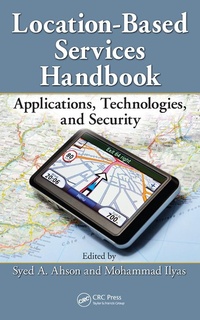
Location-Based Services Handbook
Applications, Technologies, and Security
Published on 3. September 2018
327 pages
978-1-4200-7198-6 (ISBN)
Description

Location-Based Services Handbook: Applications, Technologies, and Security is a comprehensive reference containing all aspects of essential technical information on location-based services (LBS) technology. With broad coverage ranging from basic concepts to research-grade material, it presents a much-needed overview of technologies for positioning and localizing, including range- and proximity-based localization methods, and environment-based location estimation methods. Featuring valuable contributions from field experts around the world, this book addresses existing and future directions of LBS technology, exploring how it can be used to optimize resource allocation and improve cooperation in wireless networks.
It is a self-contained, comprehensive resource that presents:
A detailed description of the wireless location positioning technology used in LBS
Coverage of the privacy and protection procedure for cellular networks-and its shortcomings
An assessment of threats presented when location information is divulged to unauthorized parties
Important IP Multimedia Subsystem and IMS-based presence service proposals
The demand for navigation services is predicted to rise by a combined annual growth rate of more than 104 percent between 2008 and 2012, and many of these applications require efficient and highly scalable system architecture and system services to support dissemination of location-dependent resources and information to a large and growing number of mobile users.
This book offers tools to aid in determining the optimal distance measurement system for a given situation by assessing factors including complexity, accuracy, and environment. It provides an extensive survey of existing literature and proposes a novel, widely applicable, and highly scalable architecture solution. Organized into three major sections-applications, technologies, and security-this material fully covers various location-based applications and the impact they will have on the future.
It is a self-contained, comprehensive resource that presents:
A detailed description of the wireless location positioning technology used in LBS
Coverage of the privacy and protection procedure for cellular networks-and its shortcomings
An assessment of threats presented when location information is divulged to unauthorized parties
Important IP Multimedia Subsystem and IMS-based presence service proposals
The demand for navigation services is predicted to rise by a combined annual growth rate of more than 104 percent between 2008 and 2012, and many of these applications require efficient and highly scalable system architecture and system services to support dissemination of location-dependent resources and information to a large and growing number of mobile users.
This book offers tools to aid in determining the optimal distance measurement system for a given situation by assessing factors including complexity, accuracy, and environment. It provides an extensive survey of existing literature and proposes a novel, widely applicable, and highly scalable architecture solution. Organized into three major sections-applications, technologies, and security-this material fully covers various location-based applications and the impact they will have on the future.
More details
Language
English
Place of publication
Baton Rouge
United States
Publishing group
Taylor & Francis Inc
Target group
Professional and scholarly
All researchers, designers, and technicians in wireless services; students entering the field; researchers in LBS.
Illustrations
76 s/w Abbildungen, 27 s/w Tabellen
27 Tables, black and white; 76 Illustrations, black and white
File size
13,01 MB
ISBN-13
978-1-4200-7198-6 (9781420071986)
Copyright in bibliographic data and cover images is held by Nielsen Book Services Limited or by the publishers or by their respective licensors: all rights reserved.
Schweitzer Classification
Other editions
Additional editions
Syed Ahson | Mohammad Ilyas
Location-Based Services Handbook
Applications, Technologies, and Security
Book
06/2017
1st Edition
CRC Press
€108.40
Shipment within 10-20 days
Syed Ahson | Mohammad Ilyas
Location-Based Services Handbook
Applications, Technologies, and Security
Book
07/2010
1st Edition
CRC Press
€305.05
Article not available at the moment
Persons
Syed Ahson is a senior software design engineer with Microsoft. As part of the Mobile Voice and Partner Services group, he is busy creating new and exciting end-to-end mobile service and applications. Prior to Microsoft, Syed was a senior staff software engineer with Motorola, where he contributed signifcantly in leading roles toward the creation of several iDEN, CDMA, and GSM cellular phones. Syed has extensive experience with wireless data protocols, wireless data applications, and cellular telephony protocols. Prior to joining Motorola, Syed was a senior software design engineer with NetSpeak Corporation (now part of Net2Phone), a pioneer in VoIP telephony software. Syed has published more than ten books on emerging technologies such as cloud computing, mobile web 2.0, and service delivery platforms. His recent books include Cloud Computing and Software Services: Theory and Techniques and Mobile Web 2.0: Developing and Delivering Services to Mobile Phones. Syed has authored several research papers and teaches computer engineering courses as adjunct faculty at Florida Atlantic University, Boca Raton, Florida, where he introduced a course on Smartphone technology and applications. Syed received his MS degree in computer engineering in July 1998 at Florida Atlantic University. Syed received his BSc degree in electrical engineering from Aligarh University, India, in 1995.
Dr. Mohammad Ilyas is associate dean for research and industry relations at the College of Engineering and Computer Science at Florida Atlantic University, Boca Raton, Florida. Previously, he has served as chair of the Department of Computer Science and Engineering and interim associate vice president for research and graduate studies. He received his Ph.D degree from Queen's University in Kingston, Canada. His doctoral research was about switching and fl ow control techniques in computer communication networks. He received his BSc degree in electrical engineering from the University of Engineering and Technology, Pakistan, and his MS degree in electrical and electronic engineering at Shiraz University, Iran. Dr. Ilyas has conducted successful research in various areas, including traffic management and congestion control in broadband/high-speed communication networks traffic characterization, wireless communication networks, performance modeling, and simulation. He has published over 25 books on emerging technologies, and over 150 research articles. His recent books include Cloud Computing and Software Services: Theory and Techniques (2010) and Mobile Web 2.0: Developing and Delivering Services to Mobile Phones (2010). He has supervised 11 PhD dissertations and more than 37 MS theses to completion. He has been a consultant to several national and international organizations. Dr. Ilyas is an active participant in several IEEE technical committees and activities. He is a senior member of IEEE and a member of ASEE.
Dr. Mohammad Ilyas is associate dean for research and industry relations at the College of Engineering and Computer Science at Florida Atlantic University, Boca Raton, Florida. Previously, he has served as chair of the Department of Computer Science and Engineering and interim associate vice president for research and graduate studies. He received his Ph.D degree from Queen's University in Kingston, Canada. His doctoral research was about switching and fl ow control techniques in computer communication networks. He received his BSc degree in electrical engineering from the University of Engineering and Technology, Pakistan, and his MS degree in electrical and electronic engineering at Shiraz University, Iran. Dr. Ilyas has conducted successful research in various areas, including traffic management and congestion control in broadband/high-speed communication networks traffic characterization, wireless communication networks, performance modeling, and simulation. He has published over 25 books on emerging technologies, and over 150 research articles. His recent books include Cloud Computing and Software Services: Theory and Techniques (2010) and Mobile Web 2.0: Developing and Delivering Services to Mobile Phones (2010). He has supervised 11 PhD dissertations and more than 37 MS theses to completion. He has been a consultant to several national and international organizations. Dr. Ilyas is an active participant in several IEEE technical committees and activities. He is a senior member of IEEE and a member of ASEE.
Content
Positioning Technologies in Location-Based Services. Wireless Location Technology in Location-Based Services. Location in Wireless Local Area Networks. Radio Frequency Identification Positioning. Supporting Smart Mobile Navigation in a Smart Environment. Location Determination: Environmental Impacts, Algorithm Robustness, and Performance Evaluation. Location-Aware Access Control: Scenarios, Modeling Approaches, and Selected Issues. Location-Based Services and Privacy. Protecting Privacy in Location-Based Applications. Presence Services for the Support of Location-Based Applications. Data-Flow Management for Location-Based Service Applications using the Zoning Concept. Global Navigation Satellite Systems: An Enabling Technology for High Demanding Location-Based Services. Index.
