

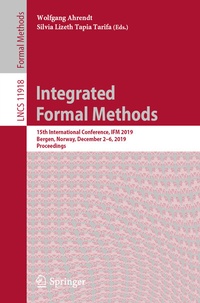
Integrated Formal Methods
15th International Conference, IFM 2019, Bergen, Norway, December 2-6, 2019, Proceedings
Published on 22. November 2019
XVII, 554 pages
978-3-030-34968-4 (ISBN)
Description

This book constitutes the refereed proceedings of the 15th International Conference on Integrated Formal Methods, IFM 2019, held in Bergen, Norway, in December 2019.
The 25 full papers and 3 short papers were carefully reviewed and selected from 95 submissions. The papers cover a broad spectrum of topics: from language design to verification and analysis techniques, to supporting tools and their integration into software engineering practice including both theoretical approaches and practical implementations. Also included are the extended abstracts of 6 "journal-first" papers.
The 25 full papers and 3 short papers were carefully reviewed and selected from 95 submissions. The papers cover a broad spectrum of topics: from language design to verification and analysis techniques, to supporting tools and their integration into software engineering practice including both theoretical approaches and practical implementations. Also included are the extended abstracts of 6 "journal-first" papers.
More details
Series
Language
English
Place of publication
Cham
Switzerland
Publishing group
Springer International Publishing
Target group
Professional and scholarly
Product notice
Reflowable
Illustrations
XVII, 554 p. 1489 illus., 92 illus. in color.
File size
30,46 MB
ISBN-13
978-3-030-34968-4 (9783030349684)
DOI
10.1007/978-3-030-34968-4
Schweitzer Classification
Other editions
Additional editions
Wolfgang Ahrendt | Silvia Lizeth Tapia Tarifa
Integrated Formal Methods
15th International Conference, IFM 2019, Bergen, Norway, December 2-6, 2019, Proceedings
Book
11/2019
Springer
€53.49
Shipment within 7-9 days
Content
- Intro
- Preface
- Organization
- Abstracts of Invited Talks
- Deductive Verification of OCaml Libraries
- Safe Deep Neural Networks
- Contents
- Invited Talk
- The Digital Thread in Industry 4.0
- 1 From the Digital Twin to the Digital Thread
- 2 Bringing the UR3 Controller in the Web
- 2.1 Programming the UR3
- 2.2 Case Study: A Web UR3 Controller
- 3 DIME as a Model Driven IDE for Robotics
- 3.1 Behavioural Models and Feature DSL
- 3.2 The UR3 Native DSL
- 3.3 GUI Models and Their DSL
- 4 XMDD for the Digital Thread
- 4.1 Innovation Directions
- 4.2 Experiential Evidence so Far
- References
- Regular Papers
- Accelerating Parameter Synthesis Using Semi-algebraic Constraints
- 1 Introduction
- 2 CTL Parameter Synthesis
- 2.1 Parameter Synthesis Problem
- 2.2 Parallel Lock-Free Algorithm
- 3 Semi-algebraic Sets as Cylindrical Decompositions
- 3.1 Preliminaries
- 3.2 Method Overview
- 3.3 Open CAD Construction
- 3.4 Reduced CAD Tree
- 4 Evaluation
- 5 Conclusions
- References
- Uniqueness Types for Efficient and Verifiable Aliasing-Free Embedded Systems Programming
- 1 Introduction
- 2 Overview
- 2.1 Aliasing-Free Programming
- 2.2 Uniqueness Types for High-Performance Aliasing-Free Programming
- 3 Type and Permission System
- 3.1 Uniqueness Annotation
- 3.2 Uniqueness Semantics
- 3.3 Permissions
- 3.4 Rules
- 4 Formalization
- 4.1 Syntax
- 4.2 Operational Semantics
- 4.3 Type and Permission System
- 4.4 Soundness
- 5 Implementation
- 6 Validation
- 6.1 Annotation Overhead
- 6.2 Performance Benchmark
- 7 Related Work
- 8 Conclusion
- References
- Using Ontologies in Formal Developments Targeting Certification
- 1 Introduction
- 2 Background
- 2.1 Isabelle and HOL
- 2.2 The Isabelle/DOF Framework
- 2.3 A Guided Tour Through ODL
- 3 The Underlying Methodology
- 4 A Case-Study: An Odometer-Subsystem
- 4.1 System Requirements Specification as an Integrated Source
- 4.2 Formal Enrichment of the Software Requirements Specification
- 4.3 Verification of the Software Requirements Specification
- 5 The CENELEC Ontology
- 5.1 Tracking Concepts and Definitions
- 5.2 Major Ontological Entities: Requirements and Evidence
- 5.3 Tracking Claims, Derived Requirements and Evidence
- 6 Ontological Embedding and Compliance
- 7 Generating Document Variants
- 8 Related Work
- 9 Conclusion
- References
- A Program Logic for Dependence Analysis
- 1 Introduction
- 2 Program Logic and Calculus
- 2.1 Syntax
- 2.2 Semantics
- 2.3 Calculus
- 2.4 Memory Locations and Heap in JavaDL
- 3 Dependence-Aware Program Logic
- 3.1 Formal Semantics of Read and Write Dependences
- 3.2 Memory Access Updates
- 3.3 Specification of Data Dependence Properties
- 3.4 Verification of Data Dependence Properties
- 4 Experiments
- 5 Related Work
- 6 Future Work and Conclusion
- References
- Evaluation of Program Slicing in Software Verification
- 1 Introduction
- 1.1 Related Work
- 2 Program Slicing
- 2.1 Slicing Programs Using Dependence Graphs
- 2.2 Program Slicing in Verification
- 3 Considered Tools
- 3.1 Symbiotic
- 3.2 Slicing Algorithm
- 3.3 Verification Tools and Their Integration
- 4 Experiments and Evaluation
- 5 Conclusion
- References
- Integrated Model-Checking for the Design of Safe and Efficient Distributed Software Commissioning
- 1 Introduction
- 2 Madeus and Petri Nets
- 3 MADA
- 3.1 From Madeus to Petri Nets
- 3.2 Property Language and Temporal Logic
- 4 Evaluation
- 4.1 MADA Evaluation
- 4.2 Discussion
- 5 Related Work
- 6 Conclusion
- References
- Learning to Reuse: Adaptive Model Learning for Evolving Systems
- 1 Introduction
- 2 Background
- 2.1 Finite State Machines
- 2.2 Model Learning
- 2.3 Adaptive Learning
- 3 The partial-Dynamic L*M Algorithm
- 3.1 (Step 1) On-the-Fly Exploration of the Reused Table
- 3.2 (Step 2) Building an Experiment Cover Tree
- 3.3 (Step 3) Running L*M Using the Outcomes of L*M
- 4 Empirical Evaluation
- 4.1 Research Questions
- 4.2 Subject Systems
- 4.3 Experiment Design
- 4.4 Analysis of Results
- 4.5 Threats to Validity
- 5 Conclusions and Future Work
- References
- Axiomatic Characterization of Trace Reachability for Concurrent Objects
- 1 Introduction
- 2 The Programming Language
- 3 Axiomatization
- 4 Program Synthesis
- 5 Future Extensions
- 6 Discussion
- References
- Dynamic Reconfigurations in Frequency Constrained Data Flow
- 1 Introduction
- 2 Motivation
- 3 The Polygraph Modeling Language
- 3.1 Background
- 3.2 Additional Properties of Polygraph Executions
- 3.3 Mode Extension of the Polygraph Modeling Language
- 4 Method and Tool Support to Check Coherence
- 5 Discussion and Related Work
- 6 Conclusion
- References
- Ontology-Mediated Probabilistic Model Checking
- 1 Introduction
- 2 Preliminaries
- 2.1 Markov Decision Processes
- 2.2 Stochastic Programs
- 2.3 Description Logics
- 3 Ontologized Programs
- 3.1 Ontologizing Stochastic Programs
- 3.2 Semantics of Ontologized Programs
- 4 Analysis of Ontologized Programs
- 5 Evaluation
- 6 Related Work
- 7 Discussion and Future Work
- References
- Fuzzing JavaScript Environment APIs with Interdependent Function Calls
- 1 Introduction
- 2 Prototype Graphs
- 3 Interdependent Function Calls
- 4 Experimental Results
- 5 Related Work
- 6 Summary
- References
- Dione: A Protocol Verification System Built with Dafny for I/O Automata
- 1 Introduction
- 2 Background: Brief Overview of IOA
- 3 Overview of Dione
- 3.1 Dione Language
- 3.2 Translating Dione to Dafny
- 3.3 Bounded Model Checking and k-Induction with Dafny
- 4 Case Studies with Dione
- 4.1 Self-stabilization Protocol on a Bidirectional Array
- 4.2 Self-stabilization Protocol on a Ring
- 4.3 Asynchronous Leader Election on a Ring
- 4.4 CAN bus Arbitration
- 5 Conclusion
- References
- Relating Alternating Relations for Conformance and Refinement
- 1 Introduction
- 2 Preliminaries
- 3 Two Preorders on Interface Automata
- 3.1 Input-Failure Refinement
- 3.2 Input Universal/Output Existential Traces
- 4 Characterizing uioco
- 5 Game Characterizations
- 5.1 Alternating-Trace Containment for IA
- 5.2 The Game of Input-Failure Refinement
- 6 Alternating Simulation
- 7 Conclusion and Future Work
- References
- Embedding SMT-LIB into B for Interactive Proof and Constraint Solving
- 1 Introduction and Motivation
- 2 Introductory Examples
- 3 Translating SMT-LIB to B
- 3.1 If-Then-Else
- 3.2 Let
- 3.3 Formal Definition of Translation
- 4 Interactive Proof Using Atelier B
- 5 Constraint Solving Using ProB
- 6 Related Work
- 7 Future Work
- 8 Discussion and Conclusion
- References
- An Integrated Approach to a Combinatorial Optimisation Problem
- 1 Introduction
- 2 Problem Motivation and Informal Description
- 3 Related Work and Justification of an SMT Approach
- 4 Formal Model of the Problem and of Its Solution
- 4.1 Paths Calculation
- 4.2 Interaction Constraints
- 5 SMT Translation
- 6 Verification
- 6.1 First Step: Generating SMT-LIB Code from Theorem Hypotheses
- 6.2 Second Step: Linking Generated SMT Code to the Existing Code
- 7 Conclusions
- References
- Computing Bisimilarity Metrics for Probabilistic Timed Automata
- 1 Introduction
- 2 Background
- 2.1 Probabilistic LTS and Bisimulation Metrics
- 2.2 Probabilistic Timed Automata
- 3 Zone Graph
- 3.1 Zone Graphs in Normal Form
- 3.2 Action and Timed Transitions over Zones
- 4 Computing n-Bisimilarity Metric
- 4.1 Action Transitions
- 4.2 Timed Transitions
- 4.3 Computing Kantorovich Lifting
- 4.4 Computing Bisimilarity Metrics
- 5 Future Work
- References
- Sound Probabilistic Numerical Error Analysis
- 1 Introduction
- 2 Background
- 3 Tracking Probabilistic Errors
- 3.1 Probabilistic Interval Subdivision
- 3.2 Probabilistic Roundoff Error Analysis
- 3.3 Probabilistic Analysis with Approximate Error Specification
- 3.4 Implementation
- 4 Experimental Evaluation
- 5 Related Work
- 6 Conclusion
- References
- Automated Drawing of Railway Schematics Using Numerical Optimization in SAT
- 1 Introduction
- 2 Problem Definition and Formalization
- 2.1 Linear Positioning System
- 2.2 Track Network Representation
- 2.3 Linear Schematic Drawing
- 3 Model Definitions and Drawing Algorithms
- 3.1 Vertical Ordering Relation on Edges
- 3.2 Level-Based Linear Programming Encoding
- 3.3 Level-Based SAT Encoding
- 3.4 Cross-Section SAT Encoding
- 3.5 Symbols and Labels
- 4 Tool Usage
- 5 Conclusions and Future Work
- References
- Asynchronous Testing of Synchronous Components in GALS Systems
- 1 Introduction
- 2 GRL Model of an Autonomous Car
- 3 Model Checking and Conformance Test Generation
- 3.1 Model Checking
- 3.2 Conformance Test Generation
- 4 Testing Techniques for Synchronous Components
- 5 Test Projection and Exploration
- 5.1 Test Graph Projection
- 5.2 Translating and Renaming
- 5.3 Test Graph Exploration
- 6 Related Work
- 7 Conclusion
- References
- Isabelle/SACM: Computer-Assisted Assurance Cases with Integrated Formal Methods
- 1 Introduction
- 2 Preliminaries
- 3 Case Study: Tokeneer
- 4 Isabelle/SACM
- 4.1 Modelling: Embedding SACM in Isabelle
- 4.2 Interactive Assurance Language (IAL)
- 5 Modelling and Verification of Tokeneer
- 5.1 Modelling and Mechanisation
- 5.2 Formal Verification of SFR1
- 6 Mechanising the Tokeener Assurance Case
- 7 Related Work
- 8 Conclusions
- References
- Practical Abstractions for Automated Verification of Message Passing Concurrency
- 1 Introduction
- 2 Programs and Processes
- 2.1 Programs
- 2.2 Processes
- 3 Verification Example
- 4 Formalisation
- 4.1 Program Logic
- 4.2 Program Judgments
- 4.3 Soundness
- 5 Extensions
- 6 Related Work
- 7 Conclusion
- References
- Formal Verification of an Industrial Safety-Critical Traffic Tunnel Control System
- 1 Introduction
- 1.1 Contributions and Outline
- 2 Preliminaries
- 2.1 Modelling and Analysis with mCRL2
- 2.2 Deductive Verification with VerCors
- 3 Informal Tunnel Software Specification
- 3.1 Structure of the FSM
- 3.2 Pseudo Code Specification
- 4 Modelling the Tunnel Control System Using mCRL2
- 5 Analysing the Tunnel Control System with mCRL2
- 6 Specification Refinement Using VerCors
- 7 Related Work
- 8 Conclusion
- References
- Resource Sharing via Capability-Based Multiparty Session Types
- 1 Introduction
- 2 Multiparty Session -Calculus with Capabilities
- 3 Multiparty Session Types with Capabilities
- 4 Case Study: Producer-Consumer
- 5 Technical Results
- 6 Related Work, Conclusion and Future Work
- References
- A Multi-target Code Generator for High-Level B
- 1 Introduction and Motivation
- 2 Steps of Code Generation
- 3 Code Generation in Practice
- 3.1 Template-Based Code Generation
- 3.2 Code Generation with StringTemplate and B AST
- 3.3 Extensibility for Other Programming Languages
- 3.4 Implementation of B Data Types
- 3.5 Quantified and Non-deterministic Constructs
- 3.6 Identifier Clash Problem with Keywords
- 4 Performance Considerations and Evaluation
- 5 Related Work
- 6 Discussion, Conclusion and Future Work
- References
- Visualization and Abstractions for Execution Paths in Model-Based Software Testing
- 1 Introduction
- 2 Extended Finite State Machines and Modbat
- 3 Execution Paths and Representation
- 4 Path Coverage Visualization
- 5 State-Based and Path-Based Graphs
- 5.1 State-Based Graphs
- 5.2 Path-Based Graphs
- 5.3 User-Defined Search Function
- 6 Experimental Evaluation
- 7 Related Work
- 8 Conclusions and Future Work
- References
- Short Papers
- HYPpOTesT: Hypothesis Testing Toolkit for Uncertain Service-Based Web Applications
- 1 Introduction
- 2 Running Example: The U-Store Web Application
- 3 The Hypothesis Testing Toolkit
- 4 Evaluation
- 5 Conclusion
- References
- Interactive Visualization of Saturation Attempts in Vampire
- 1 Introduction
- 2 Proof Search in Vampire
- 3 Analysis of Saturation Attempts of Vampire
- 4 Implementation of SatVis 1.0
- 5 Conclusion
- References
- SIGmA: GPU Accelerated Simplification of SAT Formulas
- 1 Introduction
- 2 SIGmA Functionality and Architecture
- 3 Benchmarks
- 4 Conclusion
- References
- Journal-First Extended Abstracts
- Summary of: Dynamic Structural Operational Semantics
- 1 Short Introduction to Dynamic SOS
- 2 An Illustrative Example
- 3 Dynamic SOS
- References
- Summary of: An Evaluation of Interaction Paradigms for Active Objects
- 1 Introduction
- 2 Future Mechanisms
- 3 A High-Level, Future-Less Language for Active Objects
- 4 Comparison
- 5 Conclusion
- References
- Summary of: On Checking Delta-Oriented Software Product Lines of Statecharts
- 1 Background
- 2 Contributions of LIENHARDTspsetspsalspsSCPsps2018
- 3 Conclusion and Future Work
- References
- A Summary of Formal Specification and Verification of Autonomous Robotic Systems
- 1 Introduction and Methodology
- 2 Answering the Research Questions
- 3 Conclusion
- References
- Summary of: On the Expressiveness of Modal Transition Systems with Variability Constraints
- 1 Background
- 2 Contributions
- 3 Conclusion and Future Work
- References
- Summary of: A Framework for Quantitative Modeling and Analysis of Highly (re)configurable Systems
- References
- Author Index
