

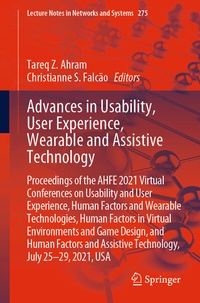
Advances in Usability, User Experience, Wearable and Assistive Technology
Description

This book addresses emerging issues in usability, interface design, human-computer interaction, user experience and assistive technology. It highlights research aimed at understanding human interactions with products, services and systems and focuses on finding effective approaches for improving the user experience. It also discusses key issues in designing and providing assistive devices and services for individuals with disabilities or impairment, offering them support with mobility, communication, positioning, environmental control and daily living. The book covers modeling as well as innovative design concepts, with a special emphasis on user-centered design, and design for specific populations, particularly the elderly. Further topics include virtual reality, digital environments, gaming, heuristic evaluation and forms of device interface feedback (e.g. visual and haptic). Based on the AHFE 2021 Conferences on Usability and User Experience, Human Factors and Wearable Technologies, Human Factors in Virtual Environments and Game Design, and Human Factors and Assistive Technology, held virtually on 25-29 July, 2021, from USA, this book provides academics and professionals with an extensive source of information and a timely guide to tools, applications and future challenges in these fields.
More details
Other editions
Additional editions
Persons
Content
- Intro
- Advances in Human Factors and Ergonomics 2021
- Preface
- Contents
- Human Factors and Wearable Technologies
- Design Principles for Mobile Brain-Body Imaging Devices with Optimized Ergonomics
- Abstract
- 1 Introduction
- 2 Design Process
- 2.1 Design with 3D Anthropometric Data
- 2.2 Dry Electrode and Skin Sensor
- 2.3 Fabrication
- 3 Design Assessment
- 4 Discussion and Future Work
- References
- Training Capabilities Assessment in Support of Enhanced Military Training: Comparing Head-Mounted Displays
- Abstract
- 1 Introduction
- 1.1 Training Proof of Concept
- 1.2 Mixed Reality for Training
- 2 Method
- 2.1 Training Capabilities Assessment
- 3 Results
- 4 Discussion
- Acknowledgment
- References
- Interactive Floor Mapping with Depth Sensors
- Abstract
- 1 Introduction
- 2 Review of SLAM Algorithms and Depth Sensors
- 3 Depth-Based SLAM Algorithm
- 4 Registration of the 3D Point Cloud to a Floor Map
- 4.1 Ground Plane Extraction
- 4.2 Floor Map Registration
- 4.3 Floor Mapping with a Floor Plan or Footprint
- 5 Edge Detection
- 6 Conclusions
- Acknowledgment
- References
- Detecting Daytime Bruxism Through Convenient and Wearable Around-the-Ear Electrodes
- Abstract
- 1 Introduction
- 2 Related Work
- 3 Method
- 4 Signal Preprocessing and Inspection
- 5 Classification Results
- 6 Discussion and Conclusion
- References
- On the Diversity of Self-tracking Purposes: Systematizing the Objectives in Tracking Oneself
- Abstract
- 1 Introduction
- 2 Methodological Approach
- 3 Results
- 4 Concluding Remarks
- References
- Wearables for Quality Assurance in Manual Assembly: A Qualitative Study
- Abstract
- 1 Introduction
- 2 Theoretical Background
- 2.1 Wearables
- 3 Research Methodology
- 3.1 Qualitative Interviews
- 4 Results
- 4.1 Digitization Level in Companies
- 4.2 Quality Assurance - Problems
- 4.3 Wearables
- 5 Conclusion
- References
- The Pattern-Making and Refinement of a Smart Compression Trouser Design for Taiwan University Football Team
- Abstract
- 1 Introduction
- 2 Methods
- 2.1 Idea Generation
- 2.2 Smart Trouser Design Development
- 2.3 The Sizing of the Smart Trousers
- 3 Conclusion
- Acknowledgment
- References
- Detection of Racial Bias from Physiological Responses
- Abstract
- 1 Introduction
- 2 Background and Related Work
- 2.1 Detecting Bias via the Implicit Association Test (IAT)
- 2.2 Physiological Sensing and its Relation to Bias
- 3 Methods
- 3.1 Data Collection
- 3.2 Data Processing
- 3.3 Machine Learning Analysis
- 4 Results
- 5 Discussion
- 6 Conclusion
- References
- The Importance of Product Language: An Exploratory Study of Smartwatches for Remote Healthcare
- Abstract
- 1 Introduction
- 2 Design and Health
- 3 Design and Gender
- 4 Method
- 5 Discussion and Conclusion
- References
- Pilot State Monitoring Wearable Systems in Real Environment: Pilot's Usability and Acceptance Feedback to Enhance Risk Management
- Abstract
- 1 Introduction
- 1.1 Monitoring Pilot State in Real Environment
- 1.2 The Research Objectives
- 2 Methods
- 2.1 Simulated vs. Real Environment Flights
- 2.2 Design of Pilot-Centered Wearables
- 2.3 Implementing Pilot Feedback
- 3 Results
- 3.1 Step 1: Definition of Wearable and Camera Combination
- 3.2 Step 2: Acceptance and Usability Tool and Protocol
- 3.3 Step 3: Short-Haul and Long-Haul Flights Protocol
- 4 Discussion
- 4.1 Next Steps: Data Collection and Data Analysis
- Acknowledgments
- References
- Children's Garments Based Near Filed Positioning Safety Oriented to Intelligence
- Abstract
- 1 Introduction
- 2 Implementing iBeacon Positional Children's Garments
- 2.1 The Firmware Threads
- 2.2 The Clothing Design
- 2.3 Circuit Design
- 2.4 Design of the Bluetooth Low Energy Technology
- 2.5 Software Control
- 3 Summary of the Design of the iBeacon-Based Children's Positioning Safety Clothing
- 4 Conclusion
- References
- The Perception and Acceptance of Wearable Fitness Devices Among People and Designing Interventions for Prolonged Use
- Abstract
- 1 Introduction
- 2 Wearable Fitness Technology
- 2.1 Wearable Devices
- 2.2 Awareness of Wearable Technology Devices Among People
- 3 Study of the Acceptance of Wearable Fitness Technology
- 3.1 Technology Acceptance
- 3.2 Unified Theory of Acceptance and Use of Technology (UTAUT)
- 3.3 Unified Theory of Acceptance and Use of Technology 2
- 4 Discussion
- References
- Innovative Design of Indigo Print in Soft Smart Knitted Garments
- Abstract
- 1 Introduction
- 2 Characteristics and Present Situation of Traditional Indigo Print
- 3 Design of Indigo Print in Soft Smart Knitted Garments
- 3.1 Material Design
- 3.2 Pattern Design
- 3.3 Technological Design
- 4 Guide to the Design of Soft Smart Knitted Garments by Indigo Print
- 4.1 Cultural Guide
- 4.2 Traditional Technological Guide
- 5 Conclusion
- References
- Evaluation of VR/AR Visual Comfort Based on Color Perception
- Abstract
- 1 Introduction
- 2 Materials and Methods
- 2.1 Experiment Variables
- 2.2 Experiment Variables
- 2.3 Subjects
- 2.4 Experimental Environment
- 2.5 Experimental Procedure
- 2.6 Data Analysis
- 3 Results and Analysis
- 3.1 Hue
- 3.2 Saturation
- 3.3 Brightness
- 4 Experimental Verification
- 5 Conclusion
- Acknowledgements
- References
- Virtual Reality Applications
- Eye Movements in VR Training: Expertise Measurement and it's Meaning for Adaptive Chess Training
- Abstract
- 1 Introduction
- 2 Related Work
- 3 Method
- 3.1 Study Design
- 3.2 Results
- 3.3 Discussion
- 4 Conclusion and Future Work
- References
- Framework for Integration of Virtual Reality into Model Based Systems Engineering Approach
- Abstract
- 1 Introduction
- 2 Literature Review
- 2.1 Systems Modeling Language (SysML)
- 2.2 VR in MBSE
- 3 VR-MBSE Framework
- 4 Discussions
- 5 Conclusion
- References
- Designing for Rapport with Virtual Agents in a Simulated Mixed Reality Environment: Results from a Pilot Study with Senior Users in the bewARe Project
- Abstract
- 1 Introduction
- 2 Method
- 2.1 Design
- 2.2 Measures
- 2.3 Participants
- 3 Results
- 3.1 Rapport Scale
- 3.2 Interviews
- 4 Discussion
- Acknowledgments
- References
- How Simulation Training Can Benefit from Virtual Reality Extensions? Case: A Virtual Reality Extension to a Simulated Ship Bridge for Emergency Steering Training
- Abstract
- 1 Introduction
- 2 Related Work
- 3 Technical Setup
- 4 Training Setup
- 5 Test Setup
- 6 Test Results
- 7 Conclusion and Future Work
- References
- User Individual Characteristics and Perceived Usability in Immersive HMD VR: A Mixed Method Explorative Study
- Abstract
- 1 Introduction
- 1.1 User Individual Factors Possibly Affecting Usability
- 2 Method
- 2.1 Participants and Equipment
- 2.2 Experimental Task
- 2.3 Questionnaires
- 2.4 Analyses
- 3 Results
- 3.1 Quantitative Data
- 3.2 Qualitative Data
- 4 Discussion
- 5 Conclusion
- Acknowledgements
- References
- Evaluating User Experience in Sandbox Game's Development Environment in Higher Education
- Abstract
- 1 Introduction
- 2 Methodology
- 3 Results
- 4 Analysis
- 5 Discussion
- 6 Conclusion and Future Work
- References
- Towards Understanding of User's Immersion Using Electroencephalogram (EEG) and Activity-Adhered Biosensor in an Environment of Full-Body Game Gesture
- Abstract
- 1 Introduction
- 1.1 Electroencephalogram (EEG) and Activity-Adhered Biosensor
- 2 Research Method
- 2.1 Participant, Equipment, and Full-Body Game Gesture
- 2.2 EEG Wearable Headband and Activity Adhered Biosensor
- 2.3 Procedure Collecting and Analyzing Data
- 3 Results and Discussion
- 3.1 The Results of the Quantitative Method
- 3.2 The Results of the Qualitative Method
- 3.3 The Analysis of Findings
- 4 Conclusions and Future Works
- Appendix
- References
- Virtual Reality and Game Design in Education
- Developing Interactive Company Presentations in the 3D Glue Virtual Reality Environment: A Collaborative Educational Approach
- Abstract
- 1 Introduction
- 2 Theoretical Background
- 2.1 Company Presentation Including Co-creation and Collaborative Learning Approaches
- 3 Methodology
- 3.1 Settings and Research Questions
- 3.2 Participants
- 3.3 Instruments for Virtual Workshop Design and Survey
- 4 Results
- 5 Conclusion and Future Work
- Acknowledgments
- References
- A Theoretical Model of Video Game Design in the Educational Context
- Abstract
- 1 Introduction
- 2 Game Design of Educational Video Games
- 3 The Educational Video Games Design Model Proposed by Navarro, Zapata, Vega and Chiroque (2018) and Its Revisions
- 4 Modifications of the Model by Navarro et al. [11] Based on the Development Experiences of Three Video Games
- 4.1 Modification 1: Hierarchy and Structure of the Model
- 4.2 Modification 2: Conceptual Clarity
- 5 Conclusions
- References
- Behind the Chain Coffee Shop: Design of Utilizing Virtual Reality for Coffee-Making Training
- Abstract
- 1 Introduction
- 2 Related Work
- 3 The Development of VR Coffee-Making Training System Design
- 3.1 Qualitative Data Analysis
- 3.2 System Design
- 4 Discussion
- 5 Limitation
- 6 Conclusion
- References
- Efficacy of Romantic Poetry: Chinese Classical Poetry Education Project Based on Augmented Reality Technology for Elementary School Students
- Abstract
- 1 Introduction
- 2 Related Work
- 2.1 Augmented Reality in Education
- 2.2 Audio-Visual Education
- 3 AR System of "Romantic Poetry"
- 4 Methodology
- 5 Results
- 6 Discussion and Conclusion
- References
- User Experience Design of Online Education Based on Flow Theory
- Abstract
- 1 Introduction
- 2 The Flow
- 2.1 The Flow Theory
- 2.2 Flow Conditions
- 3 Construction and Analysis of Flow Model
- 3.1 Construction of Heart Flow Model in Online Education Environment
- 3.2 Use Structural Equation Modeling to Test Flow Model
- 3.3 Experimental Methods and Procedures
- 3.4 Experimental Data Analysis
- 4 Conclusion
- 4.1 The Conclusion of Flow Model
- 4.2 Research Limitations and Shortcomings
- 4.3 Research Outlook
- References
- MindJourney: Employing Gamification to Support Mindfulness Practice
- Abstract
- 1 Introduction
- 2 Related Work
- 2.1 Mindfulness in HCI
- 2.2 Technologies for Mindfulness Meditation
- 2.3 Gamification
- 3 Methods
- 3.1 Gamification Principles for Mindfulness
- 3.2 Mind Journey
- 3.3 Experiment
- 4 Results
- 4.1 Questionnaire Results
- 4.2 Interview Results
- 5 Conclusion
- Acknowledgments
- References
- Virtual Environments and Game Design
- Data2Game: Towards an Integrated Demonstrator
- Abstract
- 1 Introduction
- 2 Architecture and Building Blocks
- 3 DILEMMA Game Engine and Data2Game Scenario
- 4 Stress Model
- 5 Text Generation in the Crisis Game
- 6 Player Assessment and Instructional Interventions
- 7 Conclusion
- Acknowledgments
- References
- Traditional Chinese Medical Face Diagnosis System Visualized by Augmented Reality Interface Design
- Abstract
- 1 Introduction
- 2 The TCM Face Diagnosis by Computer Vision
- 2.1 The Input Data: Face Diagnosis Data by Computer Vision
- 2.2 The Output Data: AR Face Painting
- 3 The Usability of the Interactive Prototype
- 3.1 The Face Diagnosis Template
- 3.2 The Dilemma Between Medicine Rigor and Digital Arts Entertainment
- 4 Conclusion and Discussion
- Acknowledgments
- References
- Interactive Animation of Mobile Apps
- Abstract
- 1 Introduction
- 1.1 Animation and Interactive Animation
- 1.2 Development and Application of Interactive Animation
- 2 Classification of Interactive Animation in Mobile Apps
- 2.1 Functional Animation
- 2.2 Entertainment Animation
- 2.3 Interactive Animation Advertising
- 3 Characteristic Analysis of Interactive Animation in Mobile Apps
- 3.1 Interactivity
- 3.2 Narrative
- 3.3 Integration
- 3.4 Usability
- 3.5 Emotionalization
- 4 Conclusion
- References
- Joining Battles with Mouse: How Gaming Mouse Connects the Virtual World and Body
- Abstract
- 1 Introduction
- 2 Methods
- 3 Results
- 3.1 Typology Analysis of Gaming Mouse
- 3.2 Interaction Between Body and Vision
- 4 Conclusions
- Acknowledgments
- References
- UX in Virtual and Augmented Reality Environments
- What Factors Contribute to the Perceived Usability of Virtual Reality Technology of Conservative Industrial Consumers
- Abstract
- 1 Introduction
- 1.1 Usability
- 1.2 Technology Acceptance and Use
- 2 Method
- 3 Result
- 3.1 Technological Aspects: Reliability and Robustness, Quality and Costs
- 3.2 Individual Aspects: Differences in Adjustment to Technology
- 3.3 Organizational Aspects: Coordination, Communication and Trust
- 3.4 Environmental/Contextual Aspects: Visibility of Benefits
- 4 Discussion and Conclusion
- Acknowledgments
- References
- Social Virtual Agents and Loneliness: Impact of Virtual Agent Anthropomorphism on Users' Feedbacks
- Abstract
- 1 Introduction
- 2 Method
- 3 Results
- 3.1 Before the Avatar Update
- 3.2 After the Avatar Update
- 4 Discussion
- Acknowledgments
- References
- The Effect of Restorative Environment and Presence Based on Virtual Reality for Anxiety and Depression
- Abstract
- 1 Introduction
- 2 Study 1: Design and Preliminary Testing of Restorative and Present VR Scenarios
- 2.1 Design and Technical Implementation of VR Scenarios
- 2.2 Method
- 2.3 Results
- 2.4 Discussion
- 3 Study 2: The Effectiveness of Restorative and Present VR Scenarios to Improve Anxiety and Depression
- 3.1 Method
- 3.2 Results
- 3.3 Discussion
- 4 Summary
- Funding Information
- References
- Improved UX Design of Self-autopilot Driving Takeover Audio Prompt Based on UCD Method
- Abstract
- 1 Introduction
- 2 Research Framework
- 3 User Research
- 3.1 User Interview
- 3.2 Coding Analysis
- 3.3 Results
- 4 Self-autopilot Driving Takeover Audio Prompt Design
- 5 Experiment and Results
- 5.1 Procedure
- 5.2 SUS Data Analysis
- 6 Conclusion
- References
- One-Handed Text Entry in Mobile-Based Virtual Reality: An Ambiguous Keyboard Technique
- Abstract
- 1 Introduction
- 2 Related Works
- 3 One-Handed Ambiguous Keyboard
- 3.1 Keyboard Prototype Description
- 3.2 Tactile and Visual Feedback
- 3.3 Layout
- 4 Technique Demonstration
- 4.1 Apparatus
- 4.2 Mobile VR Application
- 4.3 Limitations
- 5 Conclusion and Future Work
- Acknowledgments
- References
- A Virtual Learning Environments as Training Tools: An Experience with NEO LMS in Physics Teaching
- Abstract
- 1 Introduction
- 2 Methodology
- 3 VLE Resources and Educational Paradigm
- 3.1 Scenario 1
- 3.2 Scenario 2
- 3.3 Scenario 3
- 3.4 VLE Activities Evaluation
- 4 Results
- 5 Conclusions
- References
- The Impact of AR Technology on the Knowledge Learning Experience of Science and Technology Museums
- Abstract
- 1 Introduction
- 1.1 Background
- 2 Literature Review
- 2.1 The Impact of AR Technology on Learning
- 2.2 Learning Experience Measurement
- 3 Methods
- 3.1 Research Purposes and Significance
- 3.2 Research Hypothesis
- 3.3 Research Process
- 3.4 Experimental Design
- 3.5 Experimental Tools and Processes
- 4 Research Conclusions
- 4.1 Experimental Overview
- 4.2 Experimental Conclusions
- 5 Discussion and Suggestions
- References
- Virtual Environments in the Mathematics Teaching-Learning Processes in High School
- Abstract
- 1 Introduction
- 2 Methodological Design
- 2.1 Objective
- 2.2 Learning Sessions
- 2.3 Results
- 3 Conclusions
- References
- User Experience of Virtual Reality Interfaces Based on Cognitive Load
- Abstract
- 1 Introduction
- 2 Research Steps
- 3 Data Analysis
- 4 Some Recommended Solutions
- 5 Conclusion
- References
- UX in Gamification and Wearables
- Motivational and Behavioral Differences Between Traditional and Digital Tabletop Games
- Abstract
- 1 Introduction
- 2 Study 1
- 2.1 Literature Review
- 2.2 Methods
- 2.3 Results
- 2.4 Brief Discussion
- 3 Study 2
- 3.1 Methods
- 3.2 Results
- 3.3 Brief Discussion
- 4 Integration and Conclusion
- Acknowledgments
- References
- Sentiment Analysis of Elderly Wearable Device Users Based on Text Mining
- Abstract
- 1 Introduction
- 2 Research Status
- 3 Research Process
- 3.1 Data Preprocessing
- 3.2 Building Feature Word List
- 4 Word Frequency Statistics and Emotion Analysis
- 4.1 Word Frequency Statistics
- 4.2 Emotion Analysis
- 5 Discussion
- References
- The Impact of Interactive Games on Children's Experience of Aerosol Therapy
- Abstract
- 1 Introduction
- 2 Related Work
- 3 Materials and Methods
- 3.1 System Design
- 3.2 Participants
- 3.3 Assessment
- 4 Results
- 4.1 Compliance Analysis
- 4.2 User Experience Questionnaire (UEQ)
- 5 Discussion
- 5.1 Improvements to the Current Game
- 5.2 Limitation
- 6 Conclusion
- Acknowledgments
- References
- Comparison of Different Types of Multi-screen Method and Element of Traditional Animation on Human Experience
- Abstract
- 1 Introduction
- 2 Method
- 2.1 Screen Display
- 2.2 Research Design
- 3 Results
- 3.1 Participants Analysis
- 3.2 Comparison of Two Animations on Different Types of the Display Screen
- 4 Discussion
- 5 Conclusion
- References
- Audience Participation Behavior Model of Museum Digital Narrative
- Abstract
- 1 Introduction
- 2 Characteristics of Digital Narrative and Digital Text User Participation Theory
- 2.1 Importance of Digital Narrative in Museums
- 2.2 Characteristics of Layers of User Participation in Digital Narrative Texts
- 3 Analysis on Characteristics of Audience Participation Behavior in Museum Digital Narrative
- 3.1 Museum Website/Online Exhibition Hall Cases
- 3.2 Interactive Virtual Exhibition Cases in Physical Exhibition Halls
- 3.3 Museum AI Interaction Case
- 4 Summary of Audience Participation Behavior Modes in Museum Digital Narrative
- 4.1 Changeable Narrative Path Mode
- 4.2 Audience-dominating Narrative Mode
- 4.3 Real-time Story Generation Mode
- 5 Conclusion
- Acknowledgment
- References
- Assistive Technology
- Gait Recognition from Drone Videos
- Abstract
- 1 Introduction
- 2 Adaptive Pose Estimation (APE)
- 2.1 Drone Camera Gimbal Angle Estimation
- 2.2 Key Point Generation and Size Filter
- 3 Gait Recognition
- 4 Experiment Results
- 5 Conclusions
- Acknowledgement
- References
- Collision Prediction and Prevention in Contact Sports Using RFID Tags and Haptic Feedback
- Abstract
- 1 Introduction
- 2 Methods
- 3 Results
- 3.1 Initial Tests
- 3.2 Implementation
- 3.3 Simulation
- 4 Concluding Remarks
- References
- "IKnow": Helping Those with Hearing Impairment Communicate Fluently
- Abstract
- 1 Introduction
- 2 Research
- 2.1 Participants
- 2.2 Method
- 3 Result
- 4 Established Requirement
- 5 "IKnow" Design
- 5.1 Idea Selection
- 5.2 Design Description
- 5.3 Function Introduce
- 6 Discussion
- References
- Estimation of Probe Angles Based on Inertial Measurement and Human Skill Assessment
- Abstract
- 1 Introduction
- 2 Equipment for Evaluating the Skills of Eddy Current Testing Technicians
- 2.1 ET Surface Test Pieces
- 2.2 Eddy Current Tester
- 2.3 Inertial Measurement Unit
- 2.4 EAR Value
- 3 Experiment
- 3.1 Probe Posture
- 3.2 Eye Movement
- 4 Discussion
- 5 Summary
- References
- Visual Guidance by Blinking Light of LED Block for Individuals Affected with Low Vision
- Abstract
- 1 Introduction
- 2 Experimental Method
- 2.1 Research Method
- 2.2 Experimental Method of Blinking Light
- 2.3 Lighting Pattern
- 2.4 Experiment Outline
- 2.5 Experimental Procedure
- 3 Experimental Results and Discussion
- 4 Conclusion
- Acknowledgments
- References
- Developing Quality Assistive Technology and Better Supports for Breasts with the Help of Low-Cost Sensors
- Abstract
- 1 Introduction
- 2 Why 3D Scan
- 3 Portable Low-Cost Sensors
- 4 Methods
- 5 Specificities for External Breast Prostheses
- 6 Results
- 7 Conclusions
- Acknowledgments
- References
- Developing and Creating an Operational Controller for Automation Within Mining Operations
- Abstract
- 1 Introduction
- 2 Considerations
- 2.1 Description of Proposed System
- 2.2 Shuttle Car Design Elements and Functionality
- 3 Results
- 4 Discussion
- 5 Conclusion
- Acknowledgments
- Multimodal Technology: Improving Accessibility of the Design of Home Appliances
- Abstract
- 1 Introduction
- 2 Multimodal Technology in Home Appliances
- 3 Method
- 4 Results
- 5 Discussion
- 6 Considerations
- Acknowledgments
- References
- Pedagogical Interface Agent for Kenya Sign Language
- Abstract
- 1 Introduction
- 2 Statement of the Problem
- 2.1 Challenges in the Use of KSL
- 3 Technology Description of the KSL PIA
- 3.1 Steps in Creation of the KSL PIA Font
- 4 Conclusion
- References
- Promoting Social Skills in Technology-Mediated Communication Contexts: First Results on Adopting the Social Compass Curriculum
- Abstract
- 1 Introduction
- 2 Users, Scenarios and Goals
- 2.1 Personas
- 2.2 Illustrative Scenario
- 2.3 Requirements
- 3 Development
- 4 Evaluation with End-Users
- 5 Conclusions
- Acknowledgments
- References
- Profiling of E-Learning Users with Accessibility Needs
- Abstract
- 1 Introduction
- 2 Search Cycle of Literature Review
- 3 Analysis of the Literature Review
- 4 Discussion and Conclusion
- References
- Intervention Platform for Children with Intellectual Disability: Chatbots and IBM Watson Services in the Ecuadorian Context
- Abstract
- 1 Introduction
- 2 Related Work
- 3 Proposal Description
- 3.1 Web-Based Collaboration Tool
- 3.2 Chatbot
- 3.3 Multilevel Interactive Games
- 4 Pilot Experiment
- 5 Conclusions
- References
- Low-Cost Myoelectrical Hand Orthosis to Regain Autonomy in Daily Tasks After a Stroke: A Neurorehabilitation Case Study
- Abstract
- 1 Introduction
- 2 Methodology
- 3 Results
- 4 Conclusions
- References
- Usability and User Experience Applications
- A Co-Design Approach for a Smart Cooking Appliance. The Application of a Domain Specific Language
- Abstract
- 1 Introduction
- 2 Ubiquitous Computing for the Cooking Process
- 3 Co-Designing Using the Idiom of the Users
- 4 The Community Supported Appliance Systems Architecture
- 5 Conclusions
- Acknowledgments
- References
- The Acceptance Factors of Smart Home Technologies: The Case of Croatian Households
- Abstract
- 1 Introduction
- 2 Background to the Research
- 3 Methodology
- 4 Results and Discussion
- 4.1 Participants
- 4.2 Findings
- 5 Conclusion
- References
- Customer Experience of Smart Hotel Based on Network Evaluation Information
- Abstract
- 1 Development Background of Smart Hotel
- 2 International Research Status
- 3 Construction of Smart Hotel Sevicescape Model Framework
- 4 Research on User Experience with Applying of Smart Hotel Servicescape Model
- 5 Design Innovation of Smart Hotel Servicescape Based on User Experience
- References
- Interactive Automatic Refrigerator Door for Emotional Satisfaction
- Abstract
- 1 Introduction
- 2 Related Work and Background
- 3 Video Prototype Experiment
- 3.1 Study Design
- 3.2 Participants
- 3.3 Video Clips
- 4 Result and Analysis
- 5 Discussion
- 6 Conclusion
- References
- Inner City Development for Kids in South Africa: A Jewel City Mixed Use Precinct Case Study Approach
- Abstract
- 1 Introduction
- 2 Literature Review
- 3 Research Methodology
- 4 Results
- 5 Conclusion
- References
- Personalized Video Recommendation Integrating User Portrait and Collaborative Filtering
- Abstract
- 1 Introduction
- 2 Related Research
- 2.1 Personalized Recommendation System
- 2.2 User Portrait
- 3 Personalized Recommendation Algorithm
- 3.1 Personalized Recommendation System
- 3.2 Set Label Weight
- 3.3 Calculate User Similarity Based on User Tags
- 3.4 User Similarity of Collaborative Filtering Algorithm
- 3.5 Personalized Recommendation of Video Platform Integrating User Portrait and Collaborative Filtering
- 4 Experimental Verification
- 4.1 Data Collection and Processing
- 4.2 User Similarity Calculation
- 4.3 Top-N Project Recommendation
- 4.4 Recommended Result Test
- 5 Conclusion
- References
- The Effect of Valence and Layout of Online Reviews on Purchase Intention
- Abstract
- 1 Introduction
- 2 Method
- 2.1 Participants and Tasks
- 2.2 Experimental Design and Procedure
- 2.3 Electroencephalogram
- 3 Results
- 4 Discussion
- 5 Conclusion
- References
- Product Ergonomics Testing and Application Based on Multiple Methods
- Abstract
- 1 Introduction
- 2 Methods
- 2.1 Subjects
- 2.2 Mattress Information
- 2.3 Spinal Curvature Measurement
- 2.4 Subjective Ratings
- 3 Experimental Results and Analysis
- 3.1 Body Pressure Distribution
- 3.2 Spinal Curvature
- 3.3 Subjective Comfort Evaluation
- 3.4 Analysis
- 4 Discussion
- Acknowledgments
- References
- Analysis of the Level of Accessibility of Scientific Online Conferences for Blind Participants
- Abstract
- 1 Introduction
- 2 Methodology
- 3 Results and Discussion
- 4 Conclusion
- References
- Application of Background Color in Banner Design
- Abstract
- 1 Introduction
- 2 The Importance of Color in Banner
- 3 Application of Background Color in Banner
- 4 Experiment
- 4.1 Purpose of the Experiment
- 4.2 Samples
- 4.3 Experimental Variables and Design
- 4.4 Experimental Steps
- 4.5 Results and Data Analysis
- 4.6 Discussion
- 5 Conclusion
- References
- Human-Computer Interface Design of Intelligent Spinning Factory Monitoring System Based on Eye Tracking Technology
- Abstract
- 1 Introduction
- 2 Human-Machine Interface of Intelligent Spinning Factory Monitoring System
- 2.1 Construction of Human-Machine Interface Framework of Intelligent Spinning Factory Monitoring System
- 2.2 Intelligent Spinning Factory Monitoring Human-Machine Interface Design Elements
- 3 Method
- 3.1 Experimental Purpose
- 3.2 Experimental Design
- 3.3 Experimental Process
- 3.4 Experimental Results and Discussion
- 4 Human-Machine Interface Design and Evaluation of Intelligent Spinning Workshop Monitoring System
- 5 Conclusion
- References
- User Experience Design of Second-Hand Luxury APP Based on Kano-QFD Model
- Abstract
- 1 Current Situation
- 1.1 The Secondary Market
- 1.2 Second-Hand Luxury App
- 2 Research Methods
- 2.1 Kano Model
- 2.2 Satisfaction Index
- 2.3 QFD Model
- 3 Research Process
- 3.1 A Satisfaction Influence Model Based on Kano Model
- 3.2 Questionnaire Design and Results
- 3.3 To Quantify the Kano Model Get the User Demand Ranking
- 3.4 Obtain the Ranking of Design Points Based on QFD Model
- 4 Research Results
- 4.1 The Questionnaire Results
- 4.2 Kano - QFD Matrix
- 5 Design Points
- 6 Conclusion
- References
- Contextual-Aware Fire Product Interaction Design
- Abstract
- 1 Introduction
- 1.1 Overview of Context Awareness Theory
- 1.2 Application of Situational Awareness in Fire-Protection Product Design
- 2 Research Methods
- 2.1 Stage of Context Awareness
- 2.2 Data Processing and Demand Transformation
- 2.3 Matching User Demands and Product Functions
- 3 Case Study: Contextual-Aware Firefighting UAV Design
- 3.1 Awareness Stage of Fire Context
- 3.2 Stage of Data Processing
- 3.3 Stage of Demand Transformation
- 3.4 Establishment of Product Function Design List for Firefighting UAV
- 3.5 Interaction Design Plan of Fire Products
- 4 Conclusion
- References
- User Experience: Portraits of Young User Groups for the Future Chinese High-End Electronic Communication Product Market
- Abstract
- 1 Introduction
- 2 Research Process and Conclusion
- 2.1 Research Process of College Students' Users Behavior Based on Lifestyle Measurement
- 2.2 User Grouping and User Portraits Based on the Censydiam Model
- 2.3 Hierarchy Value Maps for College Students
- 3 Design Insights
- 3.1 Potential Demands of Users
- 3.2 Factors Affecting Their Purchase
- 3.3 Views of Users About the Future of Mobile Phones
- 4 Conclusion
- Acknowledgments
- References
- Public User Experience Satisfaction of E-Government in China: Review and Prospect
- Abstract
- 1 Introduction
- 2 The Definition and the Art-of-the-State of E-Government in Chinese Mainland
- 2.1 Definition of E-Government
- 2.2 The E-Government Applications
- 3 Studies on User Experience Satisfaction of E-Government in Chinese Mainland
- 3.1 The Public's User Experience Satisfaction Evaluation Model
- 3.2 Method of Analyzing Data on the Public's User Experience Satisfaction Evaluation
- 4 Countermeasure and Suggestion to Promoting Public User Experience Satisfaction of E-Government
- References
- User Experience Redesign Based on the Emotional Interaction Needs of Bullet Screen
- Abstract
- 1 Introduction
- 2 Empirical Study
- 3 Findings and Discussion
- 4 Proposed 'Bullet Screen Groups'
- 5 Conclusion
- Acknowledgments
- References
- STEAM Education Mode Based on New Technology and User Experience Design
- Abstract
- 1 Introduction
- 2 STEAM Education and PBL Learning
- 2.1 STEAM Education Model and Current Situation
- 2.2 The Integration of PBL Education Mode Under the STEAM Education
- 3 STEAM Education Led by User Experience Design Ideas
- 3.1 User Experience Design and Education Situation
- 3.2 STEAM Education Integrated User Experience Design
- 4 PBL-Style STEAM Education Experience Based on Augmented Reality and Spatial Interaction
- 5 Plan Interpretation
- 6 Summary and Conclusion
- References
- User Experience Design Method from the Perspective of Scalability
- Abstract
- 1 Introduction
- 2 Scalability of Experience
- 3 Scalability of User Experience at Different Dimension
- 4 User Experience Design Methods from the Perspective of Horizontal Scalability
- 4.1 The Design Strategy of Sub-experiences
- 4.2 The Design Strategy for Overall Experience
- 5 User Experience Design Methods from the Perspective of Vertical Scalability
- 5.1 Study
- 5.2 Results
- 5.3 Discussion
- 6 Conclusion and Future Work
- References
- The Role of Digital Marketing for Aesthetic Tourism: Understanding Tourist Behavior
- Abstract
- 1 Introduction
- 2 Digital Marketing
- 2.1 Digital Marketing and Aesthetic Tourism
- 3 Digital Marketing Strategies
- 3.1 E-commerce
- 3.2 SEO and SEM
- 3.3 Social Media Marketing
- 3.4 Online Websites Communities
- 3.5 Email-Marketing
- 4 Conclusions
- References
- User Experience Applications in Transportation
- Usability and User Experience Evaluation of a New Immersive Pilot Training Device
- Abstract
- 1 Introduction
- 1.1 Scope of Evaluation
- 2 Methodology
- 2.1 Participants
- 2.2 Immersive Training Devices (ITDs)
- 2.3 Usability and User Experience Metrics
- 2.4 Questionnaires
- 2.5 Procedures
- 3 Results and Discussion
- 3.1 Seats
- 3.2 Sticks
- 3.3 Throttles
- 3.4 Rudder Pedals
- 4 Recommendations
- 5 Conclusion
- Acknowledgements
- References
- Touch Screen Application in Flight Deck for Civil Aircraft
- Abstract
- 1 Introduction
- 2 Advantages of Touch Screen Application in Cockpit
- 3 Common Gestures Recommended for Aviation Purpose
- 4 Operation Scenario Analysis for Touch Screen Application
- 5 The Potential Application Area of Touch Screens in Cockpit
- 6 Conclusion
- References
- Modeling the Dynamic Visual Attention Resource Allocation in Cockpit with Discrete Event Simulation
- Abstract
- 1 Introduction
- 2 Framework of the Dynamic Attention Allocation Model
- 3 Verification of Dynamic Attention Allocation Model
- 3.1 Participant
- 3.2 Materials
- 3.3 Experiment Design and Task Scenarios
- 3.4 Experiment Procedures
- 3.5 Theoretical Results and Experimental Results
- 3.5.1 Theoretical Results
- 3.5.2 Experiment Results and Regression Analysis
- 4 Discussion and Conclusion
- Acknowledgments
- References
- Intelligent Agents in Cars: Investigating the Effects of Anthropomorphism and Physicality of Agents in Driving Contexts
- Abstract
- 1 Introduction
- 2 Related Works
- 3 Method
- 3.1 Design and Participants
- 3.2 Stimuli Creation
- 3.3 Apparatus
- 3.4 Procedure
- 3.5 Measures
- 4 Results
- 5 General Discussion
- Acknowledgments
- References
- Design of the Resumption and Prompt Interface for Online Meetings Under Automatic Driving
- Abstract
- 1 Introduction
- 2 Online Meeting Task Under Autonomous Driving
- 2.1 Scenarios Analysis
- 2.2 Interruption and Resumption Model
- 3 The Design of the Resumption and Prompt Interface
- 3.1 Interface Design Framework
- 3.2 Interface Design Proposal
- 4 Design Evaluation
- 4.1 Evaluation Experiment Design
- 4.2 Evaluation Experiment Results
- 5 Conclusion
- References
- Design of Electric Bicycle for Delivery from the Perspective of Perceptual Engineering
- Abstract
- 1 Introduction
- 2 Research Significance
- 2.1 Security Level
- 2.2 Environmental Level
- 3 Questionnaire and Data Analysis
- 3.1 Questionnaire Design
- 3.2 Calculation of Weighted Arithmetic Mean of Semantic Analysis Scale
- 3.3 Cluster Analysis of Weighted Arithmetic Average of Electric Vehicle
- 4 Research on Influencing Factors in the Design of E-bike for Delivery
- 4.1 User Population Survey
- 4.2 Use of Environmental Research
- 5 Thought on Design of Take-Out Electric Bicycle
- 6 Research Results
- 6.1 Better Integration of Take-Away Box and Electric Bicycle Frame
- 6.2 Reasonable Space Utilization
- 6.3 Improve Interactivity
- References
- How Pedestrian-AV Interaction Is Affected by the eHMI: A Virtual Reality Experiment
- Abstract
- 1 Introduction
- 2 Method
- 2.1 Participants
- 2.2 Materials and Apparatus
- 2.3 Experimental Design
- 2.4 Procedure
- 3 Result and Discussion
- 4 Conclusion
- Acknowledgments
- References
- Identifying Key Influential Factors Critical to Determining Consumers/Users' Satisfaction of User Experience in Passenger Car by FA-DEMATEL Approach
- Abstract
- 1 Introduction
- 2 Method
- 2.1 Collecting Preliminary Influencing Factors
- 2.2 Extracting and Defining Main Influencing Factors
- 2.3 DEMATEL Questionnaire Survey and Operations
- 3 Conclusion and Discussion
- References
- Usability and User-Centered Design
- Advanced Interactive Style Guide for Design Consistency
- Abstract
- 1 Introduction
- 1.1 Motivation
- 1.2 Background
- 1.3 Display Hardware
- 2 Objectives
- 3 Approach - Design and Development
- 3.1 User Interface Design Applications to Navy Projects
- 4 Conclusions and Future Work
- References
- Improving Usability of a Gaze-Based Surveillance Support Tool Through User-Centered Design
- Abstract
- 1 Introduction
- 2 Design Thinking Workshops
- 2.1 Method
- 2.2 Results and Discussion
- 3 Empirical Evaluation of the Tool
- 3.1 Method
- 3.2 Results and Discussion
- 4 General Discussion
- Acknowledgments
- References
- Enhancing Blood Donation Intentions Using Mobile Responsive Web Design
- Abstract
- 1 Introduction
- 2 Method
- 3 Results
- 4 Discussion
- 5 Conclusion
- References
- How Experts and Novices Perceive the Photographic Image Composition: An Eye-Tracking Study on Composition
- Abstract
- 1 Introduction
- 1.1 Rule of Thirds
- 1.2 Leading Lines
- 2 Method
- 2.1 Participants
- 2.2 Stimuli and Apparatus
- 2.3 Procedure
- 2.4 Analysis
- 3 Results
- 3.1 Rule of Thirds
- 3.2 Leading Lines
- 4 Discussion
- Acknowledgments
- References
- Online Shopping Web Sites' Perceived Usability: A Case Study with Turkish Shopping Related Web Sites
- Abstract
- 1 Introduction
- 2 Method and Procedure of the Study
- 2.1 Usability Test with CogTool
- 3 Results
- 3.1 The Completion Time of the Buying Process
- 3.2 Effectiveness of the Interaction
- 4 Discussion and Conclusion
- References
- Applying an Iterative Design Approach to Kafu Games to Enhance the User Experience of Gamers in Saudi Arabia
- Abstract
- 1 Introduction
- 2 State of the Art
- 2.1 What is ESports?
- 2.2 How is esports Similar to Other Kinds of Sport?
- 2.3 Emotional Gratifications of an eSports Players
- 3 Solution
- 3.1 Phase 1
- 3.2 Phase 2
- 4 Conclusion
- References
- Insight into the Needs of Mobile Performance Speakers Based on Multimodal Sensory User Experience
- Abstract
- 1 Introduction
- 2 Insight into User Experience Requirements of Physical Products
- 2.1 The Current Situation of Insight into User Experience Requirements of Physical Products
- 2.2 Multimodal Sensory User Experience Demand Analysis
- 2.3 Method of Analyzing Product User Needs Based on Stata
- 2.4 Analysis of Product User Experience Needs Based on Online Reviews
- 3 Product User Requirements Design Method and Process
- 3.1 Analysis of Product Design Factors
- 3.2 User Demand Analysis Based on Multi-modal Sensory User Experience
- 3.3 User Experience Demand Analysis Based on Multi-modal Sensory User Experience
- 4 Case Analysis
- 4.1 Case Background
- 4.2 Acquisition and Processing of User Needs of Mobile Performance Speakers
- 4.3 Construction of User Demand Model for Mobile Performance Speakers Based on Multi-Modal Sensory User Experience
- 4.4 Multiple Regression Analysis of User Demand for Mobile Performance Audio
- 4.5 Robust Analysis of User Demand for Mobile Performance Audio
- 5 Summary
- References
- Interface Color Design of Intelligent Vehicle Central Console
- Abstract
- 1 Introduction
- 2 Experimental Design
- 2.1 Preliminary Preparations
- 2.2 Simulator Settings
- 2.3 Driving Scene Settings
- 3 Experiment Execution
- 4 Experimental Results
- 4.1 Data Collection
- 4.2 Subjective Data
- 4.3 Objective Data
- 5 Discussion
- Acknowledgments
- References
- Design of Drinking Water Facilities in Shanghai Botanical Garden Based on Service Design
- Abstract
- 1 Introduction
- 1.1 Concepts of Service Design
- 1.2 Principles, Tools and Methods of Service Design
- 2 Current Situation of Drinking Water Facilities in Shanghai Botanical Garden
- 2.1 Public Facilities Survey
- 2.2 Drinking Way Investigate
- 3 Apply Service Design Concepts to Drinking Water Facility Design
- 3.1 Exploration
- 3.1.1 Refine Typical Users
- 3.1.2 Target User Experience Journey Construction and Analysis
- 3.2 Creation and Rethinking
- 3.2.1 Public Drinking Facilities
- 3.2.2 Stakeholder Analysis and Project Implementation
- 3.3 Implementation
- 4 Design Strategy and Model Display
- 5 Conclusion
- References
- Product Identity Design of Yiwu General Merchandise Based on User Experience
- Abstract
- 1 Introduction
- 1.1 Development Status of General Merchandise
- 2 About User Experience
- 2.1 Concept of User Experience
- 2.2 Application Status of User Experience in General Merchandise
- 3 About PI Design
- 3.1 PI Design Concept
- 3.2 Application Cases of PI Design in Related Design Brands
- 4 PI design Strategy of Yiwu General Merchandise Based on User Experience
- 4.1 Initial Stage of Brand Creation
- 4.2 Strive to Bring Good User Experience to Users
- 4.3 Create Daily Necessities Suitable for Domestic Market
- 4.4 Reject Homogenization, Protect Rights and Create Daily Department Store Products
- 5 Conclusion
- Acknowledgments
- References
- Measure of the Attentional Bias in Children Using Eye Tracking During a Psychological Test
- Abstract
- 1 Introduction
- 2 Methodology
- 3 Conclusion
- References
- The Color Semantics of Compact Car: A Case Study on Ford Focus
- Abstract
- 1 Introduction
- 2 Method
- 2.1 Participants
- 2.2 Sample
- 2.3 Colors
- 2.4 Stimuli
- 2.5 Questionnaire
- 3 Results
- 3.1 Reliability of the Questionnaire
- 3.2 Data Analysis
- 4 Conclusion and Outlook
- Acknowledgments
- References
- Improved Kano Model Based on Stakeholder - Centered Design
- Abstract
- 1 Introduction
- 2 Analysis Model of Demand Category and Importance
- 3 An Improved Method of the Kano Model
- 3.1 Qualitative Analysis of Improved Kano Model
- 3.2 Quantitative Analysis of Improved Kano Model
- 4 The Improved Method of the Kano Model
- 5 Conclusion
- Acknowledgments
- References
- GVUI: Graphic-Assisted Voice User Interface Based on Multi-modal Human-Machine Conversation
- Abstract
- 1 Introduction
- 2 Related Works
- 3 Design Theory of GVUI
- 3.1 Reconstruction of Multi-modality
- 3.2 Principles of Conversational Interaction
- 3.3 Patterns of Visual Reply
- 4 Weather Query as a Practice
- 5 Conclusion
- References
- User Interface and Accessibility
- Effects of Culturally Tailored User Interface Design
- Abstract
- 1 Introduction
- 2 Background Study
- 2.1 User Interface
- 2.2 Intercultural Interface Design
- 3 Research Method and Design
- 3.1 Prototype Design and Specification
- 3.2 Data Collection
- 3.3 Procedure
- 4 Results
- 4.1 Respondents' Socio-demographic Characteristics
- 4.2 Perceived Usefulness
- 4.3 Perceived Ease of Use
- 5 Discussion
- 6 Conclusion
- References
- The Effective Interface Format for Communicating Risk Information in Shared Decision Making
- Abstract
- 1 Introduction
- 2 Methods
- 3 Design of Experiment
- 4 Design of Risk Graphic
- 5 Results
- 6 Discussion
- 7 Conclusion
- References
- Improving the Usability of Visual Displays for a COVID-19 Household Screener
- Abstract
- 1 Introduction
- 1.1 Objective
- 2 Methods
- 3 Results
- 3.1 Alternative Visual Aid A
- 3.2 Alternative Visual Aid B
- 3.3 Text Description
- 3.4 Preference Between Visual Aids
- 3.5 Feedback on Visual Aids
- 4 Discussion
- References
- Multi-scale Evaluation of HCI Acoustic Expression in Digital Performance Space
- Abstract
- 1 Introduction
- 2 Construction Evaluation System for Acoustic Expression
- 2.1 Implementation
- 2.2 Data Processing
- 2.3 Results and Analysis
- 3 Case Studies
- 3.1 Digital Performance in Chinese Theatre Art Interactive Area
- 3.2 Data Collection
- 3.3 Results and Discussion
- 3.4 Optimization Design Strategy
- 4 Conclusion
- Acknowledgments
- References
- Usability in a Token-Based Ecosystem
- Abstract
- 1 Introduction
- 2 Method
- 3 Results
- 4 Discussion
- 5 Conclusion
- Acknowledgments
- References
- Changes in Usability Evaluation of Human-Machine Interfaces from the Perspective of Automated Vehicles
- Abstract
- 1 Introduction
- 2 Usability Issues of AV-HMI
- 2.1 Research Framework of AV-HMI Usability
- 2.2 Features of AV-HMI Usability
- 3 Usability Tools of AV-HMI
- 3.1 Usability Evaluation Index of AV-HMI
- 3.2 Usability Evaluation Methods of AV-HMI
- 4 Conclusion
- References
- Evaluation Model of Voice User Interface
- Abstract
- 1 Introduction
- 2 Related Work
- 3 Method
- 3.1 Study Design and Setting
- 3.2 Study Procedures and Materials
- 3.3 Data Analysis
- 4 Results and Conclusion
- Acknowledgments
- References
- Interface Zooming and Planning Task Experiment Under Multiple Interactive Perspectives
- Abstract
- 1 Experiment Summary
- 1.1 Summary of Experiment Content
- 1.2 Software and Hardware Requirements
- 1.3 Personnel Requirements
- 1.4 Task Experiment Process
- 2 Experimental Data Analysis
- 3 Data Analysis in the Interactive Mode of Mouse and Touch
- 3.1 Operating Time
- 3.2 Operate the Number of Primes
- 4 Conclusion
- References
- Effects of Affordance on the Visual Perception of Smart Washing Machine User Interface Design
- Abstract
- 1 Introduction
- 2 Method
- 2.1 Materials
- 2.2 Experiment Design and Procedure
- 3 Results and Analyses
- 3.1 Task Analyses
- 3.2 System Usability Scale (SUS)
- 4 Conclusions
- References
- Color Matching Method for Foreground Based on Complex Background Image Processing: Example of Mobile Phone Interface
- Abstract
- 1 Introduction
- 2 Color Scheme
- 2.1 Matching Method of Foreground Color and Background Color
- 2.2 Color Processing Method
- 2.3 Program Code
- 3 Visual Comfort Experiment
- 3.1 The Experiment 1 and the Analysis of Its Result
- 3.2 The Experiment 2 and the Analysis of Its Result
- 4 Discussion
- 5 Conclusion
- Acknowledgments
- Appendix 1
- Appendix 2
- Appendix 3
- References
- Wayfinding Performance Using Mobile Maps with an Overview and Detail Interface: Effects of the Number of Off-Screen Objects
- Abstract
- 1 Introduction
- 2 Method
- 2.1 Participants
- 2.2 Materials and Apparatus
- 2.3 Experimental Design and Procedure
- 3 Results
- 3.1 Task Analysis
- 3.2 Subjective Preference Analysis
- 4 Discussion
- 5 Conclusion
- References
- A Simple and Automatic Typesetting Method Based on BM Value of Interface Aesthetics and Genetic Algorithm
- Abstract
- 1 Introduction
- 2 Genetic Algorithms and Galapagos Arithmetic Unit
- 2.1 Genetic Algorithms
- 2.2 Galapagos Arithmetic Unit
- 3 Empirical Study
- 3.1 Layout Size, Layout Elements of the Basic Settings
- 3.2 Automatic Typesetting Algorithm
- 3.3 Satisfaction Evaluation of Automatic Typesetting Results
- 3.3.1 Experimental Participant
- 3.3.2 The Test Process
- 3.3.3 Analysis of Test Results
- 4 Conclusion
- References
- The Notification Design of a Mobile User Interface
- Abstract
- 1 Introduction
- 2 Experiment and Methods
- 3 Results
- 3.1 The Overall Response of the Notification
- 3.2 Notification screen
- 3.3 Terminology and Notification Information
- 3.4 The Correlation Analysis of the QUIS Results and Subjective Emotions
- 4 Discussion
- 5 Conclusions
- References
- Design of Outdoor Public Seating Based on Environmental Psychology: The Example of Shanghai Botanical Garden
- Abstract
- 1 Introduction
- 2 Investigation and Analysis of Shanghai Botanical Garden
- 2.1 Current Status of the Botanical Garden
- 2.2 Field Research
- 2.3 Existing Problems of Public Seats
- 2.4 Research Summary
- 3 Environmental Psychology Theory and Related Factors
- 3.1 Concept
- 3.2 Human-Related Factors
- 3.3 Factors Related to the Environment
- 3.4 Factors Related to Public Seats
- 4 The Basic Principles of Public Seat Design
- 4.1 Principles of Humanization
- 4.2 Principles of Environmental Coordination
- 4.3 Principles of Ecology and Sustainability
- 5 Summary
- References
- UX Design and Evaluation
- Assessing Clustering Methods to Establish Reliability and Consensus in Card Sorting Tasks
- Abstract
- 1 Introduction
- 2 Case Study 1: Interview Coding
- 2.1 Results
- 3 Case Study 2: Website Design
- 3.1 Results
- 4 Assessing Reliability and Consensus Among Raters
- 5 Summary
- References
- Enhancing a Personality-Based User Selection Tool to Maximize User eXperience Redesign Effectiveness
- Abstract
- 1 Introduction
- 2 Tools and Methods
- 2.1 Persel
- 3 Research Activities
- 3.1 Survey Planning, Questionnaire Design and Submission
- 3.2 Data Collection and Analysis
- 4 Results and Discussion
- 5 Conclusions
- Acknowledgments
- References
- UX Design for Holistic User Journey of Future Robotaxi
- Abstract
- 1 Introduction
- 2 Method
- 2.1 Participants
- 2.2 Apparatus
- 2.3 Procedure
- 3 Results
- 4 Conclusion
- Acknowledgement
- References
- User Experience in Previewing Interactive Mode of Live Streaming News
- Abstract
- 1 Introduction
- 2 Research Background
- 2.1 System Usability Scale (SUS)
- 3 Method
- 4 Results
- 5 Discussions
- 6 Conclusions
- Acknowledgments
- References
- Usability of the Self-check-In Kiosk in Airports Based on Users' Behavior Mapping
- Abstract
- 1 Introduction
- 2 Methods
- 3 Result
- 4 Discussion
- 5 Conclusion
- References
- People's Perception of Artificial Intelligence Objects-Focusing on People's Emotional Response to Robot Cleaner Designs
- Abstract
- 1 Introduction
- 1.1 Research Background
- 1.2 Robot Cleaner Design Factors
- 2 Related Work
- 3 Study Design
- 3.1 Method
- 3.2 Process
- 4 Results
- 4.1 User-Friendly Appearance by Intuitive Elements of Appearance
- 4.2 Comfortable Sound
- 4.3 Satisfactory Behavior
- 5 Design Implications
- 5.1 Clean Surface, Simple Color
- 5.2 Fewer Buttons Are Better
- 5.3 User's Tasks Should Be Done Without Learning
- 5.4 Familiar Vacuum Sound in Middle Pitch
- 5.5 Show Differentiated Functions Intuitively
- 5.6 Make the Object Work like Its User
- 6 Conclusions
- References
- Eye Movements During Dynamic Visual Search
- Abstract
- 1 Introduction
- 2 Methods
- 3 Result and Discussion
- 4 Conclusion
- References
- Exploring the Interactive Mode and User Experience of Dining Space Alone During the Post-Covid-19 Period from the Perspective of Cultural Probes
- Abstract
- 1 Introduction
- 1.1 Research Scope and Purpose
- 2 Literature Review
- 2.1 Catering Services
- 2.2 Culture Probe
- 2.3 Interactive Design
- 3 Research Methods
- 3.1 Cultural Probe Research Process
- 3.2 Geometric Shape Feature Trajectory
- 3.3 Design Interactive Mode
- 4 User Experience Design
- 5 Conclusion
- References
- Usability Evaluation
- Usability and Users Readability of Nuclear Evacuation Map Design
- Abstract
- 1 Introduction
- 2 Method
- 3 Results
- 4 Discussion
- 5 Conclusion
- References
- Product Ergonomics Evaluation Model Based on Online and Offline Multi-method Collaboration
- Abstract
- 1 Introduction
- 2 Evaluation Method for Product Ergonomics
- 2.1 Offline Evaluation Method
- 2.2 Online Evaluation Method
- 2.3 Principles for Selection of Evaluation Methods
- 3 Product Ergonomics Evaluation Model
- 3.1 Establishment of Index System and Selection of Evaluation Methods
- 3.2 Result Judgment
- 4 Experiment
- 4.1 Methods
- 4.2 Results
- 5 Conclusions
- Acknowledgments
- References
- Usability of the User Interface Design of Tablet Drawing Applications
- Abstract
- 1 Introduction
- 2 The Three Samples of Drawing Applications
- 3 Methods
- 3.1 Participants, Experimental Tools, and Environment
- 3.2 Experimental Tasks
- 3.3 Statistical Tool and Questionnaire
- 3.4 Procedure
- 4 Results and Discussions
- 4.1 The Results of Task Completion Time
- 4.2 SUS Result
- 4.3 Discussions
- 5 Conclusion
- Acknowledgments
- References
- Inserting Plugs into Electric Sockets in Visually Disturbed Situations
- Abstract
- 1 Introduction
- 2 Inserting a Plug into a Socket in the Fitts' Movement Perspective
- 3 Experiment for Plug Inserting Task
- 3.1 Participants and Apparatus
- 3.2 Experimental Design
- 4 Results
- 4.1 Effects of Socket Installation Location and Ambient Brightness
- 4.2 Effects of Plug-Socket Types
- 5 Discussion and Conclusion
- Acknowledgments
- References
- Aesthetic Evaluation of Card Game Interface Based on Analytical Hierarchy Process
- Abstract
- 1 Introduction
- 2 Evaluation Index
- 2.1 Balance
- 2.2 Symmetry
- 2.3 Order
- 2.4 Cohesion
- 2.5 Simplicity
- 2.6 Unity
- 3 Construction of Evaluation Model
- 3.1 Sample Selection
- 3.2 Sample Aesthetic Score
- 3.3 Evaluation Model Based on Analytic Hierarchy Process
- 4 Conclusion
- References
- UX in Healthcare and Aging
- "Quantified (Self for) Others": Lessons Learned from the Evaluation of a Remote Monitoring Service of the Activities of the Elderly
- Abstract
- 1 Introduction
- 2 Ergonomic Evaluation of an Activity-Monitoring Service for Elderly People
- 2.1 Presentation of the Service and the Study
- 2.2 Participants and Methodology
- 3 Results
- 3.1 Monitoring Activities of Interest to the Elderly, But Only for Other People
- 3.2 Fostering Social Interactions Through Self-quantification, Within a Context of Joint Caring
- 3.3 The Quantification of Others (Elderly Parents): Providing Reassurance Remotely
- 3.4 The Fine Line Between Privacy and Efficient Sensing: Quantification Based on Diverse and Context-Specific Needs and Requirements
- 3.5 Privacy Is Not an Obstacle. When Guarantees Are Provided
- 3.6 Suggesting the Eventual Help of a Remote Monitoring Service: A Daunting Task for Relatives Who Say Tailored Support Services Are Needed
- 4 Conclusion
- References
- Usability Testing of Optimizing Senior-Friendly Online Survey System: Lessons Learned
- Abstract
- 1 Introduction
- 2 Background
- 3 The Case of LELEHO
- 4 Lessons Learned
- 4.1 The Difficulties and Importance of the Elderly User Research
- 4.2 The Adaptation of Research Method for the Elders
- 5 Implications for the Practice
- 6 Future Research
- 6.1 Content Usability
- 6.2 The Impact of Experience on Usability
- References
- Development and Evaluation of a Technical Information Sharing System for International Remote Medical Education
- Abstract
- 1 Introduction
- 2 Method
- 2.1 System Design
- 2.2 Criteria for Evaluation
- 3 Result
- 3.1 System Design
- 3.2 Evaluation
- 4 Discussion
- 5 Conclusion
- Acknowledgments
- References
- Improving the Experience of Hemotherapy Treatment for Kids with Leukemia
- Abstract
- 1 Introduction
- 2 Methodology
- 3 Results
- 3.1 Design Justification
- 3.2 Design System
- 4 Conclusion
- 5 Future Work
- References
- User Interface Design of Smart IoT Care Products for the New-Age Elderly
- Abstract
- 1 Introduction
- 2 Method
- 2.1 Experimental Variables
- 2.2 Participants
- 2.3 Experimental Tasks and Variables
- 3 Results
- 4 Discussions
- 5 Conclusion
- Acknowledgments
- References
- Interactive Design Under the Smart Elderly Community Service System
- Abstract
- 1 Introduction
- 2 Analysis of the Needs of the Elderly
- 2.1 Existing Old-Age Care Model
- 2.2 Analysis of the Needs of the Elderly
- 2.3 Development of Smart Elderly Care Model
- 3 Analysis of the Interaction Design of Existing Elderly Care Community App Products
- 3.1 Single Function, No Specific Service Scenarios for the Elderly Community
- 3.2 Lack of Humanized Operating Experience
- 3.3 Complex Visual Presentation
- 4 Analyze the Key Points of the Interaction Design of the Elderly App Used in the Smart Elderly Community Service System
- 4.1 Intuitive and Easy-to-Use Interactive Interface
- 4.2 Humanized User Operation
- 4.3 Concise Functional Design
- 5 Conclusion
- References
- UX Heuristic Evaluation of Maxillo-Facial Surgery
- Abstract
- 1 Introduction
- 2 Tools and Methods
- 2.1 UX Evaluation Based on Heuristics
- 2.2 Maxillo-Facial Surgery
- 3 Research Activities
- 4 Conclusions
- References
- Analysis of the Public Participation Experience of Online Opera Concerts in the Context of Epidemic Situation and Research on Influencing Factors
- Abstract
- 1 Introduction
- 2 Analysis of Actual Cases of Online Opera Concerts
- 3 Analysis on the Influencing Factors of Public Participation in Online Opera Concerts
- 3.1 Factor Collation
- 3.2 Research Methods
- 4 New Forms of Online Opera Interpretation and Public Experience
- References
- Rehab: New Ways to Improve Physiotherapy Rehabilitation Experience
- Abstract
- 1 Introduction
- 2 Project Development
- 3 Conceptualization, Design and Justification
- 3.1 Conceptualization Process
- 3.2 Design Proposal for UI and UX
- 3.3 Design and Usability Proposal for Camera Companion
- 3.4 Validation
- 4 Results
- 5 Conclusions and Discussion
- Acknowledgments
- References
- Manual Wheelchair Tire Pressure and Ride Comfort When Pushed by a Caregiver
- Abstract
- 1 Introduction
- 2 Experimental Methods
- 2.1 Method of Vibration Experiment
- 2.2 Sensory Evaluation Method
- 3 Result and Discussion
- 3.1 Results of the Vibration Experiment
- 3.2 Results of Sensory Evaluation
- 4 Conclusion
- References
- Elderly in Outdoors: Naturalistic Observations in a Public Park
- Abstract
- 1 Introduction
- 2 Method
- 2.1 The Context
- 2.2 Sample
- 2.3 Apparatus
- 2.4 Procedure
- 3 Results
- 4 Conclusion
- Acknowledgments
- References
- Author Index
