

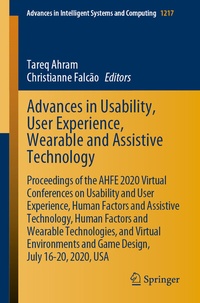
Advances in Usability, User Experience, Wearable and Assistive Technology
Description

This book addresses emerging issues in usability, interface design, human-computer interaction, user experience and assistive technology. It highlights research aimed at understanding human interactions with products, services and systems and focuses on finding effective approaches for improving the user experience. It also discusses key issues in designing and providing assistive devices and services for individuals with disabilities or impairment, offering them support with mobility, communication, positioning, environmental control and daily living. The book covers modeling as well as innovative design concepts, with a special emphasis on user-centered design, and design for specific populations, particularly the elderly. Further topics include virtual reality, digital environments, gaming, heuristic evaluation and forms of device interface feedback (e.g. visual and haptic). Based on the AHFE 2020 Virtual Conference on Usability and User Experience, the AHFE 2020 Virtual Conference on Human Factors and Assistive Technology, the AHFE Virtual Conference on Human Factors and Wearable Technologies, and the AHFE 2020 Virtual Conference on Virtual Environments and Game Design, held on July 16-20, 2020, it provides academics and professionals with an extensive source of information and a timely guide to tools, applications and future challenges in these fields.
More details
Other editions
Additional editions
Persons
Content
- Intro
- Advances in Human Factors and Ergonomics 2020
- Preface
- Contents
- User Interface and Accessibility
- The Importance of Computer Auto Personalization
- Abstract
- 1 Introduction
- 2 Research Method
- 3 Research Results
- 4 Conclusion
- References
- Designing Universal Icons: An Explorative Study
- Abstract
- 1 Introduction
- 1.1 The Universal Design of Icons
- 1.2 Effect of Culture on Icon Preference
- 2 Method
- 2.1 Participants
- 2.2 Experimental Design and Procedure
- 2.3 Item Categorization
- 3 Results
- 3.1 Icon Analysis
- 4 Discussion
- Acknowledgments
- References
- Identifying and Improving Usability Problems of Cryptocurrency Exchange Mobile Applications Through Heuristic Evaluation
- Abstract
- 1 Introduction
- 2 Method
- 3 Results
- 4 Discussion
- 5 Conclusion
- Acknowledgments
- References
- Enhancing Webpage Navigation with a Novel Scrollbar Design
- Abstract
- 1 Introduction
- 2 Related Work
- 3 System Design
- 4 Experimental Study
- 5 Results and Discussion
- 6 Conclusion
- References
- The Effect of Peephole Interaction Mode and User Experience on Wayfinding Performance
- Abstract
- 1 Introduction
- 2 Method
- 2.1 Participants
- 2.2 Materials and Apparatus
- 2.3 Experimental Design and Procedure
- 3 Results
- 3.1 Task Analysis
- 3.2 Analysis of System Usability Scale Questionnaire
- 4 Discussion
- 5 Conclusion
- References
- Fine Design of Music Application User Experience Based on First Sense Interactive Node Optimization: Example of Splashscreen
- Abstract
- 1 Introduction
- 2 Theories and Methods
- 2.1 Fine Design and Primacy Effect
- 2.2 Interaction Nodes
- 2.3 Semantic Difference Method
- 3 Splashscreen
- 3.1 Concept of Splashscreen
- 3.2 Importance Analysis of Splashscreen
- 3.3 Analysis of Splashscreen Design
- 4 Questionnaire Survey and Result Analysis
- 4.1 Questionnaire Survey
- 4.2 Result Analysis
- 5 Summary and Suggestions
- References
- The Assessment of Motion Sickness Induced by Sensory Conflict and Posture Instability
- Abstract
- 1 Introduction
- 2 Literature Review
- 2.1 Motion Sickness
- 2.2 Postural Instability Theory
- 2.3 Sensory Conflict Theory
- 2.4 Fast Motion Sickness Scale
- 3 Research Approach
- 3.1 Experiment Design
- 3.2 Experiment I. Subjects Without Training
- 3.3 Experiment II. Subjects with Training
- 3.4 Research Hypotheses
- 4 Experimental Results
- 5 Conclusion
- Acknowledgments
- References
- Study on Online Service Experience of Public Cultural Learning Space: Using the Self-service Seat Selection System of University Library as an Example
- Abstract
- 1 Introduction
- 2 The Investigation of University Library Seat Selection Interface
- 2.1 Formation and Distribution of Questionnaires
- 2.2 SUS Data Analysis
- 2.3 User Survey
- 3 Interaction Characteristics of the Existing System
- 4 Suggestions and Design of System Interface Optimization
- 5 Conclusion and Prospect
- References
- Research on Design of Children's Experiential Space in Museum Based on Interaction Concept: Take Perth, Australia as an Example
- Abstract
- 1 Introduction Concept and Children's Experience
- 2 Design Method of Children's Experience Space in Museum Based on Interaction Concept
- 2.1 Interaction Methods Between Children and Space Environment
- 2.2 Methods for Children to Interact with Digital Media
- 2.3 Interaction Methods Between Child and Child, Child and Adult
- Acknowledgments
- References
- Usability Evaluation and Interface Design
- Improving the Usability of a Digital Neurobehavioral Assessment
- Abstract
- 1 Introduction
- 2 Methodology
- 3 Results
- 3.1 User Feedback and Heuristic Evaluation One
- 3.2 Mobile Application Heuristic Evaluation
- 3.3 User Evaluations
- 3.4 Redesign Recommendations
- 4 Conclusion
- References
- Progress Bar Effects as a Time Clue for the Touch-Sensitive User Interface of a Smart Microwave Oven
- Abstract
- 1 Introduction
- 2 Method
- 2.1 Experiment
- 2.2 Materials
- 2.3 Experimental Design
- 2.4 Procedure
- 3 Results
- 3.1 Task Analyses
- 3.2 NASA Task Load Index
- 4 Discussion
- 5 Conclusion
- References
- Designing the AI Developing System Through Ecological Interface Design
- Abstract
- 1 Introduction
- 2 Analysis of the Artificial Intelligence Development Environment
- 2.1 AI Development Environment Analysis
- 2.2 Machine Learning Analysis
- 2.3 AI Development Process Analysis
- 3 How to Improve AI Development via New System
- 4 Validation of AI Development System
- 5 Discussion
- 6 Conclusion
- References
- Analysis of Children's Content on YouTube Channels by Parents
- Abstract
- 1 Introduction
- 2 Methodology
- 3 Results
- 4 Conclusion
- Acknowledgments
- References
- Scent Interfaces Definition: Diffuser Devices Interaction and Control
- Abstract
- 1 Introduction
- 2 Scent Interfaces
- 2.1 Scent Interfaces - Scope
- 2.2 Conclusion
- 3 Scent Interfaces Objects Evaluation
- 3.1 Moodo Home Fragrance Diffuser and Rituals Perfume Genie
- 4 Conclusion and Findings
- References
- Satisfaction Evaluation of the Passenger Interface Design of High-Speed Train Based on G1-Entropy Weight Method
- Abstract
- 1 Introduction
- 2 Methods
- 2.1 Survey on Passenger Satisfaction
- 2.2 Evaluation Indexes
- 2.3 Computation of Importance Degree of Indexes with G1-Entropy Weight Method
- 3 Results and Discussion
- 4 Conclusion
- Acknowledgements
- References
- Usability and User-Centered Design
- Subjectively Experienced Time in Human-Computer Interaction: The Role of Passage of Time in User Experience
- Abstract
- 1 Introduction
- 1.1 Time Flies When You're Having Fun, but Do You Have Fun When Time Flies?
- 1.2 User Experience
- 2 Method
- 2.1 Participants
- 2.2 Experimental Design and Operationalization
- 2.3 Procedure
- 2.4 Hypothesis and Analysis Strategy
- 3 Results
- 4 Discussion
- References
- Storyboarding the Virtuality: Methods and Best Practices to Depict Scenes and Interactive Stories in Virtual and Mixed Reality
- Abstract
- 1 Introduction
- 2 Prototyping Virtual Reality
- 2.1 VR for Storyboarding?
- 2.2 3D and Perspective View Storyboards
- 2.3 Combining 3D and Point of View (POV) Depictions
- 2.4 Annotating Traditional Storyboards for VR
- 3 Prototyping Mixed Reality
- 4 Conclusion
- References
- Scent as a Modality: Study on the Olfactory Sense in Multisensorial Design
- Abstract
- 1 Introduction
- 2 Multisensorial Design
- 2.1 Senses and Design
- 2.2 Synesthesia
- 2.3 Prosody Effects
- 2.4 The Olfactory System and Scent
- 3 Scent as a Modality
- 3.1 Scent and Design
- 3.2 Scent as a Modality
- 4 Conclusion and Findings on the Use of Odors as a Modality
- References
- Towards Understanding Customer Co-creation Experience for Mass Customization
- Abstract
- 1 Introduction
- 2 Literature Review and Observation of Product Configurators
- 3 Method
- 4 Results and Discussion
- 5 Conclusion
- References
- A Methodology for Data Analytics Based on Organizational Characterization Through a User-Centered Design: A Systematic Literature Review
- Abstract
- 1 Introduction
- 2 Methodology
- 2.1 Research Question
- 2.2 Research Strategy
- 2.3 Selection Criteria
- 2.4 Quality Assessment
- 3 Results
- 4 Discussion and Proposal
- 4.1 Discussion
- 4.2 Proposal
- 5 Conclusions
- References
- Framework Based on Gestalt Principles to Design Mobile Interfaces for a Better User Experience
- Abstract
- 1 Introduction
- 2 Related Work
- 3 Gestalt Prototyping Framework
- 3.1 Statement 1. The Match Between the System and the Real World
- 3.2 Statement 2. Recognition Rather Than Recall
- 3.3 Statement 3. Aesthetic and Minimalistic Design
- 4 Experiment and Results
- 5 Conclusions and Future Work
- References
- Reflections on the Concepts of Informational Ergonomics and Their Compatibility in User Experience
- Abstract
- 1 Introduction
- 2 Informational Ergonomic
- 3 User Experience
- 4 Informational Ergonomic and User Experience
- 5 Conclusions
- References
- Progressive Disclosure Options for Improving Choice Overload on Home Screen
- Abstract
- 1 Introduction
- 2 Exploratory Study - Feasibility Test of Progressive Disclosure Option
- 3 Literature Research
- 4 Idea Development of Prototyping
- 4.1 Prototype 1 of "Prior Disclosure Icons"
- 4.2 Prototype 2 of Additional "Second Priority Disclosure Icons"
- 5 Conclusions
- References
- An Exploratory Analysis of Technical Issues in Remote Education Between International Medical Institutions
- Abstract
- 1 Introduction
- 2 Methods
- 3 Results
- 3.1 Technical Error
- 3.2 User Behavior
- 3.3 Context Factor
- 3.4 Human Factor
- 3.5 System Factor
- 4 Discussion
- 5 Conclusion
- Acknowledgments
- References
- Easy Identity Management and Enhanced Security in Account Linking
- Abstract
- 1 Introduction
- 2 Related Works
- 3 Account Linking
- 3.1 Account Linking
- 3.2 How Account Linking Works
- 3.3 Account Linking in Multiple Devices
- 3.4 Account Linking in Shared Devices
- 3.5 Advanced Account Linking
- 4 Discussion
- 5 Conclusion
- References
- How Efficiency and Naturalness Change in Multimodal Interaction in Mobile Navigation Apps
- Abstract
- 1 Introduction
- 2 Method
- 2.1 Experimental Hypothesis
- 2.2 Participants
- 2.3 Experimental Setup
- 2.4 Procedure
- 3 Results and Discussion
- 3.1 Assessments of Efficiency
- 3.2 Scores of Naturalness
- 3.3 Correlation and Dependence
- 3.4 Transcription of User Interviews
- 4 Conclusion
- References
- User Experience and Human-machine Interaction
- Flat-Design Icon Sets: A Case for Universal Meanings?
- Abstract
- 1 Introduction
- 2 Related Work
- 3 Research Study
- 3.1 Materials
- 3.2 Protocol
- 3.3 Participants
- 4 Results and Discussion
- 5 Conclusions and Future Work
- References
- How Can We Improve the Driving Experience with Human-Machine-Interface for Automated Driving?
- Abstract
- 1 Introduction
- 2 Methods
- 2.1 The Driving Experience Assessment
- 2.2 Questionnaire and Interview
- 2.3 Procedure
- 3 Results
- 4 Discussion
- Acknowledgments
- References
- Technology Products Suitability for Experimental Display Size and Color Research
- Abstract
- 1 Introduction
- 2 Discussion
- 3 Research Methods
- 4 Research Purpose
- 4.1 A Test Plan
- 5 Discussion and Conclusions
- References
- Visual Elements for the Design of a Robotic Head in Si-Robotics Project
- Abstract
- 1 Introduction
- 2 Designing a Robotic Face: Why
- 3 Designing a Robotic Face: How
- 4 A Taxonomy of Robotic Morphologies
- 5 Si-Robotics: A Case Study
- 6 Conclusion and Further Developments
- References
- Development of Gender-Sensitive Questionnaire for Transport and Mobility Surveys
- Abstract
- 1 Introduction
- 2 Methodology
- 2.1 Literature Review
- 2.2 Data Collection
- 3 Gender-Related Transport Issues
- 3.1 Transport Safety and Security
- 3.2 Travel Patterns and Purposes
- 3.3 Transport Mode Availability and Accessibility
- 3.4 Sustainable Transport Behaviour and Attitudes
- 4 Discussion
- Acknowledgments
- References
- Human Factors Guideline in the Human Machine Interface Design of Datalink System
- Abstract
- 1 Background
- 2 Introductions to the Applications of Datalink Systems in Civil Aircraft
- 2.1 Airline Operational Control Communications Application
- 2.2 Air Traffic Service Application
- 2.3 Controller Pilot Data Link Communications Application
- 3 Design Guidelines
- 3.1 Responsibility Allocation of Operation Procedure
- 3.2 Consistency with Operation Environment
- 3.3 Priority and Sorting Rules of Messages
- 3.4 Degree of Automation
- 3.5 Peripheral Equipment
- 3.6 Use Restriction
- 3.7 Time Limitation
- 4 Conclusions
- References
- Technology as a Tool to Improve Student Understanding of Assessment Questions
- Abstract
- 1 Introduction
- 2 Guidelines
- 2.1 Reading Comprehension Guidelines
- 2.2 Serious Games (SGs) Guidelines
- 2.2.1 Usability and User Experience
- 2.2.2 Brainwaves and Cognition
- 2.2.3 Game Design and Elements
- 3 Methods
- 4 Results
- 5 Discussion
- 6 Conclusion
- References
- Research on Availability of Campus Vending Machines: An Example for Xuhui Campus of East China University of Technology
- Abstract
- 1 Introduction
- 2 Research Background and Purpose
- 3 Theoretical Basis
- 4 Experiment Design
- 4.1 Questionnaire Design
- 4.2 Service System Availability Assessment Survey (SUS)
- 4.3 Data Analysis
- 4.4 Analysis of Experimental Results
- 5 The Link Between Human-Computer Interaction and Vending Machine Availability
- 6 The Impact of Human-Computer Interaction on the Future Use of Vending Machines
- 7 Summary
- Acknowledgments
- References
- Security Guidelines for the Design of ATM Interfaces
- Abstract
- 1 Introduction
- 2 Relevant Concepts
- 2.1 Automatic Teller Machine
- 2.2 User Experience
- 2.3 Security
- 2.4 User Interfaces
- 3 Literature Review
- 4 Validation
- 5 Conclusions and Future Work
- References
- The Analysis of Influence Factors of User Experience in Bullet Screen
- Abstract
- 1 Introduction
- 2 Theoretical Review
- 2.1 Visual Stimulation in Bullet Screen
- 2.2 Emotional Response in Bullet Screen
- 3 Methodology and Study
- 3.1 Research Model
- 3.2 Design Characterization in Bullet Screen
- 3.3 Study Analysis
- 4 Conclusions
- References
- Ergonomic Assessment of a Parking Ticket Payment Machine for Filipino Use
- Abstract
- 1 Background of the Study
- 2 Methodology
- 2.1 Participants
- 2.2 Cognitive Usability Assessment
- 2.3 Anthropometric Assessment
- 2.4 Data Analysis
- 3 Results and Discussion
- 3.1 Learnability
- 3.2 Satisfaction
- 3.3 Affordance
- 3.4 Efficiency
- 3.5 Design Recommendations
- 4 Conclusion
- References
- Usability Assessment of a Philippine Commuting Navigation Application
- Abstract
- 1 Introduction
- 1.1 Background of the Study
- 1.2 Objectives of the Study
- 2 Methodology
- 3 Results and Discussion
- 4 Recommendations
- Acknowledgements
- References
- Creative Design of Kitchenware Products Based on the Concept of Affordance
- Abstract
- 1 Introduction
- 1.1 The Concept of Affordance
- 1.2 Application of Affordance in Design
- 2 Related Work
- 2.1 The Relationship Between Affordance and Product Semantics
- 2.2 Human-Computer Interaction in the Development of Kitchenware
- 3 Creative Design Methods for Kitchenware Products
- 3.1 Construct Multiple Uses from Functional Affordance
- 3.2 Construct Symbols from Cognitive Affordance
- 3.3 Construct Multi-sensory Interactions from Sensory Affordance
- 3.4 Comprehensive Use of Different Affordances
- 4 Conclusion and Future Work
- Acknowledgments
- References
- Evaluating User-Elicited Gestures for Physical Peripheral Interaction with Smart Devices
- Abstract
- 1 Introduction
- 2 User Elicitation Study
- 2.1 Tasks of Gestural Interaction
- 2.2 Low-Fidelity Prototypes
- 2.3 Study Setup
- 2.4 Elicited Gestures
- 3 Evaluating Elicited Gestures
- 3.1 Selecting Gestures
- 3.2 Evaluating Gestures for Peripheral Interaction in Lab-Test
- 3.3 Results and Findings
- References
- A Study on the Effect of Artificial Light Environment on Consumers' Purchase Intention for Fruits
- Abstract
- 1 Introduction
- 2 Experimental Study
- 2.1 The Experiment 1 and the Analysis of Its Result
- 2.2 The Experiment 2 and the Analysis of Its Result
- 3 Conclusion
- Acknowledgements
- References
- User-Defined Gestures for Taking Self-portraits with Smartphone Based on Consistency
- Abstract
- 1 Introduction
- 2 Experiment 1: Gesture Set Acquisition
- 2.1 Participants
- 2.2 Procedure
- 2.3 Results
- 3 Experiment 2: Consistency Verification and Evaluation
- 3.1 Participants
- 3.2 Procedure
- 3.3 Results
- 4 Conclusion
- References
- Study on Influencing Factors of User Experience of In-Vehicle Infotainment System Based on DEMATEL Method
- Abstract
- 1 Introduction
- 2 Methods
- 2.1 Literature Review
- 2.2 DEMATEL
- 3 Results
- 3.1 Analysis of the Direct and Indirect Influence Degree of the Factors
- 3.2 Data Analysis
- 4 Discussion
- 5 Conclusion
- References
- Design Principles and Strategies of Interface in Extra Vehicular Activity Spacesuit
- Abstract
- 1 Introduction
- 2 Research Method
- 3 Human-Machine Interactive System of an EVA Spacesuit
- 3.1 Interactive Design and Interface Design
- 3.2 Introduction of "Human-Machine Interface" and Interactive System of EVA Spacesuit
- 3.3 Influencing Factors of EVA Spacesuits' Human-Machine Interaction Process
- 4 Design Principle of the Interface for the EVA Spacesuit
- 4.1 Interactive Behavior Level: Design Principles with Human "Interactive Behavior" Design as the Main Research Object
- 4.2 Hierarchical Division of Behaviors of "Human-Machine Interaction" of EVA Spacesuit
- 4.3 Analysis of Upper Limbs' Accessible Domains in an EVA Spacesuit
- 4.4 Interactive Media Level- Final Materialization and Presentation of Design Principles
- 5 Conclusions and Discussion
- Acknowledgments
- References
- Research on Improved Design of Distance Measuring Wheel for Measuring Traffic Accidents
- Abstract
- 1 Introduction
- 2 Research Method
- 3 Research Results
- 4 Discussions and Suggestions
- Acknowledgments
- References
- Research on Availability of Intelligent Express Cabinet Service System
- Abstract
- 1 Introduction
- 2 Establish Usability Standards
- 2.1 Initially Establish Usability Assessment Indicators
- 2.2 Usability Evaluation Experiment
- 2.3 Building the Usability Standard of Intelligent Express Cabinet
- 3 Optimization of Intelligent Express Cabinet Service System
- 4 Conclusions
- References
- Usability and User Experience Applications
- An Application of Bayesian Regression in Ergonomics
- Abstract
- 1 Introduction
- 2 Data and Problem Description
- 3 Results
- References
- The Effect of Touch Screen Size on Pattern Experiments
- Abstract
- 1 Introduction
- 2 Discussion
- 3 Research Methods
- 3.1 Experiment Two Design - Design Elements of the Experiment
- 3.2 Three Test Screen Sizes and Applicability Statistics Tests
- 3.3 Three Test Screen Sizes and Applicability Statistics Tests
- 4 Discussion and Conclusions
- References
- The Digital Divide: How Low-Literate Freshman Search for Information
- Abstract
- 1 Introduction
- 2 Literature Review
- 2.1 Information Literacy and Retrieval
- 3 Methodology
- 3.1 Procedure
- 3.2 Participants
- 4 Findings
- 5 Conclusion
- References
- Editorial Design of Interactive Picture Book with Mobile Application Based on Uxd User Experience Design
- Abstract
- 1 Introduction
- 2 Methods and Materials
- 2.1 Participatory Design (Editorial Design - AR - UxD)
- 2.2 Fundamentals of Bi and Three-Dimensional Design (Editorial Design)
- 2.3 Reticular Deconstruction (Editorial Design)
- 2.4 Reticular Structures (Editorial Design)
- 2.5 Laws of Gestalt (Editorial Design)
- 2.6 Semi-cognitive Model (UxD)
- 2.7 Clark's Method (AR)
- 2.8 Semiotic Engineering (UxD)
- 2.9 Interactive Flowchart (UxD)
- 2.10 Interaction Syntax (UxD)
- 2.11 The Metaphor (UxD)
- 2.12 The Affordances (UxD)
- 3 Proposal Development
- 4 Results
- 5 Conclusions and Future Works
- References
- An Improvement on the Progress Bar: Make It a Story, Make It a Game
- Abstract
- 1 Introduction
- 2 Experiment One: Unpredictable Progress Bar Decorations
- 2.1 Methods
- 2.2 Results
- 3 Experiment Two: Interactive Progress Bar Decorations
- 3.1 Methods
- 3.2 Results
- 4 Discussion
- 5 Conclusion
- References
- Factors Affecting Low Response Effort in Online Survey Tasks for Passive Stakeholders: Insights from a Design Ethnography Research
- Abstract
- 1 Introduction
- 2 Design Ethnography Research
- 3 Data Collection
- 3.1 Participant
- 3.2 Semi-structured Interview
- 3.3 Thematic Coding
- 4 Analysis and Results
- 4.1 Respondents
- 4.2 Procedure and Results
- 5 Conclusion
- References
- A Framework to Improve Evaluation of Novel Decision Support Tools
- Abstract
- 1 Introduction
- 1.1 Applying User Research Methods
- 2 Interface Experience Framework
- 3 Case Study: Assessing Tool Introduction at USTRANSCOM
- 4 Discussion and Process Recommendations
- 5 Conclusions
- References
- A MATLAB-Based Tool Usability Evaluation for 3D Reconstruction Environments
- Abstract
- 1 Introduction
- 2 Related Work
- 3 The Tool
- 4 Usability Assessment
- 5 Results
- 6 Conclusions
- References
- User Experience Design Trend of Mobile E-Commerce Vlog Application on Information Product
- Abstract
- 1 Introduction
- 2 Three Constituent Elements: E-Commerce Vlog Information Product
- 2.1 The Role of Consumer
- 2.2 Media Communication
- 2.3 Information Interaction
- 3 The Ecosphere of "Vlog+" Information Product
- 3.1 Human-Computer Interaction and Vlog Generation
- 3.2 Media Convergence Promotes User Experience Upgrading
- 3.3 Mobile Scene Enables User Experience
- 4 Conclusion
- Acknowledgments
- References
- Duolun Road Cultural Street: Research on Cultural and Creative Products Using User Portraits
- Abstract
- 1 Introduction
- 1.1 Duolun Road Cultural Street
- 1.2 Cultural and Creative Design
- 1.3 Service Design
- 1.4 User Portrait
- 2 Insight
- 2.1 Observation
- 2.2 Interview
- 2.3 User Portrait
- 2.4 Case Study
- 3 Research Results
- 3.1 Design Show
- 4 Conclusion
- References
- Research on Customer Relationship Management System Based on Cognitive Psychology Theory: Analysis and Research of the World Business Website
- Abstract
- 1 Introduction
- 2 Customer Relationship Management System Based on Cognitive Psychology Theory
- 2.1 Customer Relationship Management
- 2.2 Cognitive Psychology
- 2.3 Application of Cognitive Psychology to Customer Relationship Management of Tourism E-Commerce Website
- 3 Case Study-the "Looking at the World" Website
- 3.1 Introduction to the Website
- 3.2 Design of Website Customer Relationship Management System
- 4 Conclusion
- References
- Applying DEMATEL to Identify Critical Factors of Chinese Urban Residents' Participation in Domestic Garbage Classification
- Abstract
- 1 Introduction
- 2 Methods
- 2.1 Importance Judgment Experiment and Main Influencing Factors
- 2.2 DEMATAL Operation
- 2.3 DEMATEL Causal Diagram
- 3 Conclusion
- References
- Factor Analysis of Jewelry Design Based on Consumer Behavior Research and DEMATEL Method
- Abstract
- 1 Introduction
- 2 Methods
- 2.1 Factor Selection
- 2.2 DEMATEL Questionnaire Survey
- 2.3 The DEMATEL Process
- 3 Results
- 3.1 The Prominence and Relation Values
- 3.2 The Causal Diagram
- 4 Discussion and Conclusion
- 4.1 Dominant Factors of Young Women Jewelry Consumption
- 4.2 Relationship and Interrelationship of Factors Influencing Jewelry Consumption
- 4.3 Limitations
- Acknowledgement
- References
- Design and Research on the Parent-Child Indoor Environment of Chinese Middle-and-Upper Income Families
- Abstract
- 1 Introduction
- 1.1 Background
- 1.2 Research Purpose
- 1.3 Research Scope
- 2 Literature Review
- 2.1 The Importance of the Family Indoor Environment to Children's Growth
- 2.2 Literature Results on the Study of the Parent-Child Indoor Environment
- 3 Method
- 3.1 Ethnography
- 3.2 Statistical Analysis
- 4 Construction of the Indoor Environment Evaluation Model
- 4.1 Limits of the Existing Evaluation Model
- 4.2 Extract Design Attributes from Field Survey
- 4.3 Expert Assessment of Design Attributes
- 4.4 Hypothesis of the Parent-Child Indoor Environment Evaluation Model
- 5 Verification and Amendment
- 5.1 Questionnaire Reliability Analysis
- 5.2 Validity and Factor Analysis
- 5.3 Revision and Improvement of the Evaluation Model
- 6 Conclusion
- Acknowledgments
- References
- Research on the User Experience of Educational App in the Context of "Intangible Cultural Heritage"
- Abstract
- 1 Introduction
- 2 Research on Influential Factors of APP Design for ICH Handicraft Education
- 2.1 Speciality of Handicraft Material Cultural Heritage Education APP
- 2.2 Influential Factors of APP Design for ICH Handicraft Education
- 3 Experimental Study
- 4 Analysis and Inference
- 4.1 Factors Affecting Users' Willingness to Continue Using
- 4.2 Factors Affecting User Experience and Willingness to Continue Using
- 4.3 Summary and Inference
- 5 Discussion
- References
- Research on the Design and Application of Persuasive Game in Calligraphy Learning
- Abstract
- 1 Introduction
- 2 Method and Material
- 3 Process
- 3.1 Semi-structured Interviews
- 3.2 The Questionnaire Survey
- 4 Discussion
- 4.1 PSD Model
- 5 Conclusion
- References
- Factors Affecting the Purchase Decision of Sneakers in Post-90s Consumer Groups
- Abstract
- 1 Introduction
- 2 Literature Review
- 2.1 DEMATEL Method
- 2.2 Critical Factors of Consumption Decision
- 3 A Case Study
- 3.1 The Questionnaire
- 4 Data Processing
- 5 Conclusions
- References
- Wearable Technologies
- Smart Digital Assistance Devices for the Support of Machine Operation Processes at Future Production Workplaces
- Abstract
- 1 Introduction
- 2 Method
- 2.1 Participants
- 2.2 Experimental Design
- 2.3 Apparatus
- 2.4 Procedure
- 3 Results
- 4 Discussion
- 4.1 General Discussion
- 5 Limitations
- 6 Conclusion and Outlook
- Acknowledgments
- References
- A Way of Motivating Patient in Rehabilitation - Case Study of a Motion Tracking Wearable Device
- Abstract
- 1 Introduction
- 2 Design
- 2.1 Prototype Construction
- 3 Evaluation
- 3.1 Method
- 3.2 Results
- 4 Discussion
- References
- Technology as an Interface of Wear: Wearables and the Irreversible Human-Computer Interaction
- Abstract
- 1 Introduction
- 2 Panorama of the New Wear and the Interaction Mediated by the Technological
- 3 Human-Computer Interaction
- 4 Partial Considerations
- References
- SWear: Sensing Using WEARables. Generalized Human Crowdsensing on Smartwatches
- Abstract
- 1 Introduction
- 2 SWear Design and Implementation
- 2.1 SWear Runtime
- 2.2 Companion App
- 2.3 Data Monitoring Dashboard
- 3 Example of Studies that Used SWear
- 3.1 Study I: Activity Recognition on Wrist Worn Smartwatches
- 3.2 Study II: Heart Rate Estimation from Smartphone Sensor Data
- 4 Discussion, Limitations and Conclusions
- References
- Is That What I Think It Is? Impact of Screen Size on User Ability to Identify Human Activities
- Abstract
- 1 Introduction
- 2 Method
- 2.1 Participants
- 2.2 Materials
- 2.3 Design
- 2.4 Procedure
- 3 Results
- 3.1 Accuracy of Responses by Display Size
- 3.2 Accuracy and Relative Response Time by Display Size
- 3.3 Participant Confidence Based on Display Size
- 3.4 Activity, Correctness, and Relative Reaction Time
- 4 Discussion and Future Work
- Acknowledgments
- References
- The Impact of Eye Tracking Technology
- Abstract
- 1 Introduction
- 2 Literature Review of Eye Tracking Research
- 2.1 The Impact of the Use of Eye Tracking Technology
- 2.2 Eye Tracking Usability Studies
- 2.3 Studies Focusing on Training
- 3 Eye Tracking Data Analysis
- 3.1 Scanpath Analysis
- 4 Discussion
- References
- Why Would You? Looking into Applicable Motives to Use Life-Logging
- Abstract
- 1 Introduction
- 2 Related Work
- 2.1 Physical Activity and Health
- 2.2 Motivation
- 2.3 Technology Acceptance
- 2.4 Life-Logging and Activity Trackers
- 3 Empirical Approach
- 3.1 Online Questionnaire
- 3.2 Statistical Analysis
- 3.3 Sample
- 4 Results
- 4.1 Hierarchical Bayes Estimation
- 4.2 Latent-Class
- 5 Discussion
- 6 Limitations and Outlook
- Acknowledgments
- References
- Interactive Indoor Localization on Helmet
- Abstract
- 1 Introduction
- 2 Related Studies
- 3 Helmet System Architecture
- 4 Map Generation
- 5 Inertial Sensory Fusion for Estimating Steps and Orientation
- 6 Wall-Following Algorithm
- 7 Landmark Checking
- 8 Indoor Navigation Experiments
- 9 Conclusions
- 10 Future Work
- Acknowledgments
- References
- Wearable Real-Time Monitoring System Based on Fiber Bragg Grating Pressure Sensor for Compression Therapy Applications
- Abstract
- 1 Introduction
- 2 Materials and Methods
- 2.1 Working Principle of the Fiber Bragg Grating Sensor
- 2.2 Fabrication of the FBG-PDMS Sensor
- 2.3 Experiments
- 3 Results and Discussion
- 4 Conclusion
- Acknowledgments
- References
- Human-Centered Design for the Spacesuit Development: A Case Study of the "Feitian" EVA Spacesuit
- Abstract
- 1 Introduction
- 1.1 HCD in Aerospace Product Design
- 1.2 Extravehicular Activity (EVA) and Spacesuit Design
- 2 Research Methods
- 3 Case Study: HCD in Spacesuit Design Process
- 3.1 Space Product R&D Department's Current Space Product Design Process
- 3.2 Spacesuit Design Process Based on HCD
- 4 Discussion
- References
- The Development of an Audible Warning System for Parachute Landing at Night
- Abstract
- 1 Introduction
- 2 Background
- 3 Methods
- 4 Results
- 5 Discussion
- References
- A Study on the Size of Head and Face of Chinese Minors
- Abstract
- 1 Introduction
- 2 Samples Collected
- 3 Data Items
- 4 Data Analysis
- 5 Conclusions
- Acknowledgments
- Reference
- The Effects of Vagus Nerve Stimulation on Insomnia Persons for Stress Reduction and Sleep Induction
- Abstract
- 1 Introduction
- 2 Methodology
- 2.1 Insomnia Selection Criteria
- 2.2 Experimental Setup
- 2.3 Feature Extraction
- 2.4 Statistical Analysis
- 3 Results
- 3.1 Melatonin Analysis
- 3.2 ECG and EEG Analysis
- 3.3 Subjective Evaluation
- 4 Conclusion
- Acknowledgments
- References
- Human Factors in Game Design
- Stratagems: Embedding Cognitive Training in Game-Based Environments
- Abstract
- 1 Introduction
- 2 Methods
- 3 Results
- 3.1 Review of Common Decisions and Cognitive Skills
- 3.2 Cognitive Task Analysis
- 3.3 Incident Selection
- 3.4 Training Scenario
- 3.5 Validation with SMEs
- 4 Discussion
- 4.1 Next Steps
- Acknowledgements
- References
- Linkage Between Gamification and Moral Organisational Climate
- Abstract
- 1 Introduction
- 2 Theoretical Background
- 3 Methodology
- 4 Empirical Findings
- 5 Conclusions
- References
- Designing a Serious Game for Labor Inclusion of People with Intellectual Disabilities Using iPlus Methodology
- Abstract
- 1 Introduction
- 2 Designing a Serious Game Using IPlus Methodology
- 2.1 A Serious Game for Solving Temporal Sequences of Work Tasks
- 2.2 iPlus Methodology
- 3 Game Implementation
- 4 Conclusions
- References
- Brain Reality Gaming: Concepts, Advances and Current Challenges
- Abstract
- 1 Introduction
- 2 About Hedonic Design
- 2.1 The Use of Biosensors in Hedonic Design
- 2.2 The Biofeedback as an Hedonic Design Strategy of Game Development with Biosensors
- 2.3 Types of Biofeedback
- 3 Adaptive Systems in Hedonic Design of Digital Products
- 4 Advances and Current Challenges in Brain Reality Gaming
- 5 Final Considerations
- Acknowledgments
- References
- Serious-Games-Based Exercises for Arthroplasty Rehabilitation
- Abstract
- 1 Introduction
- 2 Related Work
- 3 Game Environments
- 4 Usability Evaluation
- 5 Evaluation Results
- 6 Conclusions
- Acknowledgments
- References
- Engagement in the Cinematography of Videogames: Proposal of an Algorithm for Colors and Foci of Attention Analysis
- Abstract
- 1 Introduction
- 2 Methodology for the Construction of the Interface
- 3 Case of Study
- 3.1 Algorithm 1
- 4 Conclusions
- References
- The Research on Critical Factors Affecting the Game Experience of Daily Quests System in Mobile Game
- Abstract
- 1 Introduction
- 1.1 Research Background
- 1.2 Problem Location
- 2 Determination of Factors
- 2.1 Preparation
- 2.2 Definition of Factors
- 3 DEMATEL Procedure
- 3.1 Introduction to DEMATEL
- 3.2 DEMATEL Operations
- 4 Discussion
- 4.1 To Focus on the Influence Factors First
- 4.2 The Core Factors Are the Key to the Problem
- 4.3 Focus on the New Opportunity Found in the Data
- References
- Research on the Application Trend of Immersive Game Interactive Experience Space in Museum
- Abstract
- 1 Introduction
- 2 Method
- 2.1 The Introduction of Immersive Game Interaction Technology Provides Museum Design Language and the Information Expression of Space Theme with More Creative Guidance
- 2.2 How Museum Information Achieves Spatial Experience and Information Dissemination with This Latest Technology
- 3 Results
- 4 Conclusion
- Acknowledgments
- References
- Virtual, Augmented, and Mixed Realities Applications
- An Augmented Reality Command and Control Sand Table Visualization on Top of an Advanced User Interface Display on Large Touch Table Interface
- Abstract
- 1 Introduction
- 1.1 Motivation
- 1.2 Technical Background
- 1.3 Display Hardware and Interfaces to Information Systems
- 2 Objectives
- 3 Approach - Design and Development of an AR Overlay
- 3.1 User Interface Design
- 3.2 Experimentation Plans and Metrics
- 3.3 The AR Component Network Development
- 3.4 The AR Component Camera Synchronization Development
- 3.5 The AR Component Camera Synchronization Development
- 3.6 The AR Component Utilizing Simulation Data
- 3.7 The AR Component Graphics and Computational Load Reduction
- 3.8 The AR Component Entity Data Tags
- 4 Conclusions and Future Work
- References
- The Use of Immersive Technologies for Design Reviews
- Abstract
- 1 Introduction
- 2 Method
- 3 Results
- 4 Discussion
- 5 Conclusion
- References
- VRMouse: Mouse Emulation with the VR Controller for 2D Selection in VR
- Abstract
- 1 Introduction
- 2 Related Work
- 3 VRMouse
- 3.1 Attachment
- 4 Experimental Evaluation
- 4.1 Participants, Apparatus and Experimental Settings
- 4.2 Experimental Design and Procedure
- 4.3 Data Analysis
- 5 Results and Discussion
- 5.1 Performance
- 5.2 Subjective Evaluation
- 5.3 Limitations and Future Work
- 6 Conclusion
- Acknowledgments
- References
- The Effect of Ocular Dominance on Decision Making in a Virtual Environment
- Abstract
- 1 Introduction
- 1.1 Research Questions
- 1.2 VR Stimulus
- 1.3 Procedures and Experimental Setup
- 2 Results and Discussions
- 2.1 Eye Dominance vs. Gender
- 2.2 Eye Dominance and Decision Making in Horizontal Direction
- 2.3 Eye Dominance and Decision Making in Vertical Direction
- 3 Conclusion
- Acknowledgments
- References
- Exploring Attention in VR: Effects of Visual and Auditory Modalities
- Abstract
- 1 Introduction
- 1.1 Goals and Objectives
- 2 Method
- 2.1 Participants
- 2.2 VR System
- 2.3 Measures
- 2.4 Procedure
- 3 Results
- 3.1 Sensory Modality Effects on Attention in VR
- 3.2 Visual Attention
- 3.3 Auditory Attention
- 4 Discussion and Implications
- Acknowledgment
- References
- The Impact of Interactive AR on Learning Ability of Children's Chinese Characters Self-learning
- Abstract
- 1 Introduction
- 2 Design Paradigm
- 2.1 Traditional Learning
- 2.2 AR-Assisted Learning
- 3 Method and Data
- 3.1 Participants and Procedure
- 3.2 Learning Tasks
- 3.3 Measurement of Learning Ability
- 4 Results
- 5 Conclusion
- References
- AR-Based Assembly Assistance System with Efficient Evaluation of Misalignment Between Virtual and Real Objects
- Abstract
- 1 Introduction
- 2 Related Work
- 3 Core Design of the AR-Based Assembly Assistance System
- 3.1 Microsoft HoloLens
- 3.2 Coordinate Calibration
- 3.3 Efficient Evaluation of Misalignment Between Virtual and Real Objects
- 4 Experiment
- 4.1 Assembly Operation and Evaluation of Misalignment
- 4.2 Discussion
- 5 Conclusion
- References
- The Use of Immersive Technologies for Concept Design
- Abstract
- 1 Introduction
- 2 Method
- 3 Results
- 4 Discussion
- 5 Conclusion
- References
- Bringing Virtual Reality into Military Mental Health Education: A Pilot Study on Stress Management Course
- Abstract
- 1 Introduction
- 2 Literature Review
- 2.1 Stress Mindset Theory
- 2.2 Application of Virtual Reality to Stress Management
- 3 Course Design for Integration of Virtual Reality into Stress Management
- 3.1 Course Participants
- 3.2 Tools
- 3.3 Combining Course Content with Virtual Reality
- 4 Conclusions and Recommendations
- References
- Evaluation of Vehicles' Best Route in Virtual Tactical Teaching Environment Based on Machine-Learning Techniques
- Abstract
- 1 Introduction
- 2 Related Work
- 2.1 Virtual Tactical Teaching Environment
- 2.2 Machine Learning for DSS
- 2.3 Decision Tree
- 3 Application of the Methodology
- 3.1 Conceptual Framework
- 3.2 3D Information Visualization
- 4 Discussion and Future Work
- References
- Augmented Reality Assisted Sensory Integration Therapy for Improving Attention of Children with Autism
- Abstract
- 1 Introduction
- 2 Scooters in Sensory Training
- 3 Scooter Game Assisted with AR
- 3.1 Gamify the Training Process
- 3.2 System of the Game
- 3.3 Mechanism of the Game
- 4 Results
- 5 Conclusion and Discussion
- References
- Handedness Effect and Its Implication for Designing Two-Handed Interactive Applications in Virtual Reality
- Abstract
- 1 Introduction
- 2 Methodology
- 2.1 Participants
- 2.2 Apparatus
- 2.3 Procedure
- 3 Analyses and Results
- 3.1 Handedness Effect on Target Acquisition Efficiency
- 3.2 Handedness Effect on Target Acquisition Accuracy
- 3.3 Hand Operation Duration and Arm Fatigue Level
- 4 Discussion and Conclusion
- Acknowledgments
- References
- Design and Evaluation of a Virtual Reality Serious Game
- Abstract
- 1 Introduction
- 2 Related Works
- 3 Designing a Virtual Reality Game Using iPlus Methodology
- 3.1 Phase 1: Identification
- 3.2 Phase 2: Pedagogical Objectives
- 3.3 Phase 3: Ludic Game Script
- 3.4 Phase 4: GamePlay
- 3.5 Phase 5: Refine
- 4 A Serious Virtual Reality Game for Recreational Therapy
- 5 Usability Evaluation
- 5.1 Results and Discussions
- 6 Conclusions and Perspectives
- References
- Application of Virtual Reality Combined with Eye Tracking Technology for Design and Its Assessment by Fuzzy Evaluation Method
- Abstract
- 1 Introduction
- 2 Analysis of Current Research and Development
- 3 Research Methods and Routes
- 3.1 Objectives of Research
- 3.2 Key Problems
- 3.3 Overall Research Plan
- 4 Research Process and Experimental Steps
- 4.1 Establish a Virtual Simulation Resource Library to Create Immersive Design Scene
- 4.2 Establish the Design Process of Eye Movement Feedback Plus Immersive Scene
- 4.3 Fuzzy Model for Horizontal Comparison Evaluation
- 5 Conclusion
- Acknowledgments
- References
- Ergonomics Study on Taking and Putting Objects Based on Subjective Evaluation and Virtual Simulation
- Abstract
- 1 Introduction
- 2 Methods
- 2.1 Subjects
- 2.2 Experiment on Taking and Putting
- 2.3 Body Posture Capture During Taking and Putting Tasks
- 2.4 Modeling and Analysis of Taking and Putting Tasks
- 3 Results
- 3.1 Subjective Score of Taking and Putting Task
- 3.2 Body Posture Angles of Taking and Putting Tasks
- 3.3 Strength Prediction of Lumbar Spine (L4/L5)
- 4 Discussion and Conclusions
- Acknowledgments
- References
- Evaluation of Virtual Reality Concepts for Rapid Prototyping of Gears Using Additive Layer Technology
- Abstract
- 1 Introduction
- 2 About Plastic Gear Production
- 3 Methodology
- 3.1 Building the Model
- 4 Conclusion
- References
- Virtual Reality as a Factor to Improve Productivity in Learning Processes
- Abstract
- 1 Introduction
- 2 Problem
- 3 Methodology
- 4 Results
- 5 Conclusions
- Acknowledgments
- References
- The Effect of Augmented Reality on the Memorization in History and Humanities Education
- Abstract
- 1 Introduction
- 2 Augmented Reality in Education
- 3 Learning Case Introduction
- 4 Control Experiment
- 4.1 Purpose
- 4.2 Experiment Object
- 4.3 Experimental Procedure
- 4.4 Experimental Materials
- 4.5 Experimental Results and Analysis
- 5 Conclusion
- References
- Usability and Gaming Experience Assessment of the Nintendo Switch User Interface by Filipino Users
- Abstract
- 1 Background of the Study
- 2 Methodology
- 2.1 Participants
- 2.2 General Navigation Assessment
- 2.3 Game Experience Assessment
- 2.4 Data Analysis
- 3 Results and Discussion
- 3.1 Effectiveness
- 3.2 Efficiency
- 3.3 Satisfaction
- 3.4 Design Recommendations
- 4 Conclusion
- References
- Human Factors and Assistive Technology
- Reflections on an Interdisciplinary Approach: Integrating Assistive Technologies and Experience-Based Knowledge in Maintenance
- Abstract
- 1 The Relevance of Experiential Knowledge in Maintenance
- 2 Use Cases for Assistive Technologies in Steel Industry
- 2.1 Documentation of Experiential Knowledge in the Work Process
- 2.2 Technology-Assisted Handover Talks
- 3 Discussion and Conclusion
- Acknowledgments
- References
- Assistive Device Design for Animal Needs in Human Society
- Abstract
- 1 Background
- 2 Scope and Goals
- 3 Challenges
- 4 Ideation and Usability Testing
- 5 Functional Prototype
- 6 Product Innovation
- 7 Future Study
- Intelligent Homecare Systems: An Exploration of System Requirements from a User's Perspective
- Abstract
- 1 Introduction
- 2 Research Questions and Approach
- 3 Results
- 4 Discussion of Results
- 5 Conclusion
- Acknowledgements
- References
- MagicContact Web: A Multiplatform Application for Augmentative and Alternative Communication
- Abstract
- 1 Introduction
- 2 Related Work
- 2.1 Existing AAC Software Applications
- 2.2 Critical Analysis
- 3 Web Application Development
- 3.1 Speech Synthesis
- 3.2 Mouse Interaction Mode
- 3.3 Scanning Interaction Mode
- 3.4 Horizontal/Vertical Lines Interaction Mode
- 3.5 Offline Mode
- 4 Verification and Validation
- 5 Conclusions and Future Work
- References
- Determination of the Perception Threshold Between Conscious and Subconscious Sitting Discomfort
- Abstract
- 1 Introduction
- 2 Research Approach
- 3 Experimental Setup
- 4 Measurements
- 5 Discussion
- 6 Conclusion
- References
- Drivers for Change: Initial Insights from Mapping Half a Century of Inclusive Paediatric Mobility Design
- Abstract
- 1 Introduction to Inclusive Paediatric Mobility
- 2 Understanding IPM Design
- What, Why, Who?
- 2.1 Why IPM Design Matters
- 2.2 IPM Design Stakeholders, Expert Fields and Missing Voices
- 3 Mapping Methodology and Results
- 4 Key Findings and Drivers for Change
- 5 Conclusion and Future Research Direction
- Acknowledgments
- References
- A Research About Personalized Tickets' Pattern and Color Design Based on Computer-Aided Technology
- Abstract
- 1 Research Background and Actuality
- 2 Perceptual Evaluation Experiments
- 3 Design Practice
- 3.1 Personalized Ticket Process Framework
- 3.2 Ticket Design Practice
- 3.3 Discussion
- 4 Conclusion
- Acknowledgments
- References
- Molecular Production System - Flexible and Attractive Manufacturing Systems of the Future
- Abstract
- 1 Motivation
- 2 State of the Art
- 2.1 Manufacturing Systems
- 2.2 Worker Assistance Systems
- 2.3 Production Work as Blue-Collar Work
- 2.4 Knowledge Work as White-Collar Work
- 3 Approach
- 4 Concept Molecular Production Systems
- 4.1 Physical Apps and Flexible Manufacturing Layouts
- 4.2 Human Factor Elements
- 4.3 Assistance Elements
- 4.4 Well-Being Elements
- 5 Conclusion
- References
- Applying Facial Expression of Augmented Reality for Teaching Students with Autism Spectrum Disorders
- Abstract
- 1 Introduction
- 2 Method
- 2.1 Participants
- 2.2 Materials
- 2.3 Design
- 2.4 Procedure
- 2.5 Strategies
- 3 Result
- 4 Discussion
- 5 Conclusion
- References
- Integrated Learning and Assistive Systems for Manual Work in Production - Proposal for a Systematic Approach to Technology Selection and Design
- Abstract
- 1 Virtual and Augmented Reality for Work-Integrated Learning
- 2 Design Process of Adaptive Assistive Systems
- 3 Design Relevant Dimensions of a Work System
- 3.1 Work Task
- 3.2 Working Person
- 3.3 Environmental Influences
- 4 Discussion
- Acknowledgement
- References
- Evaluation of Cognitive Load and Its Relationship with Physical Ability on Walking Support Using Pneumatic Artificial Muscle (PAM) Driver
- Abstract
- 1 Introduction
- 2 Experimental Method
- 2.1 Equipment
- 2.2 Walking Conditions
- 2.3 Procedure
- 2.4 Evaluation Method
- 3 Experimental Results and Discussion
- 3.1 Subjects
- 3.2 Motion Analysis
- 3.3 Cognitive Analysis
- 3.4 Correlation Analysis Between Motion- and Cognitive-Related Indexes
- 4 Conclusion
- Acknowledgments
- References
- The Significance of Space Organisation in the Realisation of Movement and Mobility for People with Visual Disability
- Abstract
- 1 Introduction
- 2 Discussion
- 3 Conclusion
- References
- Experimental Evaluation of an Interactive Workspace for Helping the Visually Impaired in Learning Linear Algebra
- Abstract
- 1 Introduction
- 2 Overview of the Workspace
- 3 The Experiments
- 4 Results and Analysis
- 4.1 First Experiment
- 4.2 Second Experiment
- 4.3 Third Experiment
- 4.4 Fourth Experiment
- 5 Conclusion and Future Research
- References
- Remote Home Healthcare Services and Tools for Supporting Aging in Place
- Abstract
- 1 Introduction
- 2 Models of Successful Aging
- 3 HCI and Human Factors
- 4 User Acceptance and Designing Technologies for Older Adults
- 5 Training and Health Education
- 6 Current Research and Development
- 7 Conclusion
- References
- The Effect of Tactile Biofeedback on the Wrist to Suppress Hand Tremors
- Abstract
- 1 Introduction
- 2 Related Work
- 3 Study Design and Methodology
- 3.1 Participants
- 3.2 Procedure
- 3.3 Equipment
- 3.4 Data Analysis
- 4 Summary and Future Work
- References
- Virtual Rehabilitation Platform for Left-Handed People Working in Industrial Environments
- Abstract
- 1 Introduction
- 2 Materials and Methods
- 2.1 Platform Implementation
- 2.2 Therapy Rehabilitation Design
- 3 Results and Discussions
- 4 Conclusions and Future Work
- Acknowledgments
- References
- Acceptance Model of an Innovative Assistive Technology by Neurological Patients with a Motor Disability of Their Upper Limb
- Abstract
- 1 Introduction
- 2 Study Methodology
- 3 Results
- 4 Conclusions
- Acknowledgments
- References
- Comparative Studies of the Behavior of Sensory Mechanisms in a Weak-visual Person and a Normal-vision Person with an Object of the New Media
- Abstract
- 1 Introduction
- 2 Process Description
- 2.1 Methodology
- 3 Results
- 4 Conclusions
- References
- Effects of Tire Pressure on Wheelchairs When Riding on Uneven Ground
- Abstract
- 1 Introduction
- 2 Experimental Methods
- 2.1 Method of Vibration Experiment
- 2.2 Sensory Evaluation Method
- 3 Result and Discussion
- 3.1 Results of Vibration Experiment
- 3.2 Results of Sensory Evaluation
- 4 Conclusion
- References
- Correction to: Applying Facial Expression of Augmented Reality for Teaching Students with Autism Spectrum Disorders
- Correction to: Chapter "Applying Facial Expression of Augmented Reality for Teaching Students with Autism Spectrum Disorders" in: T. Ahram and C. Falcão (Eds.): Advances in Usability, User Experience, Wearable and Assistive Technology, AISC 1217, https://doi.org/10.1007/978-3-030-51828-8_112
- Author Index
