

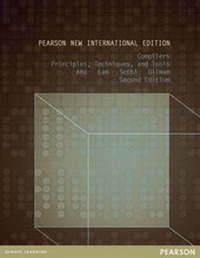
Compilers: Principles, Techniques, and Tools
Description

Compilers: Principles, Techniques and Tools, is known to professors, students, and developers worldwide as the "Dragon Book," . Every chapter has been revised to reflect developments in software engineering, programming languages, and computer architecture that have occurred since 1986, when the last edition published. The authors, recognising that few readers will ever go on to construct a compiler, retain their focus on the broader set of problems faced in software design and software development.
The full text downloaded to your computer
With eBooks you can:
- search for key concepts, words and phrases
- make highlights and notes as you study
- share your notes with friends
eBooks are downloaded to your computer and accessible either offline through the Bookshelf (available as a free download), available online and also via the iPad and Android apps.
Upon purchase, you'll gain instant access to this eBook.
Time limit
The eBooks products do not have an expiry date. You will continue to access your digital ebook products whilst you have your Bookshelf installed.
All prices
More details
Other editions
Additional editions
Content
1 Introduction
1.1 Language Processors
1.2 The Structure of a Compiler
1.3 The Evolution of Programming Languages
1.4 The Science of Building a Compiler
1.5 Applications of Compiler Technology
1.6 Programming Language Basics
1.7 Summary of Chapter 1
1.8 References for Chapter 1
2 A Simple Syntax-Directed Translator
2.1 Introduction
2.2 Syntax Definition
2.3 Syntax-Directed Translation
2.4 Parsing
2.5 A Translator for Simple Expressions
2.6 Lexical Analysis
2.7 Symbol Tables
2.8 Intermediate Code Generation
2.9 Summary of Chapter 2
3 Lexical Analysis
3.1 The Role of the Lexical Analyzer
3.2 Input Buffering
3.3 Specification of Tokens
3.4 Recognition of Tokens
3.5 The Lexical-Analyzer Generator Lex
3.6 Finite Automata
3.7 From Regular Expressions to Automata
3.8 Design of a Lexical-Analyzer Generator
3.9 Optimization of DFA-Based Pattern Matchers
3.10 Summary of Chapter 3
3.11 References for Chapter 3
4 Syntax Analysis
4.1 Introduction
4.2 Context-Free Grammars
4.3 Writing a Grammar
4.4 Top-Down Parsing
4.5 Bottom-Up Parsing
4.6 Introduction to LR Parsing: Simple LR
4.7 More Powerful LR Parsers
4.8 Using Ambiguous Grammars
4.9 Parser Generators
4.10 Summary of Chapter 4
4.11 References for Chapter 4
5 Syntax-Directed Translation
5.1 Syntax-Directed Definitions
5.2 Evaluation Orders for SDD's
5.3 Applications of Syntax-Directed Translation
5.4 Syntax-Directed Translation Schemes
5.5 Implementing L-Attributed SDD's
5.6 Summary of Chapter 5
5.7 References for Chapter 5
6 Intermediate-Code Generation
6.1 Variants of Syntax Trees
6.2 Three-Address Code
6.3 Types and Declarations
6.4 Translation of Expressions
6.5 Type Checking
6.6 Control Flow
6.7 Backpatching
6.8 Switch-Statements
6.9 Intermediate Code for Procedures
6.10 Summary of Chapter 6
6.11 References for Chapter 6
7 Run-Time Environments
7.1 Storage Organization
7.2 Stack Allocation of Space
7.3 Access to Nonlocal Data on the Stack
7.4 Heap Management
7.5 Introduction to Garbage Collection
7.6 Introduction to Trace-Based Collection
7.7 Short-Pause Garbage Collection
7.8 Advanced Topics in Garbage Collection
7.9 Summary of Chapter 7
7.10 References for Chapter 7
8 Code Generation
8.1 Issues in the Design of a Code Generator
8.2 The Target Language
8.3 Addresses in the Target Code
8.4 Basic Blocks and Flow Graphs
8.5 Optimization of Basic Blocks
8.6 A Simple Code Generator
8.7 Peephole Optimization
8.8 Register Allocation and Assignment
8.9 Instruction Selection by Tree Rewriting
8.10 Optimal Code Generation for Expressions
8.11 Dynamic Programming Code-Generation
8.12 Summary of Chapter 8
8.13 References for Chapter 8
9 Machine-Independent Optimizations
9.1 The Principal Sources of Optimization
9.2 Introduction to Data-Flow Analysis
9.3 Foundations of Data-Flow Analysis
9.4 Constant Propagation
9.5 Partial-Redundancy Elimination
9.6 Loops in Flow Graphs
9.7 Region-Based Analysis
9.8 Symbolic Analysis
9.9 Summary of Chapter 9
9.10 References for Chapter 9
<
