

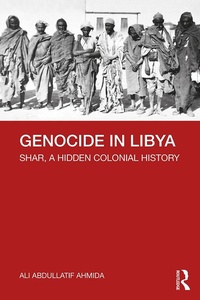
Genocide in Libya
Shar, a Hidden Colonial History
1st Edition
Published on 6. August 2020
234 pages
978-1-000-16930-0 (ISBN)
Description

Winner of the L. Carl Brown AIMS Book Prize in North African Studies 2022
This original research on the forgotten Libyan genocide specifically recovers the hidden history of the fascist Italian concentration camps (1929-1934) through the oral testimonies of Libyan survivors. This book links the Libyan genocide through cross-cultural and comparative readings to the colonial roots of the Holocaust and genocide studies.
Between 1929 and 1934, thousands of Libyans lost their lives, directly murdered and victim to Italian deportations and internments. They were forcibly removed from their homes, marched across vast tracks of deserts and mountains, and confined behind barbed wire in 16 concentration camps. It is a story that Libyans have recorded in their Arabic oral history and narratives while remaining hidden and unexplored in a systematic fashion, and never in the manner that has allowed us to comprehend and begin to understand the extent of their existence.
Based on the survivors' testimonies, which took over ten years of fieldwork and research to document, this new and original history of the genocide is a key resource for readers interested in genocide and Holocaust studies, colonial and postcolonial studies, and African and Middle Eastern studies.
This original research on the forgotten Libyan genocide specifically recovers the hidden history of the fascist Italian concentration camps (1929-1934) through the oral testimonies of Libyan survivors. This book links the Libyan genocide through cross-cultural and comparative readings to the colonial roots of the Holocaust and genocide studies.
Between 1929 and 1934, thousands of Libyans lost their lives, directly murdered and victim to Italian deportations and internments. They were forcibly removed from their homes, marched across vast tracks of deserts and mountains, and confined behind barbed wire in 16 concentration camps. It is a story that Libyans have recorded in their Arabic oral history and narratives while remaining hidden and unexplored in a systematic fashion, and never in the manner that has allowed us to comprehend and begin to understand the extent of their existence.
Based on the survivors' testimonies, which took over ten years of fieldwork and research to document, this new and original history of the genocide is a key resource for readers interested in genocide and Holocaust studies, colonial and postcolonial studies, and African and Middle Eastern studies.
Reviews / Votes
"This shattering study, based on remarkable scholarship, not only brings to light the long-suppressed genocidal policies of the Italian Fascist state but also leads to serious rethinking of how colonial history is framed and of the origins of the horrendous Nazi crimes. A powerful and revealing work." - Noam Chomsky Massachusetts Institute of Technology"Ali Abdullatif Ahmida's volume on the Libyan genocide is a masterpiece of oral history. This narrative recaptures the full texture of a great but little known atrocity. The prose and the poetry of folk memory as well as the crosscurrents of regional variation are gripping and unforgettable. A people's suffering have been truly honoured here." - James C. Scott, Yale University
"Based on oral, archival and published documentation, Ali Abdullatif Ahmida provides a damning condemnation of Italian colonialism in Libya and of the scholarship that so far has overlooked the scope and significance of the genocidal violence which enabled it. A genuine contribution to the literature on Libya, on colonialism and on studies of genocide." - Mahmood Mamdani, Columbia University
"The book is a masterpiece of scholarly skill and dedication. It tells the story that many Libyans have known and have not been able to tell the world. Combining archival research, ethnographic field work, penetrating theoretical insights, and personal testimony, Ahmida has written a book that I've longed to read but never imagined possible until now. I am deeply grateful for this book." - Khaled Mattawa, University of Michigan
"Ali Abdullatif Ahmida gives voice to the victims - and resisters - of a forgotten modern colonial genocide. Their recollections in poetry and prose provide eloquent, visceral testimony to suffering and, always, perseverance. Official narratives will no longer reign - and imperial statues should topple." - Joel Gordon, University of Arkansas
"He [Ahmida] succeeds in revealing a long-obscured and gruesome past through the reminiscences of his own elderly relatives, the disciplined excavation of suppressed official archives, the interpretation of long-recited epic poetry, and the creative deployment of comparative histories of genocide, war, and imperialism.[...] Ahmida's account is important, however, and should provoke consequential debates about the long, dark shadow of history in North Africa." - Lisa Anderson, Foreign Affairs https://www.foreignaffairs.com/reviews/capsule-review/2020-12-08/genocide-libya-shar-hidden-colonial-history
Author-interview podcast by Jeff Bachman, American University, New Books Network https://newbooksnetwork.com/genocide-in-libya "This shattering study, based on remarkable scholarship, not only brings to light the long-suppressed genocidal policies of the Italian Fascist state but also leads to serious rethinking of how colonial history is framed and of the origins of the horrendous Nazi crimes. A powerful and revealing work." - Noam Chomsky Massachusetts Institute of Technology
"Ali Abdullatif Ahmida's volume on the Libyan genocide is a masterpiece of oral history. This narrative recaptures the full texture of a great but little known atrocity. The prose and the poetry of folk memory as well as the crosscurrents of regional variation are gripping and unforgettable. A people's suffering have been truly honoured here." - James C. Scott, Yale University
"Based on oral, archival and published documentation, Ali Abdullatif Ahmida provides a damning condemnation of Italian colonialism in Libya and of the scholarship that so far has overlooked the scope and significance of the genocidal violence which enabled it. A genuine contribution to the literature on Libya, on colonialism and on studies of genocide." - Mahmood Mamdani, Columbia University
"The book is a masterpiece of scholarly skill and dedication. It tells the story that many Libyans have known and have not been able to tell the world. Combining archival research, ethnographic field work, penetrating theoretical insights, and personal testimony, Ahmida has written a book that I've longed to read but never imagined possible until now. I am deeply grateful for this book." - Khaled Mattawa, University of Michigan
"Ali Abdullatif Ahmida gives voice to the victims - and resisters - of a forgotten modern colonial genocide. Their recollections in poetry and prose provide eloquent, visceral testimony to suffering and, always, perseverance. Official narratives will no longer reign - and imperial statues should topple." - Joel Gordon, University of Arkansas
"He [Ahmida] succeeds in revealing a long-obscured and gruesome past through the reminiscences of his own elderly relatives, the disciplined excavation of suppressed official archives, the interpretation of long-recited epic poetry, and the creative deployment of comparative histories of genocide, war, and imperialism.[...] Ahmida's account is important, however, and should provoke consequential debates about the long, dark shadow of history in North Africa." - Lisa Anderson, Foreign Affairs https://www.foreignaffairs.com/reviews/capsule-review/2020-12-08/genocide-libya-shar-hidden-colonial-history
Author-interview podcast by Jeff Bachman, American University, New Books Network https://newbooksnetwork.com/genocide-in-libya
More details
Edition
1. Auflage
Language
English
Place of publication
London
United Kingdom
Publishing group
Taylor & Francis Ltd
Target group
College/higher education
Illustrations
5 Tables, black and white; 9 Halftones, black and white; 11 Illustrations, black and white
ISBN-13
978-1-000-16930-0 (9781000169300)
Copyright in bibliographic data and cover images is held by Nielsen Book Services Limited or by the publishers or by their respective licensors: all rights reserved.
Schweitzer Classification
Other editions
Additional editions
Book
08/2020
1st Edition
Routledge
€191.50
Shipment within 15-20 days
Book
08/2020
1st Edition
Routledge
€51.00
Shipment within 15-20 days
Person
Ali Abdullatif Ahmida is a professor and founding chair of the Department of Political Science, College of Arts and Sciences, at the University of New England, USA. His speciality is political theory, comparative politics, and historical sociology. His scholarship focuses on power, agency, and anti-colonial resistance in North Africa, especially modern Libya.
Content
Introduction: Thinking About Forgotten Libyan Genocide 1. Where are the Survivors: The Politics of Missing Archives and Fieldwork 2. Eurocentrism, Silence and Memory of Genocide 3. We Died Because of Shar, Evil My Son: Survivors' Stories of Death and Trauma in the Camps 4. After the Genocide: Hidden, and State Histories 5. Postscript: Rethinking Postcolonial State Formation, Crisis and Collapse in Libya Conclusion: Toward a Paradigm Shift
