

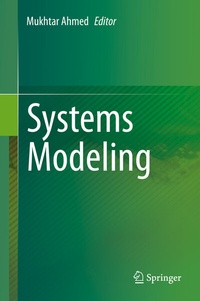
Systems Modeling
Description

Achieving food security and economic developmental objectives in the face of climate change and rapid population growth requires systems modelling approaches, for example in the design of sustainable agriculture farming systems. Such approaches increase our understanding of system responses to different soil and climatic conditions, and provide insights into the effects of various variable climate change scenarios, providing valuable information for decision-makers. Further, in the agricultural sector, systems modelling can help optimise crop management and adaptation measures to boost productivity under variable climatic conditions. Presenting key outcomes from crop models used in agricultural systems this book is a valuable resource for professionals interested in using modelling approaches to manage the growth and improve the quality of various crops.
More details
Other editions
Additional editions
Person
Mukhtar Ahmed's research focuses on the impact of climate change on crop ecology, crop physiology, cropping system and rain-fed ecosystem management. He has been involved in teaching and research since 2005. During his PhD and visit to Sydney University, Australia, he worked on the application of APSIM as a decision support tool, and rainfall forecasting using generalised additive models. He was awarded a young scientist fellowship by APCC South Korea. He also won a research productivity award from Pakistan Council of Science and Technology (PCST), and a Publons reviewer award in 2018 and 2019. He was part of the Regional Approaches for Climate Change (REACCH) project in the USA, which developed multi-model ensemble approaches to minimize the uncertainties. He is involved in the use of statistical and dynamic models as risk management tools to mitigate the challenges of climate change. His current research includes agroecosystems modelling, precision agriculture, modelling the nutrient use efficiency of legume-based cropping systems, forage agronomy and physiological responses to climate variability and its modelling. He is a Project co-leader in the Model Calibration Group of the Agricultural Model Intercomparison and Improvement Project (AGMIP) Wheat and Maize Evapotranspiration.
