

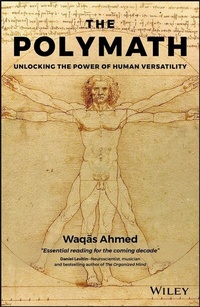
The Polymath
Unlocking the Power of Human Versatility
1st Edition
Published on 28. December 2018
336 pages
978-1-119-50852-6 (ISBN)
Description

Every human is born with multifarious potential. Why, then, do parents, schools and employers insist that we restrict our many talents and interests; that we 'specialise' in just one?
We've been sold a myth, that to 'specialise' is the only way to pursue truth, identity, or even a livelihood. Yet specialisation is nothing but an outdated system that fosters ignorance, exploitation and disillusionment and thwarts creativity, opportunity and progress.
Following a series of exchanges with the world's greatest historians, futurists, philosophers and scientists, Waqas Ahmed has weaved together a narrative of history and a vision for the future that seeks to disrupt this prevailing system of unwarranted 'hyper-specialisation.'
In The Polymath, Waqas shows us that there is another way of thinking and being. Through an approach that is both philosophical and practical, he sets out a cognitive journey towards reclaiming your innate polymathic state. Going further, he proposes nothing less than a cultural revolution in our education and professional structures, whereby everyone is encouraged to express themselves in multiple ways and fulfil their many-sided potential.
Not only does this enhance individual fulfilment, but in doing so, facilitates a conscious and creative society that is both highly motivated and well equipped to address the complexity of 21st century challenges.
More details
Other editions
Additional editions
Book
01/2019
1st Edition
Wiley
€25.50
Article not available at the moment
Person
Waqas has been called 'an emerging young Leonardo da Vinci' for his work in various fields.
He is currently Artistic Director at The Khalili Collections -- one of the world's great art collections -- and is simultaneously completing his postgraduate studies in Neuroscience at Kings College, London.
Previously, Waqas was Global Correspondent at FIRST Magazine, where his exclusive interviews included world leaders in government, business and academia. He was also the editor of Holy Makkah, the first-of-its-kind exploration of the sacred city, which received praise from UNESCO, the Commonwealth and the Vatican.
Born and raised in Britain, Waqas has since lived in several countries across Europe, Africa, the Middle East and South Asia. He has degrees in Economics (BSc, SOAS) and International Relations (MSc, LSE), but his real education came from the five years he spent travelling the world researching and writing The Polymath, his first book.
He is currently Artistic Director at The Khalili Collections -- one of the world's great art collections -- and is simultaneously completing his postgraduate studies in Neuroscience at Kings College, London.
Previously, Waqas was Global Correspondent at FIRST Magazine, where his exclusive interviews included world leaders in government, business and academia. He was also the editor of Holy Makkah, the first-of-its-kind exploration of the sacred city, which received praise from UNESCO, the Commonwealth and the Vatican.
Born and raised in Britain, Waqas has since lived in several countries across Europe, Africa, the Middle East and South Asia. He has degrees in Economics (BSc, SOAS) and International Relations (MSc, LSE), but his real education came from the five years he spent travelling the world researching and writing The Polymath, his first book.
Content
- Cover
- Title Page
- Copyright
- Contents
- Prologue: Marking 500 Years Since the Death of Leonardo da Vinci, the Archetypical Polymath
- Preface
- Chapter 1 Introduction
- Chapter 2 A Timeless People
- Patronage
- Laymen
- Women
- The 'Other'
- Encouragement
- The Myth of the 'Specialist'
- Chapter 3 Shapers of Our World
- Leaders
- King-makers
- Revolutionaries
- Intellectuals
- Educators
- Mystics
- Explorers
- Scientists
- Artists
- Entrepreneurs
- Humanitarians
- Chapter 4 The Cult of Specialisation
- The Evolution of Specialisation
- The Modern Education Crisis
- Employee Disillusionment
- Work-Life Imbalance
- Survival
- Twenty-First Century Complexity
- Machine Intelligence and the Relevance of Humans
- Chapter 5 Reconditioning the Mind
- Individuality
- Self-realisation
- Against the grain
- Self-sufficiency
- Human optimality
- Curiosity
- A natural trait
- Sources of knowledge
- The limitations of mind
- Multi-perspectivism
- Open-mindedness
- Knowledge for life
- Intelligence
- General vs multiple intelligences
- Critical thinking and common sense
- Social and emotional intelligence
- Versatility
- Switching lives
- Cognitive shifting and neuroplasticity
- Multifacetedness
- Diversifying experiences
- A thought-action mentality
- Managing time
- Creativity
- The creative force
- Hybridity
- Connections
- The art-science intersection
- Brain chemistry
- Unity
- The bigger picture
- Context
- Systems thinking
- Whole brain thinking
- Genuine specialists
- Navigating the information age
- Revolution
- Chapter 6 An Alternative System
- Society
- A community of minds
- True globalisation
- Art and culture
- Education
- Establishing the purpose of learning
- Encouraging creative autonomy
- Nurturing all-rounders
- A 'higher' education
- Self-learning
- A polymathic curriculum
- Occupation
- Revising the notion of 'work'
- The twenty-first-century career landscape
- Blessings from above?
- An opportunity
- Programming Our Future
- Chapter 7 Twenty-First-Century Polymaths
- A Vanguard of Disruptors
- Conversations with Living Polymaths
- Noam Chomsky
- F. Story Musgrave
- Seyyed Hossein Nasr
- Douglas Hofstadter
- Jao Tsung-I
- Benjamin Dunlap
- Hamlet Isakhanli
- Raymond Tallis
- Daniel Levitin
- Ashok Jahnavi Prasad
- Nathan Myhrvold
- Tim Ferriss
- Chapter 8 Owners of Our Future
- Polymathy through Time and Space
- Select Bibliography
- About the Author
- Acknowledgments
- Index
- Supplemental Images
- EULA
