

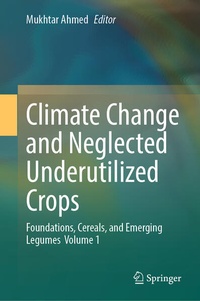
Climate Change and Neglected Underutilized Crops
Description

This book provides a comprehensive and forward-looking examination of neglected and underutilized crops (NUCs) as key enablers of climate-resilient and sustainable food systems. Addressing the urgent challenges posed by climate change, environmental degradation, and food insecurity, it brings together innovative strategies, practical case studies, and emerging technologies to demonstrate how NUCs can enhance agricultural resilience, diversify livelihoods, and support biodiversity conservation.
Integrating scientific evidence with indigenous and local knowledge, the chapters illustrate how NUCs contribute to efficient resource use, improved nutritional outcomes, and strengthened ecosystem services across diverse agroecological contexts. By combining theory with real-world applications, the book offers actionable insights for researchers, policymakers, development professionals, and practitioners seeking inclusive, low-input, and climate-adaptive solutions.
With its interdisciplinary perspective and global relevance, this volume positions neglected and underutilized crops not as marginal commodities, but as strategic assets for transforming agriculture and empowering smallholder farmers and rural communities worldwide.
More details
Other editions
Additional editions
Person
Dr. Mukhtar Ahmed has served for over two decades at Pir Mehr Ali Shah Arid Agriculture University, Rawalpindi, Pakistan, where he is widely recognized as a senior agronomist, climate change expert, and crop modeler. His research centers on climate variability, IoT-based agricultural applications, and the impacts of climate change on crop ecology, physiology, cropping systems, and rainfed farming.
He is an expert in process-based crop and agro-ecosystem modeling and remote sensing, employing tools such as APSIM, AquaCrop, DSSAT, DNDC, CropSyst, STICS, and EPIC to develop and evaluate climate-resilient agricultural strategies. Since 2020, Dr. Ahmed has been consistently listed among the world's top 2% of scientists, reflecting the global impact and citation strength of his research.
Dr. Ahmed has established extensive international collaborations with research institutions in Australia, Sweden, South Korea, South Africa, the West Indies, Thailand, the United Kingdom, and the United States. He has actively contributed to major global initiatives, including REACCH and AgMIP, and continues to play a key role in shaping global strategies for climate change adaptation and resilience in agriculture.
Content
Part I: Foundations and Context.- Role of neglected and underutilized crops in global food security, biodiversity, and climate resilience.-Challenges and opportunities in the production of neglected and underutilized crops under climate change.- Climate Change and the Water-Energy-Food (WEF) Nexus: Enhancing Resilience through Neglected and Underutilized Crops (NUCs).- Environmental protection and ecosystem services through cultivation of NUCs.- Part II: Cereal and Pseudocereal Crops: Climate Adaptation and Resource Nexus.- Quinoa (Chenopodium quinoa): Climate resilience, nutritional benefits, and water-energy efficiency.- Pendant Amaranth (Amaranthus caudatus): Sustainable production and role in soil health.- Canihua (Chenopodium pallidicaule): Adaptation to marginal environments and food security.- Fiindi (Digitaria exilis): Drought tolerance and water use efficiency.- Indian Barnyard Millet (Echinochloa frumentacea): Climate-smart cultivation and nutrient cycling.- Finger Millet (Eleusine coracana): Conservation agriculture and soil erosion control.- Teff (Eragrostis tef): Water resource management and climate adaptation.- Buckwheat (Fagopyrum esculentum): Agroecological benefits and pollinator support.- Proso Millet (Panicum miliaceum): Climate adaptation and carbon sequestration potential.- Little Millet (Panicum miliare): Enhancing food security through resilient cropping systems.- Kodo Millet (Paspalum scrobiculatum): Low-input farming and ecosystem services.- Foxtail Millet (Setaria italica): Linking nutrient use efficiency and climate resilience.- Triticale: A climate-resilient pseudocereal with food and energy nexus benefits.- Part III: Food Legume Crops: Nutrition, Water Efficiency, and Environmental Protection.- Ground Bean (Kerstingiella geocarpa): Enhancing soil fertility and food security.- Lablab Bean (Lablab purpureus): Agroforestry and water use efficiency.- Pearl Lupin (Lupinus mutabilis): Nitrogen fixation and climate adaptation.
