

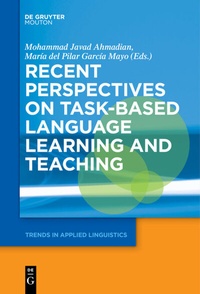
Recent Perspectives on Task-Based Language Learning and Teaching
Description

The last three decades have witnessed a growth of interest in research on tasks from various perspectives and numerous books and collections of articles have been published focusing on the notion of task and its utility in different contexts. Nevertheless, what is lacking is a multi-faceted examination of tasks from different important perspectives. This edited volume, with four sections of three chapters each, views tasks and Task-based Language Teaching (TBLT) from four distinct (but complementary) vantage points. In the first section, all chapters view tasks from a cognitive-interactionist angle with each addressing one key facet of either cognition or interaction (or both) in different contexts (CALL and EFL/ESL). Section two hinges on the idea that language teaching and learning is perhaps best conceptualized, understood, and investigated within a complexity theory framework which accounts for the dynamicity and interrelatedness of the variables involved. Viewing TBLT from a sociocultural lens is what connects the chapters included in the third section. Finally, the fourth section views TBLT from pedagogical and curricular vantage points.
More details
Other editions
Additional editions
Persons
Mohammad Ahmadian , University of Leeds, UK; María del Pilar García Mayo , University of the Basque Country, Spain.
Content
- Intro
- Table of contents
- Foreword: New Frontiers in Task-Based Language Teaching Research
- Introduction: Recent Trends in Task-Based Language Teaching and Learning
- I. Cognitive-Interactionist Perspective
- 1. Task Repetition Effects on CAF in EFL Child Task-Based Oral Interaction
- 2. Using Formulaic Sequences to Measure Task Performance: The Role of Working Memory
- 3. Examining Timing and Type of Learner- Modified Output in Relation to Perception in Face-to-Face and Synchronous Task-Based Chat
- II. Sociocultural Theory Perspective
- 4. Dynamic Strategic Interaction Scenarios: A Vygotskian Approach to Focusing on Meaning and Form
- 5. Effects of L3 Learner Proficiency and Task Types on Language Mediation: A Sociocultural Perspective
- 6. Task-Based Language Teaching and Concept-Based Instruction
- III. Complexity Theory Perspective
- 7. Dynamic Systems Theory and the Issue of Predictability in Task-Based Language: Some Implications for Research and Practice in TBLT
- 8. Using Tasks to Teach Formulaic Sequences: Interindividual and Intraindividual Variation
- 9. From Social Tasks to Language Development: Coping with Historicity and Subjectivity
- IV. Pedagogic and Educational Perspective
- 10. "If It Is All About Tasks, Will They Learn Anything?" Teachers' Perspectives on Grammar Instruction in the Task-Oriented Classroom
- 11. The Challenge of Thinking Task-Based Teaching from the Learners' Perspectives - Developing Teaching Competences Through an Action Research Approach to Teacher Education
- 12. Teaching with Tasks in Primary School EFL Classrooms in Vietnam
- Index
