

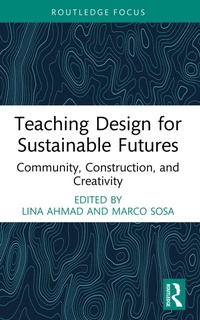
Teaching Design for Sustainable Futures
Community, Construction, and Creativity
1st Edition
Published on 22. January 2025
150 pages
978-1-040-33377-8 (ISBN)
Description

Teaching Design for Sustainable Futures: Community, Construction, and Creativity explores how creativity can be integrated into sustainability education within the built environment.
Through diverse international case studies, the book emphasizes the importance of creative approaches, community engagement, and hands-on learning, in addressing complex environmental challenges, fostering innovative design practices, and bridging the gap between theory and realworld application. Readers will gain valuable insights into the role of creativity in driving sustainable design education, with six case studies showcasing practical applications of creative methodologies to sustainability challenges. Key elements include community-driven projects, interdisciplinary collaboration, and experiential learning, all aimed at fostering student engagement and promoting innovative thinking. By integrating sustainability into real-world design challenges, the book equips educators and students with practical tools and frameworks for embedding creativity deeply into sustainability education, preparing them to address future environmental and societal issues.
This book is particularly valuable for educators, researchers, and practitioners in design and sustainability fields who seek to enhance their teaching and professional practices through creative approaches. Its interdisciplinary focus makes it an essential resource for those aiming to develop innovative solutions to environmental challenges, including design educators, sustainability professionals, and students committed to advancing sustainable development initiatives.
Through diverse international case studies, the book emphasizes the importance of creative approaches, community engagement, and hands-on learning, in addressing complex environmental challenges, fostering innovative design practices, and bridging the gap between theory and realworld application. Readers will gain valuable insights into the role of creativity in driving sustainable design education, with six case studies showcasing practical applications of creative methodologies to sustainability challenges. Key elements include community-driven projects, interdisciplinary collaboration, and experiential learning, all aimed at fostering student engagement and promoting innovative thinking. By integrating sustainability into real-world design challenges, the book equips educators and students with practical tools and frameworks for embedding creativity deeply into sustainability education, preparing them to address future environmental and societal issues.
This book is particularly valuable for educators, researchers, and practitioners in design and sustainability fields who seek to enhance their teaching and professional practices through creative approaches. Its interdisciplinary focus makes it an essential resource for those aiming to develop innovative solutions to environmental challenges, including design educators, sustainability professionals, and students committed to advancing sustainable development initiatives.
More details
Series
Edition
1. Auflage
Language
English
Place of publication
London
United Kingdom
Publishing group
Taylor & Francis Ltd
Target group
College/higher education
Professional and scholarly
Illustrations
2 Tables, black and white; 3 Line drawings, black and white; 14 Halftones, black and white; 17 Illustrations, black and white
File size
7,67 MB
ISBN-13
978-1-040-33377-8 (9781040333778)
Copyright in bibliographic data and cover images is held by Nielsen Book Services Limited or by the publishers or by their respective licensors: all rights reserved.
Schweitzer Classification
Other editions
Additional editions
Lina Ahmad | Marco Sosa
Teaching Design for Sustainable Futures
Community, Construction, and Creativity
Book
approx. 07/2026
1st Edition
Routledge
€30.00
Not yet published

Lina Ahmad | Marco Sosa
Teaching Design for Sustainable Futures
Community Construction and Creativity
Book
02/2025
New York NY
Unfortunately, price unknown
Available (delivery time upon request)
Lina Ahmad | Marco Sosa
Teaching Design for Sustainable Futures
Community, Construction, and Creativity
Book
01/2025
1st Edition
Routledge
€78.30
Shipment within 10-20 days
Persons
Lina Ahmad holds a Masters of Architecture from the Architectural Association School of Architecture, London, United Kingdom. Ahmad has over ten years of professional experience in the UAE, working across different sectors and project stages; ranging from design work and proposing alternate schemes to detailing and executing architectural packages and participating in projects' execution and site supervision. Ahmad works at Zayed University, Abu Dhabi, in the capacity of Associate Professor. Her work has been awarded and exhibited, including contributions for the National Pavilion UAE at the 14th Venice Architecture Biennale and the Smithsonian Folklife Festival in Washington DC in 2022. Lina is passionate about modern architectural heritage in the UAE, virtual reality digital immersion, and is an advocate of digital fabrication technology and its impact on regional higher education and the UAE's creative industry.
Marco Sosa is a RIBA-registered architect, Associate Professor of Interior Design, and the Assistant Dean of Research at Zayed University, Abu Dhabi. Sosa holds a BA(Hons) in architecture, a postgraduate diploma and Masters in Architecture and has over ten years of experience in the UK industry. In 2014, Marco was appointed part of the curatorial team as Head of Design, for the First National Pavilion for the UAE at the 14th Venice Architecture Biennale, the exhibition, titled "Lest We Forget; Structures of Memory in the UAE," chartered the impact of modernist architecture in the UAE. In 2022, Sosa also exhibited his research at the Smithsonian Institute's Folklife Festival. Sosa has designed exhibitions, published various academic papers, and presented at various conferences around the world. Marco Sosa is passionate about Modern Architectural Heritage in the UAE, virtual reality digital immersion, and the continuous development of design education in the UAE.
Marco Sosa is a RIBA-registered architect, Associate Professor of Interior Design, and the Assistant Dean of Research at Zayed University, Abu Dhabi. Sosa holds a BA(Hons) in architecture, a postgraduate diploma and Masters in Architecture and has over ten years of experience in the UK industry. In 2014, Marco was appointed part of the curatorial team as Head of Design, for the First National Pavilion for the UAE at the 14th Venice Architecture Biennale, the exhibition, titled "Lest We Forget; Structures of Memory in the UAE," chartered the impact of modernist architecture in the UAE. In 2022, Sosa also exhibited his research at the Smithsonian Institute's Folklife Festival. Sosa has designed exhibitions, published various academic papers, and presented at various conferences around the world. Marco Sosa is passionate about Modern Architectural Heritage in the UAE, virtual reality digital immersion, and the continuous development of design education in the UAE.
Content
List of figures
List of contributors
Acknowledgments
Preface: The Embrace of Change
Sandra Piesik
Introduction: Change as a Catalyst for Innovation
Marco Sosa and Lina Ahmad
Part One: Connecting Communities
1. Connecting Environment and Community: Teaching and Learning for a Sustainable Future
Rosamund Portus and Sara-Jayne Williams
2. Neighborhood: More-Than-Human Communities: How Can Design Work with Nature to Steward New Forms of Communities, Creating Spaces and Engagement where Species Meet?
Fabrizio Cocchiarella
Part Two: Applied Learning
3. Constructing Circularity: Seeking Alternative Pathways and Methods of Regeneration
Nicholas Brinen
4. Training Future Architects Toward Energy Poverty Challenges
Daniel Torrego Gomez, Carmen Sanchez-Guevara, Marta Gayoso Heredia, Miguel Nunez Peiro, Camila Andrea Luduena, Maria Del Mar Barbero Barrera, Miguel Angel Galvez Huertas, Gloria Maria Gomez Munoz, Luis Javier Sanchez Aparicio, Fco Javier Neila Gonzalez, Maria Emilia Roman Lopez, Manuel Rodriguez Perez and Roberto Gonzalez Lezcano
Part Three: Creative Responses
5. A Dialogue with Italo Calvino: A Reflection on the Making and Use of Physical Models in a Teaching Environment
Saidja Heynickx
6. The End of Human Dominance: Transformative University Courses
Jasmin Jossin, Myriel Milicevic, Ida-Maria Sommerfeldt and Annette Voigt
Conclusions: A Look Back, A Path Forward
Lina Ahmad and Marco Sosa
Index
List of contributors
Acknowledgments
Preface: The Embrace of Change
Sandra Piesik
Introduction: Change as a Catalyst for Innovation
Marco Sosa and Lina Ahmad
Part One: Connecting Communities
1. Connecting Environment and Community: Teaching and Learning for a Sustainable Future
Rosamund Portus and Sara-Jayne Williams
2. Neighborhood: More-Than-Human Communities: How Can Design Work with Nature to Steward New Forms of Communities, Creating Spaces and Engagement where Species Meet?
Fabrizio Cocchiarella
Part Two: Applied Learning
3. Constructing Circularity: Seeking Alternative Pathways and Methods of Regeneration
Nicholas Brinen
4. Training Future Architects Toward Energy Poverty Challenges
Daniel Torrego Gomez, Carmen Sanchez-Guevara, Marta Gayoso Heredia, Miguel Nunez Peiro, Camila Andrea Luduena, Maria Del Mar Barbero Barrera, Miguel Angel Galvez Huertas, Gloria Maria Gomez Munoz, Luis Javier Sanchez Aparicio, Fco Javier Neila Gonzalez, Maria Emilia Roman Lopez, Manuel Rodriguez Perez and Roberto Gonzalez Lezcano
Part Three: Creative Responses
5. A Dialogue with Italo Calvino: A Reflection on the Making and Use of Physical Models in a Teaching Environment
Saidja Heynickx
6. The End of Human Dominance: Transformative University Courses
Jasmin Jossin, Myriel Milicevic, Ida-Maria Sommerfeldt and Annette Voigt
Conclusions: A Look Back, A Path Forward
Lina Ahmad and Marco Sosa
Index
