

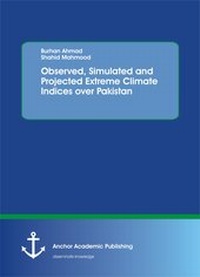
Observed, Simulated and Projected Extreme Climate Indices over Pakistan
1st Edition
Published in September 2017
102 pages
978-3-96067-672-0 (ISBN)
Description

This research explores observed, simulated, and projected extreme climate indices from a selection of different GCMs from CMIP5 ensemble for Pakistan at province level. The extreme indices for observed, simulated and projected climate are found and analysed on provincial basis over the country.
Pakistan has been facing shortages in both the power and water sector which are the lifelines of the country. Significant increases in the maximum and minimum temperatures over the country may affect such sectors drastically. Considerable increase in the frequency and intensity of extreme weather events, coupled with erratic monsoon rains may cause frequent and intense floods and droughts in the region. Rising temperatures resulting in enhanced heat and water-stressed conditions, particularly in arid and semi-arid regions, may lead to reduced agricultural productivity. This report shall bring added value to all stakeholders and policy makers in determining the hazards that extreme climate has brought in the past and may bring in the near future.
Pakistan has been facing shortages in both the power and water sector which are the lifelines of the country. Significant increases in the maximum and minimum temperatures over the country may affect such sectors drastically. Considerable increase in the frequency and intensity of extreme weather events, coupled with erratic monsoon rains may cause frequent and intense floods and droughts in the region. Rising temperatures resulting in enhanced heat and water-stressed conditions, particularly in arid and semi-arid regions, may lead to reduced agricultural productivity. This report shall bring added value to all stakeholders and policy makers in determining the hazards that extreme climate has brought in the past and may bring in the near future.
More details
Other editions
Additional editions
Burhan Ahmad | Shahid Mahmood
Observed, Simulated and Projected Extreme Climate Indices over Pakistan
Book
09/2017
1st Edition
Anchor Academic Publishing
€49.99
Shipment within 7-9 days
Content
- Observed, Simulated and Projected Extreme Climate Indices over Pakistan
- Executive Summary
- Table of Contents
- LIST OF FIGURES
- List of Tables
- 1 INTRODUCTION
- 1.1 DESCRIPTION OF REGIONAL CLIMATE IN PAKISTAN
- 1.2 CLIMATE INDUCED NATURAL DISASTERS IN PAKISTAN
- 1.3 LITERATURE REVIEW
- 2 DATA AND METHODOLOGY
- 2.1 DATA
- 2.1.1 PMD observed data
- 2.1.2 GCM simulated data
- 2.1.3 High resolution statistically downscaled GCM data
- 2.1.4 High resolution dynamically downscaled GCM data
- 2.2 METHODOLOGY
- 3 VERIFICATION OF GCMS AND RCMS
- 3.1 GCMS EMULATING OBSERVED CLIMATOLOGY
- 3.1.1 GCMs emulating observed climatology over Baluchistan
- 3.1.2 GCMs emulating observed climatology over GB-AJK
- 3.1.3 GCMs emulating observed climatology over KPK
- 3.1.4 GCMs emulating observed climatology over Punjab
- 3.1.5 GCMs emulating observed climatology over Sindh
- 3.2 STATISTICALLY DOWNSCALED GCMS EMULATING OBSERVED CLIMATOLOGY
- 3.2.1 Statistically downscaled GCMs emulating observed climatology over KPK
- 3.2.2 Statistically downscaled GCMs emulating observed climatology over Punjab
- 3.2.3 Statistically downscaled GCMs emulating observed climatology over Sindh
- 3.2.4 Statistically downscaled GCMs emulating observed climatology over Baluchistan
- 3.2.5 Statistically downscaled GCMs emulating observed climatology over GB-AJK
- 3.3 DYNAMICALLY DOWNSCALED GCMS EMULATING OBSERVED CLIMATOLOGY
- 3.3.1 Dynamically downscaled GCMs emulating observed climatology over GB AJK
- 3.3.2 Dynamically downscaled GCMs emulating observed climatology over KPK
- 3.3.3 Dynamically downscaled GCMs emulating observed climatology over Punjab
- 3.3.4 Dynamically downscaled GCMs emulating observed climatology over Sindh
- 3.3.5 Dynamically downscaled GCMs emulating observed climatology over Baluchistan
- 3.4 VERDICT OVER GCMS AND RCMS SUBSETS SELECTION
- 4 TYPES OF CLIMATE INDICES
- 4.1 PERCENTILE-BASED INDICES
- 4.2 ABSOLUTE INDICES
- 4.3 THRESHOLD INDICES
- 4.4 DURATION INDICES
- 4.5 SOCIETAL IMPACT INDICES
- 5 RESULTS AND DISCUSSION OF OBSERVED CLIMATE INDICES
- 5.1 OBSERVED INDICES OF GB-AJK
- 5.2 OBSERVED INDICES OF KPK
- 5.3 OBSERVED INDICES OF PUNJAB
- 5.4 OBSERVED INDICES OF SINDH
- 5.5 OBSERVED INDICES OF BALUCHISTAN
- 5.6 OBSERVED INDICES OF ALL PAKISTAN
- 6 GCMS AND RCMS SIMULATED INDICES
- 6.1 GCM ENSEMBLES SIMULATED INDICES
- 6.1.1 GCM ensembles simulated indices over GB-AJK
- 6.1.2 GCM ensembles simulated indices over KPK
- 6.1.3 GCM ensembles simulated indices over Punjab
- 6.1.4 GCM ensembles simulated indices over Sindh
- 6.1.5 GCM ensembles simulated indices over Baluchistan
- 6.2 STATISTICALLY DOWNSCALED GCMS (NEX-NASA) BASED CLIMATE INDICES
- 6.2.1 Nex-NASA based climate indices over GB-AJK
- 6.2.2 Nex-NASA based climate indices over KPK
- 6.2.3 Nex-NASA based climate indices over Punjab
- 6.2.4 Nex-NASA based climate indices over Sindh
- 6.2.5 Nex-NASA based climate indices over Baluchistan
- 6.3 DYNAMICALLY DOWNSCALED (CORDEX) BASED CLIMATE INDICES
- 6.3.1 CORDEX based climate indices over GB-AJK
- 6.3.2 CORDEX based climate indices over KPK
- 6.3.3 CORDEX based climate indices over Punjab
- 6.3.4 CORDEX based climate indices over Sindh
- 6.3.5 CORDEX based climate indices over Baluchistan
- 7 PROJECTED CLIMATE AND INDICES OVER THE PROVINCES OF PAKISTAN
- 7.1 NEXT 30 YEAR'S ENSEMBLE PROJECTED INDICES
- 7.1.1 Projected indices over Punjab
- 7.1.2 Projected indices over Baluchistan
- 7.1.3 Projected indices over GB-AJK
- 7.1.4 Projected indices over KPK
- 7.1.5 Projected indices over Sindh
- 7.2 PROJECTED CLIMATE OVER PAKISTAN BY 2050
- 7.2.1 Projected climate in GB-AJK
- 7.2.2 Projected climate in KPK
- 7.2.3 Projected climate in Punjab
- 7.2.4 Projected climate over Sindh
- 7.2.5 Projected climate in Baluchistan
- 7.2.6 Projected climate over All Pakistan
- 8 DISCUSSION
- 9 CONCLUSIONS
- 9.1 GB-AJK
- 9.2 KPK
- 9.3 PUNJAB
- 9.4 SINDH
- 9.5 BALUCHISTAN
- 10 REFERENCES
- 11 APPENDIX 1
- 11.1 OBSERVED CLIMATE INDICES (1960-2013)
- 11.2 ENSEMBLE MEAN GCMS SIMULATED CLIMATE INDICES (1970-2004)
- 11.3 NEX-NASA BASED CLIMATE INDICES (1970-2004)
- 11.4 CORDEX BASED CLIMATE INDICES (1970-2004)
- 11.5 NEX-NASA BASED PROJECTED CLIMATE INDICES (2016-2045)
Text Sample:
Chapter 3: VERIFICATION OF GCMS AND RCMS:
GCMs are known to have coarse horizontal resolutions with feedback and simulation biases. RCMs, on the other hand, are more sophisticated and have high horizontal resolutions, yet are not free from biases since both regional downscaling simulation and the parent driving GCM induce spatial and temporal biases (see e.g., Burhan et al., 2014). For the purpose of projecting robust climate change extremes and to have high confidence in the results, model selection is made by gauging ist ability to emulate observed climatology both for temperature and precipitation. Moreover, Taylor diagrams for GCMs and RCMs are made to obtain a concise statistical summary of how well the simulated climatology match the observed climatology in terms of their correlation, their root-mean-square difference and the ratio of their variances (Taylor, 2001).
3.1 GCMS EMULATING OBSERVED CLIMATOLOGY:
Area averaged mean annual maximum and minimum temperatures, and area averaged total annual rainfall is extracted from the 7 GCMs and put to comparison with the observed climatology of maximum and minimum temperature, and rainfall. Province based climatologies are constructed [.]. It is seen that in all provinces, maximum and minimum temperature climatologies are well represented by all GCMs except for Had-GEM2-AO (which is not in fact the actual Hadley center simulated model, but ist modeling center is NIMR, South Korea). In terms of precipitation, generally models tend to have high scatter, so the precipitation results for GCMs thereafter tend to remain in low confidence.
3.1.1 GCMs emulating observed climatology over Baluchistan:
In terms of rainfall in Baluchistan, quite haphazard climatological patterns displayed by different GCMs suggests that the coarse resolution of the GCMs are unable to resolve rugged terrain and barren climate of the province. However, CCSM4 to some extent is able to capture the peaks of annual rainfall cycle, yet with considerable wet biases yielding over-estimated results for the past climate of the province. In Baluchistan province, GCMs correlate well (95-99%), root-mean-square difference is small (less than 0.5 units), and the models lie within ?}0.5 standard deviation of the observed maximum and minimum temperatures. Nevertheless, no good correlation is seen to be established between any of the models representing precipitation statistics of the Baluchistan province [.].
3.1.2 GCMs emulating observed climatology over GB-AJK:
Both maximum and minimum temperatures in GB-AJK are well represented by simulated GCMs climatologies, however, with considerable cold biases. Moreover, GCMs tend to pick up the winter (DJFM) precipitation climatological cycle comparatively better than that in the summer (JJAS), yet, once again, with huge biases in the province. CCSM4 is seen as better representing the annual precipitation cycle, as compared to the rest of the models. In GB-AJK, all the models except HadGEM2-AO are giving 95-99% correlation with the observed in terms of maximum temperature. All the models except HadGEM2-AO are within the half root mean square difference, as well as within the +0.5 standard deviation of the observed maximum temperature. Same results hold for the minimum temperature in GB-AJK. In terms of precipitation, there is both large variability and error, along with weak correlations (some models even giving negative correlations) in the GB-AJK Province. CCSM4 gives a comparatively better estimation with 60% correlation, however, both the root-mean-square difference and the ratio of the variances tends to remain on the higher side.
3.1.3 GCMs emulating observed climatology over KPK:
Summer (JJAS) maximum and minimum temperature in KPK is better resolved as compared to that in the winter (DJFM) by GCMs. Precipitation climatologies represented by GCMs are poorly resolved for summer (JJAS) and partially better resolved in winters (DJFM), however, with both wet and dry biases. CCSM4, nevertheless, captures both winter (DJFM) and summer (JJAS) precipitation peaks, yet, once again suffers with dry biases. Both simulated maximum and minimum temperatures show good correlations (95- 99%), small root-mean-square differences, and within +0.5 standard deviation existence in the KPK province. There is however, the same exception for the HadGEM2-AO model which does not emulate the observed statistics at all. In terms of precipitation, the scatter of different GCMs is large with most of the models bearing poor Taylor Statistics. Nevertheless, CCSM4 model has a comparatively better correlation (nearly 80%), and within -0.5 standard deviation of the observed, yet the root-mean-square difference remains above 0.5 units in the KPK province.
3.1.4 GCMs emulating observed climatology over Punjab:
Unlike, Baluchistan and GB-AJK, Punjab is a plane area with vast gradually altering slopes, hence resolving terrain borne climatic features of this province is comparatively less challenging for the GCMs. However, Punjab at the same time is the province that receives maximum amount of monsoon rainfall in JAS, and hence monsoon dynamics play an important role in determining the precipitation patterns and cycles of this region. Owing to this probable limitation, the GCMs have not been able to successfully emulate precipitation peaks of monsoon in JAS. Nevertheless, CCSM4 is the only model in our analysis that has shown comparatively better annual cycle representation of precipitation with the observed in the Punjab province. The simulated maximum temperature in Punjab displays good correlations (90-99%) with the observed. The root-mean-square difference is small and the models tend to remain within an acceptable range of +0.5 standard deviation of the observed. This holds same for the minimum temperature. However, in terms of precipitation, only CCSM4 model displays high correlation (nearly 90%), a smaller root-mean-square difference and an acceptable standard deviation ratio with the observed climate of Punjab.
3.1.5 GCMs emulating observed climatology over Sindh:
Maximum and minimum temperature climatology of Sindh is resolved within justifiable ranges. However, similar to other provinces, precipitation cycle remains a challenge to get resolved with currently analyzed GCMs' monsoon dynamics. CCSM4 captures the monsoon rainfall peaks better than the remaining models. However, quite large over-estimation of precipitation in CCSM4 in monsoon rains is also observed. Simulated maximum temperature displays a high correlation (90-99%), and remains within an acceptable range of root-mean-square difference of the observed climate in Sindh province. In terms of minimum temperature, the correlation is even higher (models tending to be at 99% correlation). The ratio of the variances displayed by simulated minimum temperature is within ?}0.5 units and the root-mean-square difference remains less than 0.5 units for the minimum temperature. In terms of precipitation bcc-CSM1.1 model displays a comparatively better correlation (nearly 99%), however, at the same time it suffers with high magnitudes of variance ratio, and high magnitudes of root-mean-square differences in Sindh province. [.].
3.2 STATISTICALLY DOWNSCALED GCMS EMULATING OBSERVED CLIMATOLOGY:
Statistically downscaled Nex-NASA GCMs output is area averaged for maximum temperature, minimum temperature, and precipitation independently over all the provinces of the country. Climatologies are extracted and annual cycles are constructed to make a comparison with the observed [.]. Moreover, these climatologies are further put into Taylor Statistics to obtain high confidence over model selection [.]. The results show good climatological aspects of Nex- NASA product both in terms of temperature and precipitation.
3.2.1 Statistically downscaled GCMs emulating observed climatology over KPK:
Annual cycles of maximum and minimum temperatures, as well as of precipitation are well captured, however the temperatures suffer from cold biases whereas the precipitation suffers from dry biases. The winter peaks of precipitation are well overlapped with the observed, yet the summer peaks tend to remain below the observed, indicating under-estimation in the KPK province. All parameters (TMAX, TMIN, and precipitation) display satisfying values for Taylor Statistics in KPK province. The correlations are high in precipitation (95-99%) whereas they are higher in TMAX and TMIN (> 99%) in the KPK region. The root mean square is less than 0.5 units for all the analyzed models and the parameters for the KPK region. Moreover, the root mean square difference is small ( 99%) with the observed climate in Punjab. In terms of precipitation, the Nex-NASA product tends to display small ratios of variances (within ?}0.5 standard deviation of observed), small root mean square differences ( 95%) with the observed.
3.2.3 Statistically downscaled GCMs emulating observed climatology over Sindh:
Both maximum and minimum temperatures display a nice overlapping of the Nex- NASA and the observed data over the Sindh province. Climatology of precipitation is also well captured, however, small under-estimation of precipitation in monsoon season is observed. Nevertheless, the biases are systematic and may be removed by simple bias correction techniques for the purpose of impact studies. Temperature and precipitation climatologies of the Nex-NASA product are well coordinated with the observed, in terms of all three Taylor statistics over the Sindh region. The TMAX and TMIN have virtually no root mean square differences, and the ratios of the model variances to the observed is 1. Moreover the correlations are high (> 99%) in the region. In terms of precipitation, the root mean square differences are small (< 0.5 units). The ratios of variances to the observed tends to remain between 0.5 and 1. Furthermore, the correlations are high with values exceeding 99% for the region.
3.2.4 Statistically downscaled GCMs emulating observed climatology over Baluchistan:
The Nex-NASA product in Baluchistan is well overlapped over observed climatology of the maximum and the minimum temperature. The precipitation cycle, though well coordinated, suffers from under-estimation in the summer season. The TMAX and TMIN emulation of Nex-NASA product displays high correlations (99%) in the Baluchistan province. The root mean square difference is small (< 0.5 units), and the ratios of variances to the observed are between 0.5 and 1. In terms of precipitation, the correlations are high (80-95%), with ratios of variances to the observed ranging between 0.5 and 1 for the Baluchistan region.
Chapter 3: VERIFICATION OF GCMS AND RCMS:
GCMs are known to have coarse horizontal resolutions with feedback and simulation biases. RCMs, on the other hand, are more sophisticated and have high horizontal resolutions, yet are not free from biases since both regional downscaling simulation and the parent driving GCM induce spatial and temporal biases (see e.g., Burhan et al., 2014). For the purpose of projecting robust climate change extremes and to have high confidence in the results, model selection is made by gauging ist ability to emulate observed climatology both for temperature and precipitation. Moreover, Taylor diagrams for GCMs and RCMs are made to obtain a concise statistical summary of how well the simulated climatology match the observed climatology in terms of their correlation, their root-mean-square difference and the ratio of their variances (Taylor, 2001).
3.1 GCMS EMULATING OBSERVED CLIMATOLOGY:
Area averaged mean annual maximum and minimum temperatures, and area averaged total annual rainfall is extracted from the 7 GCMs and put to comparison with the observed climatology of maximum and minimum temperature, and rainfall. Province based climatologies are constructed [.]. It is seen that in all provinces, maximum and minimum temperature climatologies are well represented by all GCMs except for Had-GEM2-AO (which is not in fact the actual Hadley center simulated model, but ist modeling center is NIMR, South Korea). In terms of precipitation, generally models tend to have high scatter, so the precipitation results for GCMs thereafter tend to remain in low confidence.
3.1.1 GCMs emulating observed climatology over Baluchistan:
In terms of rainfall in Baluchistan, quite haphazard climatological patterns displayed by different GCMs suggests that the coarse resolution of the GCMs are unable to resolve rugged terrain and barren climate of the province. However, CCSM4 to some extent is able to capture the peaks of annual rainfall cycle, yet with considerable wet biases yielding over-estimated results for the past climate of the province. In Baluchistan province, GCMs correlate well (95-99%), root-mean-square difference is small (less than 0.5 units), and the models lie within ?}0.5 standard deviation of the observed maximum and minimum temperatures. Nevertheless, no good correlation is seen to be established between any of the models representing precipitation statistics of the Baluchistan province [.].
3.1.2 GCMs emulating observed climatology over GB-AJK:
Both maximum and minimum temperatures in GB-AJK are well represented by simulated GCMs climatologies, however, with considerable cold biases. Moreover, GCMs tend to pick up the winter (DJFM) precipitation climatological cycle comparatively better than that in the summer (JJAS), yet, once again, with huge biases in the province. CCSM4 is seen as better representing the annual precipitation cycle, as compared to the rest of the models. In GB-AJK, all the models except HadGEM2-AO are giving 95-99% correlation with the observed in terms of maximum temperature. All the models except HadGEM2-AO are within the half root mean square difference, as well as within the +0.5 standard deviation of the observed maximum temperature. Same results hold for the minimum temperature in GB-AJK. In terms of precipitation, there is both large variability and error, along with weak correlations (some models even giving negative correlations) in the GB-AJK Province. CCSM4 gives a comparatively better estimation with 60% correlation, however, both the root-mean-square difference and the ratio of the variances tends to remain on the higher side.
3.1.3 GCMs emulating observed climatology over KPK:
Summer (JJAS) maximum and minimum temperature in KPK is better resolved as compared to that in the winter (DJFM) by GCMs. Precipitation climatologies represented by GCMs are poorly resolved for summer (JJAS) and partially better resolved in winters (DJFM), however, with both wet and dry biases. CCSM4, nevertheless, captures both winter (DJFM) and summer (JJAS) precipitation peaks, yet, once again suffers with dry biases. Both simulated maximum and minimum temperatures show good correlations (95- 99%), small root-mean-square differences, and within +0.5 standard deviation existence in the KPK province. There is however, the same exception for the HadGEM2-AO model which does not emulate the observed statistics at all. In terms of precipitation, the scatter of different GCMs is large with most of the models bearing poor Taylor Statistics. Nevertheless, CCSM4 model has a comparatively better correlation (nearly 80%), and within -0.5 standard deviation of the observed, yet the root-mean-square difference remains above 0.5 units in the KPK province.
3.1.4 GCMs emulating observed climatology over Punjab:
Unlike, Baluchistan and GB-AJK, Punjab is a plane area with vast gradually altering slopes, hence resolving terrain borne climatic features of this province is comparatively less challenging for the GCMs. However, Punjab at the same time is the province that receives maximum amount of monsoon rainfall in JAS, and hence monsoon dynamics play an important role in determining the precipitation patterns and cycles of this region. Owing to this probable limitation, the GCMs have not been able to successfully emulate precipitation peaks of monsoon in JAS. Nevertheless, CCSM4 is the only model in our analysis that has shown comparatively better annual cycle representation of precipitation with the observed in the Punjab province. The simulated maximum temperature in Punjab displays good correlations (90-99%) with the observed. The root-mean-square difference is small and the models tend to remain within an acceptable range of +0.5 standard deviation of the observed. This holds same for the minimum temperature. However, in terms of precipitation, only CCSM4 model displays high correlation (nearly 90%), a smaller root-mean-square difference and an acceptable standard deviation ratio with the observed climate of Punjab.
3.1.5 GCMs emulating observed climatology over Sindh:
Maximum and minimum temperature climatology of Sindh is resolved within justifiable ranges. However, similar to other provinces, precipitation cycle remains a challenge to get resolved with currently analyzed GCMs' monsoon dynamics. CCSM4 captures the monsoon rainfall peaks better than the remaining models. However, quite large over-estimation of precipitation in CCSM4 in monsoon rains is also observed. Simulated maximum temperature displays a high correlation (90-99%), and remains within an acceptable range of root-mean-square difference of the observed climate in Sindh province. In terms of minimum temperature, the correlation is even higher (models tending to be at 99% correlation). The ratio of the variances displayed by simulated minimum temperature is within ?}0.5 units and the root-mean-square difference remains less than 0.5 units for the minimum temperature. In terms of precipitation bcc-CSM1.1 model displays a comparatively better correlation (nearly 99%), however, at the same time it suffers with high magnitudes of variance ratio, and high magnitudes of root-mean-square differences in Sindh province. [.].
3.2 STATISTICALLY DOWNSCALED GCMS EMULATING OBSERVED CLIMATOLOGY:
Statistically downscaled Nex-NASA GCMs output is area averaged for maximum temperature, minimum temperature, and precipitation independently over all the provinces of the country. Climatologies are extracted and annual cycles are constructed to make a comparison with the observed [.]. Moreover, these climatologies are further put into Taylor Statistics to obtain high confidence over model selection [.]. The results show good climatological aspects of Nex- NASA product both in terms of temperature and precipitation.
3.2.1 Statistically downscaled GCMs emulating observed climatology over KPK:
Annual cycles of maximum and minimum temperatures, as well as of precipitation are well captured, however the temperatures suffer from cold biases whereas the precipitation suffers from dry biases. The winter peaks of precipitation are well overlapped with the observed, yet the summer peaks tend to remain below the observed, indicating under-estimation in the KPK province. All parameters (TMAX, TMIN, and precipitation) display satisfying values for Taylor Statistics in KPK province. The correlations are high in precipitation (95-99%) whereas they are higher in TMAX and TMIN (> 99%) in the KPK region. The root mean square is less than 0.5 units for all the analyzed models and the parameters for the KPK region. Moreover, the root mean square difference is small ( 99%) with the observed climate in Punjab. In terms of precipitation, the Nex-NASA product tends to display small ratios of variances (within ?}0.5 standard deviation of observed), small root mean square differences ( 95%) with the observed.
3.2.3 Statistically downscaled GCMs emulating observed climatology over Sindh:
Both maximum and minimum temperatures display a nice overlapping of the Nex- NASA and the observed data over the Sindh province. Climatology of precipitation is also well captured, however, small under-estimation of precipitation in monsoon season is observed. Nevertheless, the biases are systematic and may be removed by simple bias correction techniques for the purpose of impact studies. Temperature and precipitation climatologies of the Nex-NASA product are well coordinated with the observed, in terms of all three Taylor statistics over the Sindh region. The TMAX and TMIN have virtually no root mean square differences, and the ratios of the model variances to the observed is 1. Moreover the correlations are high (> 99%) in the region. In terms of precipitation, the root mean square differences are small (< 0.5 units). The ratios of variances to the observed tends to remain between 0.5 and 1. Furthermore, the correlations are high with values exceeding 99% for the region.
3.2.4 Statistically downscaled GCMs emulating observed climatology over Baluchistan:
The Nex-NASA product in Baluchistan is well overlapped over observed climatology of the maximum and the minimum temperature. The precipitation cycle, though well coordinated, suffers from under-estimation in the summer season. The TMAX and TMIN emulation of Nex-NASA product displays high correlations (99%) in the Baluchistan province. The root mean square difference is small (< 0.5 units), and the ratios of variances to the observed are between 0.5 and 1. In terms of precipitation, the correlations are high (80-95%), with ratios of variances to the observed ranging between 0.5 and 1 for the Baluchistan region.
