

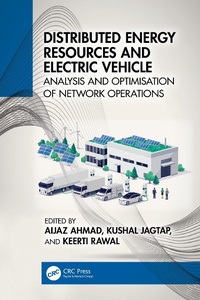
Distributed Energy Resources and Electric Vehicle
Analysis and Optimisation of Network Operations
1st Edition
Published on 29. February 2024
284 pages
978-1-003-83102-0 (ISBN)
Description

Explore the prospective developments in energy systems and transportation through an in-depth examination of Distributed Energy Resources and Electric Vehicle: Analysis and Optimisation of Network Operations . This innovative publication explores the realm of renewable energy, electric vehicles, and their in uence on network operations, offering valuable perspectives for readers from diverse disciplines.
This extensive publication delves into the complex interplay between distributed energy resources (DERs) and electric vehicles (EVs), as well as their incorporation into established power grids. The subject matter encompasses a diverse array of topics, encompassing the attributes and advantages of distributed energy resources (DERs) and electric vehicles (EVs), obstacles related to grid integration, efficient allocation of resources, and strategies pertaining to demand response. The book offers a comprehensive exploration of system analysis and optimisation techniques, emphasising the effective utilisation of distributed energy resources (DERs) and electric vehicles (EVs) in energy networks. It aims to equip readers with a robust comprehension of strategies to optimise the performance and potential of DERs and EVs in this context.
The book focuses on pioneering research and innovative solutions that are at the forefront of enhancing network operations. The authors demonstrate the novelty and applicability of their findings through the examination of real-world case studies and the utilisation of sophisticated mathematical models. This book serves as a highly valuable resource for individuals engaged in research, engineering, policy-making, and industry-related activities who are interested in effectively navigating the dynamic realm of energy systems and transportation. It equips them with the necessary knowledge and insights to make well-informed decisions that contribute to the attainment of a sustainable future.
This extensive publication delves into the complex interplay between distributed energy resources (DERs) and electric vehicles (EVs), as well as their incorporation into established power grids. The subject matter encompasses a diverse array of topics, encompassing the attributes and advantages of distributed energy resources (DERs) and electric vehicles (EVs), obstacles related to grid integration, efficient allocation of resources, and strategies pertaining to demand response. The book offers a comprehensive exploration of system analysis and optimisation techniques, emphasising the effective utilisation of distributed energy resources (DERs) and electric vehicles (EVs) in energy networks. It aims to equip readers with a robust comprehension of strategies to optimise the performance and potential of DERs and EVs in this context.
The book focuses on pioneering research and innovative solutions that are at the forefront of enhancing network operations. The authors demonstrate the novelty and applicability of their findings through the examination of real-world case studies and the utilisation of sophisticated mathematical models. This book serves as a highly valuable resource for individuals engaged in research, engineering, policy-making, and industry-related activities who are interested in effectively navigating the dynamic realm of energy systems and transportation. It equips them with the necessary knowledge and insights to make well-informed decisions that contribute to the attainment of a sustainable future.
More details
Edition
1. Auflage
Language
English
Place of publication
London
United Kingdom
Publishing group
Taylor & Francis Ebooks
Target group
College/higher education
Product notice
Reflowable
Illustrations
23 Tables, black and white; 179 Line drawings, black and white; 179 Illustrations, black and white
ISBN-13
978-1-003-83102-0 (9781003831020)
Copyright in bibliographic data and cover images is held by Nielsen Book Services Limited or by the publishers or by their respective licensors: all rights reserved.
Schweitzer Classification
Other editions
Additional editions
Aijaz Ahmad | Kushal Jagtap | Keerti Rawal
Distributed Energy Resources and Electric Vehicle
Analysis and Optimisation of Network Operations
Book
approx. 12/2025
1st Edition
CRC Press
€78.50
Not yet published
Aijaz Ahmad | Kushal Jagtap | Keerti Rawal
Distributed Energy Resources and Electric Vehicle
Analysis and Optimisation of Network Operations
Book
02/2024
1st Edition
CRC Press
€122.30
Shipment within 10-20 days
Persons
Aijaz Ahmad received his B.E. (Electrical Engg.) degree from National Institute of Technology (NIT), Srinagar, India in 1984, M.Tech. and Ph.D. from Indian Institute of Technology, New Delhi, India in 1991 and 1998 respectively. He was a Lecturer and later Assistant Professor in the Electrical Engineering Department, NIT, Srinagar. Since 2006 he has been working there as a Professor. In between he remained Head of the Department from 2012-2015. His main research interests are Power System Operation & Optimization, Power System Restructuring and Deregulation, Flexible AC Transmission, Energy System Planning & Auditing. Aijaz Ahmad is a Member IEEE, Fellow of Institution of Engineers (India), Life Member of Indian Society for Technical Education and Member Global Science and Technology Forum.
Kushal Jagtap received his B.E. (Electrical Electronics and Power Engg.) degree from the Government College of Engineering Aurangabad, Maharashtra, India in 2007 and, M.Tech. (Power System) and Ph.D. from Indian Institute of Technology Roorkee, India in 2012 and 2018, respectively. His PhD thesis title was "Loss Allocation in a Radial Distribution System with Distributed Generation." He joined as a PostDoc fellow under the project title "Impact of Electric Vehicles on Demand Side Management" at the Indian Institute of Technology Madras, India in 2018. He is presently working as an Assistant Professor in the Electrical Engineering Department, NIT Srinagar since 2018. His main research interests and major topics taught during the last three years are Loss Allocation, Distributed Generation, Power System Operation & Optimization, Power System Restructuring and Deregulation, and Flexible AC Transmission. Kushal Jagtap has been a Member IEEE for the last three years.
Keerti Rawal received her B.Tech (Electrical Engineering) from National Institute of Technology Jaipur, Rajasthan, India in 2013 and M.E. (Electrical Engineering) from Indian Institute of Science Bangalore in 2015. Keerti Rawal is currently pursuing PhD in Department of Electrical Engineering NIT Srinagar. She is exploring the impacts of integration of renewable energy resources and storage on the electrical grid, primarily focussing on electricity markets and energy analytics in her doctoral research. Her key interests are energy market, power system optimization, energy analytics, distributed optimization, energy forecasting, electric vehicles, control strategies, spinning reserves, and energy storage technologies. She has been a student member of IEEE for 4 years.
Kushal Jagtap received his B.E. (Electrical Electronics and Power Engg.) degree from the Government College of Engineering Aurangabad, Maharashtra, India in 2007 and, M.Tech. (Power System) and Ph.D. from Indian Institute of Technology Roorkee, India in 2012 and 2018, respectively. His PhD thesis title was "Loss Allocation in a Radial Distribution System with Distributed Generation." He joined as a PostDoc fellow under the project title "Impact of Electric Vehicles on Demand Side Management" at the Indian Institute of Technology Madras, India in 2018. He is presently working as an Assistant Professor in the Electrical Engineering Department, NIT Srinagar since 2018. His main research interests and major topics taught during the last three years are Loss Allocation, Distributed Generation, Power System Operation & Optimization, Power System Restructuring and Deregulation, and Flexible AC Transmission. Kushal Jagtap has been a Member IEEE for the last three years.
Keerti Rawal received her B.Tech (Electrical Engineering) from National Institute of Technology Jaipur, Rajasthan, India in 2013 and M.E. (Electrical Engineering) from Indian Institute of Science Bangalore in 2015. Keerti Rawal is currently pursuing PhD in Department of Electrical Engineering NIT Srinagar. She is exploring the impacts of integration of renewable energy resources and storage on the electrical grid, primarily focussing on electricity markets and energy analytics in her doctoral research. Her key interests are energy market, power system optimization, energy analytics, distributed optimization, energy forecasting, electric vehicles, control strategies, spinning reserves, and energy storage technologies. She has been a student member of IEEE for 4 years.
Content
1. Comprehensive Review of Grid Operation with Distributed Resources and Charging Stations for Electric Vehicles. 2. A Comprehensive Study of Life Cycle Assessments of Electric Vehicles and IC Engine Vehicles. 3. Electric Vehicle Charging Infrastructure: Optimal Location Problem Modeling Options and Solution Techniques. 4. Comprehensive Study on Electric Vehicles: Integration with Renewable Energy, Charging Infrastructure, Model Variations, Regulatory Frameworks, and Assessing Operational Efficiency of Hybrid Electric Vehicles. 5. Wireless Chargers for Electric Vehicles. 6. Review of Control Strategy with Different Loading Conditions Considering Demand Side Management. 7. Coordinated Operation of Electric Vehicle Charging Stations (EVCS) and Distributed Power Generation in Grids Using AI Technology. 8. Model Predictive Control of Grid-Connected Wind Energy Conversion System Using VSC-Based Shunt Controllers. 9. Model Predictive Control of Multiple Renewable Energy Sources in Hybrid DC Microgrids for Power Flow Control. 10. Analysis of an IUPQC Device Using Conventional PID and FOPID Controllers in a Wind Energy Conversion System. 11. Photovoltaic-Based Battery-Integrated E-Rickshaw with Regenerative Braking Using Real-Time Implementation. 12. Allocation of Distribution System Losses Considering the Effects of Load Power Factor and Distributed Generation.
