

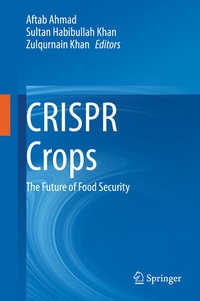
CRISPR Crops
Description

This book compiles the latest applications of the cutting-edge gene editing tool CRISPR/Cas in the area of crop improvement. It begins with an introduction to the technique and its application in crop plants. Next, it gives an updated overview of available delivery methods, design tools and resources in CRISPR/Cas. The book subsequently reviews the applications of CRISPR/Cas in connection with e.g. insect stress, disease stress, abiotic stress, nutritional and yield improvement in crop plants, etc. It also discusses the various regulatory, ethical and social aspects of the technique that must be kept in mind when designing experiments. In closing, the book summarizes the status quo and outlines future prospects for the tool in crop improvement and food security.
Given its scope, the book will especially benefit students and researchers in food science, biotechnology, agriculture and the plant sciences.
More details
Other editions
Additional editions
Persons
Dr Aftab Ahmad is currently working as Assistant Professor at Department of Biochemistry/ US-Pakistan Center for Advanced Studies in Agriculture and Food Security (CAS-AFS), University of Agriculture, Faisalabad (UAF), Pakistan. Dr Aftab's research interests include developing virus resistant and salt tolerant plants using CRISPR/Cas technology. He has published more than 15 research articles in international peer reviewed journals including Journal of Biomedical Sciences, Scientific Reports-Nature, PLOS One, Plant Molecular Biology Reporter, Molecules, Journal of Cereal Science, and Genetic Resources and Crop Evolution. Dr Aftab pursued his PhD and postdocs in Plant Molecular Biology from University of Shizuoka, Japan under Center of Excellence (COE, 21 st Century) program. Dr Aftab also served as visiting scientist in department of plant sciences, University of California, Davis, USA. Dr Aftab has been teaching biochemistry and molecular biology at UAF and his research focuses in the area of CRISPR/Cas based genome editing in plants.
Dr Sultan Habibullah Khan received his PhD from the University of Manchester-England in the field of Plant Sciences in 2004. Since his graduation from UK, Dr Khan has been working as a faculty at the University of Agriculture-Faisalabad (UAF). His postdoctoral experience also includes teaching and research at the University of California-Berkeley and Sultan Qaboos University-Oman. Currently, he is working as the Deputy Chief of Party at the US-Pakistan Center for Advanced Studies in Agriculture and Food Security (CAS-AFS) and a Tenured Associate Professor of Plant Molecular Sciences at the Centre of Agricultural Biochemistry and Biotechnology (CABB), UAF. For the last over 20 years, Dr Khan has been engaged in the fields of plant biotechnology, breeding, genetics and molecular biology. Dr Khan is recipient of national/international scholarships, Research Productivity Award (2014)and over 40 international publications with impact factor.
Dr Zulqurnain Khan is currently working as Assistant Professor in the Institute of Plant Breeding and Biotechnology (IPBB), Muhammad Nawaz Sharif University of Agriculture, Multan (MNSUAM), Pakistan. Dr Khan earned his PhD in Biotechnology from University of Agriculture, Faisalabad (UAF), Pakistan and his research focuses on CRISPR/Cas9 system for development of resistance against begomoviruses using model plants. He has published one book chapter, three review articles, and three research articles in international peer reviewed journals including Journal of Biomedical Sciences, Plant Molecular Biology Reporter and International Journal of Agriculture and Biology. Dr Khan also worked as visiting researcher with group of Professor Caixia Gao at the Institute of Genetics and Developmental Biology (IGDB), Chinese Academy of Sciences (CAS), Beijing, China.
