

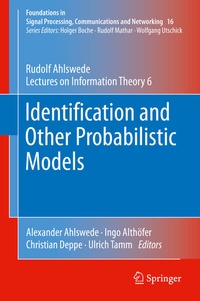
Identification and Other Probabilistic Models
Description

The sixth volume of Rudolf Ahlswede's lectures on Information Theory is focused on Identification Theory. In contrast to Shannon's classical coding scheme for the transmission of a message over a noisy channel, in the theory of identification the decoder is not really interested in what the received message is, but only in deciding whether a message, which is of special interest to him, has been sent or not. There are also algorithmic problems where it is not necessary to calculate the solution, but only to check whether a certain given answer is correct. Depending on the problem, this answer might be much easier to give than finding the solution. ``Easier'' in this context means using fewer resources like channel usage, computing time or storage space.
Ahlswede and Dueck's main result was that, in contrast to transmission problems, where the possible code sizes grow exponentially fast with block length, the size of identification codes will grow doubly exponentially fast. The theory of identification has now developed into a sophisticated mathematical discipline with many branches and facets, forming part of the Post Shannon theory in which Ahlswede was one of the leading experts. New discoveries in this theory are motivated both by concrete engineering problems and by explorations of the inherent properties of the mathematical structures.
Rudolf Ahlswede wrote:
It seems that the whole body of present day Information Theory will undergo serious revisions and some dramatic expansions. In this book we will open several directions of future research and start the mathematical description of communication models in great generality. For some specific problems we provide solutions or ideas for their solutions.
The lectures presented in this work, which consists of 10 volumes, are suitable for graduate students in Mathematics, and also for those working in Theoretical Computer Science, Physics, and Electrical Engineering with abackground in basic Mathematics. The lectures can be used as the basis for courses or to supplement courses in many ways. Ph.D. students will also find research problems, often with conjectures, that offer potential subjects for a thesis. More advanced researchers may find questions which form the basis of entire research programs.
The book also contains an afterword by Gunter Dueck.
Reviews / Votes
"The text is well organized and the book is easy to read and should be suitable for graduate students in mathematics, in theoretical computer science, physics and electrical engineering with basic knowledge in probability theory." (Jaak Henno, zbMATH 1477.94005, 2022)
More details
Other editions
Additional editions
Persons
Rudolf Ahlswede (1938 - 2010) studied Mathematics in Göttingen, and held postdoc positions in Erlangen, Germany and Ohio, USA. From 1977 on he was full Professor of Applied Mathematics at the University of Bielefeld. His work represents an essential contribution to information theory and networking. He developed and contributed to a number of central areas, including network coding, and theory of identification, while also advancing the fields of combinatorics and number theory. These efforts culminated in his research program "Development of a General Theory of Information Transfer". In recognition of his work, Rudolf Ahlswede received several awards for "Best Paper", as well as the distinguished "Shannon Award".
Content
Words and Introduction of the Editors.- Preface.- Part I Identification via Channels.- Part II A General Theory of Information Transfer.- Part III Identification, Mystery Numbers, or Common Randomness. - Part IV Identification for Sources, Identication Entropy, and Hypothesis Testing.- Part VI New Results in Identification Theory.- Part VII Supplement.- List of Notations. - Subject Index.- Author Index.
