

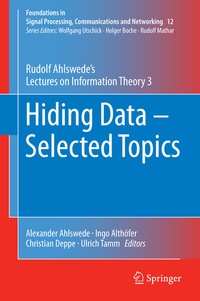
Hiding Data - Selected Topics
Description

Devoted to information security, this volume begins with a short course on cryptography, mainly based on lectures given by Rudolf Ahlswede at the University of Bielefeld in the mid 1990s. It was the second of his cycle of lectures on information theory which opened with an introductory course on basic coding theorems, as covered in Volume 1 of this series. In this third volume, Shannon's historical work on secrecy systems is detailed, followed by an introduction to an information-theoretic model of wiretap channels, and such important concepts as homophonic coding and authentication. Once the theoretical arguments have been presented, comprehensive technical details of AES are given. Furthermore, a short introduction to the history of public-key cryptology, RSA and El Gamal cryptosystems is provided, followed by a look at the basic theory of elliptic curves, and algorithms for efficient addition in elliptic curves. Lastly, the important topic of "oblivious transfer" is discussed, which is strongly connected to the privacy problem in communication. Today, the importance of this problem is rapidly increasing, and further research and practical realizations are greatly anticipated.
This is the third of several volumes serving as the collected documentation of Rudolf Ahlswede's lectures on information theory. Each volume includes comments from an invited well-known expert. In the supplement to the present volume, Rüdiger Reischuk contributes his insights.
Classical information processing concerns the main tasks of gaining knowledge and the storage, transmission and hiding of data. The first task is the prime goal of Statistics. For transmission and hiding data, Shannon developed an impressive mathematical theory called Information Theory, which he based on probabilistic models. The theory largely involves the concept of codes with small error probabilities in spite of noise in the transmission, which is modeled by channels. The lectures presentedin this work are suitable for graduate students in Mathematics, and also for those working in Theoretical Computer Science, Physics, and Electrical Engineering with a background in basic Mathematics. The lectures can be used as the basis for courses or to supplement courses in many ways. Ph.D. students will also find research problems, often with conjectures, that offer potential subjects for a thesis. More advanced researchers may find questions which form the basis of entire research programs.
More details
Other editions
Additional editions
Persons
Rudolf Ahlswede (1938 - 2010) studied Mathematics in Göttingen, and held postdoc positions in Erlangen, Germany and Ohio, USA. From 1977 on he was full Professor of Applied Mathematics at the University of Bielefeld. His work represents an essential contribution to information theory and networking. He developed and contributed to a number of central areas, including network coding, and theory of identification, while also advancing the fields of combinatorics and number theory. These efforts culminated in his research program "Development of a General Theory of Information Transfer". In recognition of his work, Rudolf Ahlswede received several awards for "Best Paper", as well as the distinguished "Shannon Award".
