

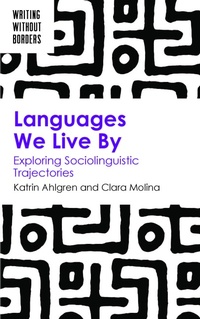
Languages We Live By
Exploring Sociolinguistic Trajectories
Published on 13. January 2026
110 pages
978-1-83668-164-9 (ISBN)
Description

This book invites readers to reflect on the impact of languages and create workshops to develop inclusive and responsible societies.
Language plays a crucial role in the creation and reproduction of social inequalities, but it can also be a key factor in their deconstruction and in the creation of a more multilingual and inclusive world. This book guides the reader through an exploration of creative and effective tools for examining the role that languages play in the life trajectories of speakers and how they can shape personal identities and promote social justice. The authors demonstrate the use of personal language family trees, language self-portraits and autobiographical narratives as means to explore sociolinguistic repertoires and language use in various contexts.
Written in an accessible, jargon-free way, with real-life examples from speakers of diverse geographical backgrounds, the book will be of interest both to scholars and students embarking on a study of the intersections between language and social justice, and to language teachers and learners who wish to explore the role that languages play in their lives.
This book is open access under a CC BY NC ND licence.
Language plays a crucial role in the creation and reproduction of social inequalities, but it can also be a key factor in their deconstruction and in the creation of a more multilingual and inclusive world. This book guides the reader through an exploration of creative and effective tools for examining the role that languages play in the life trajectories of speakers and how they can shape personal identities and promote social justice. The authors demonstrate the use of personal language family trees, language self-portraits and autobiographical narratives as means to explore sociolinguistic repertoires and language use in various contexts.
Written in an accessible, jargon-free way, with real-life examples from speakers of diverse geographical backgrounds, the book will be of interest both to scholars and students embarking on a study of the intersections between language and social justice, and to language teachers and learners who wish to explore the role that languages play in their lives.
This book is open access under a CC BY NC ND licence.
Reviews / Votes
Drawing on robust participatory action research and theoretically grounded in a biographical account of the linguistic repertoire, Ahlgren and Molina's work supports practitioners and students as they develop their critical sociolinguistic awareness. Readers will enjoy both the well-informed approach and the accessible practical workshop activities in this useful guide. * James Simpson, Hong Kong University of Science & Technology, Hong Kong * This work is hopefully a trailblazer of more to come in the form of resources for educators and ordinary people to bring multilingualism out of the closet. People need to make sense of their linguistic trajectories, transcend the hegemonic normative attitudes towards language, and develop tools to confront the linguistic prejudices they encounter. * Joan Pujolar Cos, Universitat Oberta de Catalunya, Spain * This concise resource invites readers into a set of action research journeys to explore multilingual biographies in order to enhance linguistic recognition. Educators will find these tools useful to kickstart reflections on the intersection of linguistic diversity and social justice. * Ingrid Piller, University of Hamburg, Germany *More details
Series
Language
English
Place of publication
Bristol
United Kingdom
Publishing group
Channel View Publications Ltd
Target group
College/higher education
Product notice
Reflowable
File size
2,27 MB
ISBN-13
978-1-83668-164-9 (9781836681649)
Copyright in bibliographic data and cover images is held by Nielsen Book Services Limited or by the publishers or by their respective licensors: all rights reserved.
Schweitzer Classification
Other editions
Additional editions
Book
01/2026
Multilingual Matters
€25.20
Shipment within 3-4 weeks
Persons
Katrin Ahlgren is an Associate Professor at Stockholm University, Sweden. Her research interests include linguistic and cultural diversity, language ideologies and social justice, multilingual creativity and arts-based research.
Clara Molina is an Associate Professor at Universidad Autonoma de Madrid, Spain. Her research interests include language variation and change, language education, and language in society with a focus on identity and language ideologies.
Clara Molina is an Associate Professor at Universidad Autonoma de Madrid, Spain. Her research interests include language variation and change, language education, and language in society with a focus on identity and language ideologies.
Content
Introduction
Chapter 1. What are Sociolinguistic Trajectories?
Chapter 2. Narrating Life, Self and Language
Chapter 3. Tools for Exploring Linguistic Biographies and Repertoires
Chapter 4. Workshop Proposal
Chapter 5. To Learn More
Appendix
Chapter 1. What are Sociolinguistic Trajectories?
Chapter 2. Narrating Life, Self and Language
Chapter 3. Tools for Exploring Linguistic Biographies and Repertoires
Chapter 4. Workshop Proposal
Chapter 5. To Learn More
Appendix
