

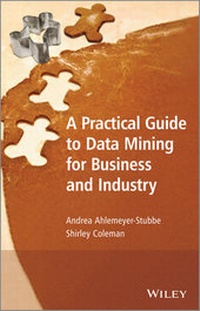
A Practical Guide to Data Mining for Business and Industry
Description

Reviews / Votes
"A Practical Guide to Data Mining for Business andIndustrygives practical tools on how information can be extractedfrom masses of data. The book is very well written, in aconversational tone that makes it enjoyable to read. The authorsare excellent communicators. If you are interested in learningabout data mining, learning to do a particular task in data mining,looking for a textbook to use in a data mining or analytics course,or have a problem or data analytic task you are working on, thisbook would be an excellent place to start." (Mathematical Association of America, 23 August 2014)More details
Other editions
Additional editions
Persons
Content
Glossary of terms xii
Part I Data Mining Concept 1
1 Introduction 3
1.1 Aims of the Book 3
1.2 Data Mining Context 5
1.2.1 Domain Knowledge 6
1.2.2 Words to Remember 7
1.2.3 Associated Concepts 7
1.3 Global Appeal 8
1.4 Example Datasets Used in This Book 8
1.5 Recipe Structure 11
1.6 Further Reading and Resources 13
2 Data Mining Definition 14
2.1 Types of Data Mining Questions 15
2.1.1 Population and Sample 15
2.1.2 Data Preparation 16
2.1.3 Supervised and Unsupervised Methods 16
2.1.4 Knowledge-Discovery Techniques 18
2.2 Data Mining Process 19
2.3 Business Task: Clarification of the Business Question behind the Problem 20
2.4 Data: Provision and Processing of the Required Data 21
2.4.1 Fixing the Analysis Period 22
2.4.2 Basic Unit of Interest 23
2.4.3 Target Variables 24
2.4.4 Input Variables/Explanatory Variables 24
2.5 Modelling: Analysis of the Data 25
2.6 Evaluation and Validation during the Analysis Stage 25
2.7 Application of Data Mining Results and Learning from the Experience 28
Part II Data Mining Practicalities 31
3 All about data 33
3.1 Some Basics 34
3.1.1 Data, Information, Knowledge and Wisdom 35
3.1.2 Sources and Quality of Data 36
3.1.3 Measurement Level and Types of Data 37
3.1.4 Measures of Magnitude and Dispersion 39
3.1.5 Data Distributions 41
3.2 Data Partition: Random Samples for Training, Testing and Validation 41
3.3 Types of Business Information Systems 44
3.3.1 Operational Systems Supporting Business Processes 44
3.3.2 Analysis-Based Information Systems 45
3.3.3 Importance of Information 45
3.4 Data Warehouses 47
3.4.1 Topic Orientation 47
3.4.2 Logical Integration and Homogenisation 48
3.4.3 Reference Period 48
3.4.4 Low Volatility 48
3.4.5 Using the Data Warehouse 49
3.5 Three Components of a Data Warehouse: DBMS, DB and DBCS 50
3.5.1 Database Management System (DBMS) 51
3.5.2 Database (DB) 51
3.5.3 Database Communication Systems (DBCS) 51
3.6 Data Marts 52
3.6.1 Regularly Filled Data Marts 53
3.6.2 Comparison between Data Marts and Data Warehouses 53
3.7 A Typical Example from the Online Marketing Area 54
3.8 Unique Data Marts 54
3.8.1 Permanent Data Marts 54
3.8.2 Data Marts Resulting from Complex Analysis 56
3.9 Data Mart: Do's and Don'ts 58
3.9.1 Do's and Don'ts for Processes 58
3.9.2 Do's and Don'ts for Handling 58
3.9.3 Do's and Don'ts for Coding/Programming 59
4 Data Preparation 60
4.1 Necessity of Data Preparation 61
4.2 From Small and Long to Short and Wide 61
4.3 Transformation of Variables 65
4.4 Missing Data and Imputation Strategies 66
4.5 Outliers 69
4.6 Dealing with the Vagaries of Data 70
4.6.1 Distributions 70
4.6.2 Tests for Normality 70
4.6.3 Data with Totally Different Scales 70
4.7 Adjusting the Data Distributions 71
4.7.1 Standardisation and Normalisation 71
4.7.2 Ranking 71
4.7.3 Box-Cox Transformation 71
4.8 Binning 72
4.8.1 Bucket Method 73
4.8.2 Analytical Binning for Nominal Variables 73
4.8.3 Quantiles 73
4.8.4 Binning in Practice 74
4.9 Timing Considerations 77
4.10 Operational Issues 77
5 Analytics 78
5.1 Introduction 79
5.2 Basis of Statistical Tests 80
5.2.1 Hypothesis Tests and P Values 80
5.2.2 Tolerance Intervals 82
5.2.3 Standard Errors and Confidence Intervals 83
5.3 Sampling 83
5.3.1 Methods 83
5.3.2 Sample Sizes 84
5.3.3 Sample Quality and Stability 84
5.4 Basic Statistics for Pre-analytics 85
5.4.1 Frequencies 85
5.4.2 Comparative Tests 88
5.4.3 Cross Tabulation and Contingency Tables 89
5.4.4 Correlations 90
5.4.5 Association Measures for Nominal Variables 91
5.4.6 Examples of Output from Comparative and Cross Tabulation Tests 92
5.5 Feature Selection/Reduction of Variables 96
5.5.1 Feature Reduction Using Domain Knowledge 96
5.5.2 Feature Selection Using Chi-Square 97
5.5.3 Principal Components Analysis and Factor Analysis 97
5.5.4 Canonical Correlation, PLS and SEM 98
5.5.5 Decision Trees 98
5.5.6 Random Forests 98
5.6 Time Series Analysis 99
6 Methods 102
6.1 Methods Overview 104
6.2 Supervised Learning 105
6.2.1 Introduction and Process Steps 105
6.2.2 Business Task 105
6.2.3 Provision and Processing of the Required Data 106
6.2.4 Analysis of the Data 107
6.2.5 Evaluation and Validation of the Results (during the Analysis) 108
6.2.6 Application of the Results 108
6.3 Multiple Linear Regression for use when Target is Continuous 109
6.3.1 Rationale of Multiple Linear Regression Modelling 109
6.3.2 Regression Coefficients 110
6.3.3 Assessment of the Quality of the Model 111
6.3.4 Example of Linear Regression in Practice 113
6.4 Regression when the Target is not Continuous 119
6.4.1 Logistic Regression 119
6.4.2 Example of Logistic Regression in Practice 121
6.4.3 Discriminant Analysis 126
6.4.4 Log-Linear Models and Poisson Regression 128
6.5 Decision Trees 129
6.5.1 Overview 129
6.5.2 Selection Procedures of the Relevant Input Variables 134
6.5.3 Splitting Criteria 134
6.5.4 Number of Splits (Branches of the Tree) 135
6.5.5 Symmetry/Asymmetry 135
6.5.6 Pruning 135
6.6 Neural Networks 137
6.7 Which Method Produces the Best Model? A Comparison of Regression, Decision Trees and Neural Networks 141
6.8 Unsupervised Learning 142
6.8.1 Introduction and Process Steps 142
6.8.2 Business Task 143
6.8.3 Provision and Processing of the Required Data 143
6.8.4 Analysis of the Data 145
6.8.5 Evaluation and Validation of the Results (during the Analysis) 147
6.8.6 Application of the Results 148
6.9 Cluster Analysis 148
6.9.1 Introduction 148
6.9.2 Hierarchical Cluster Analysis 149
6.9.3 K-Means Method of Cluster Analysis 150
6.9.4 Example of Cluster Analysis in Practice 151
6.10 Kohonen Networks and Self-Organising Maps 151
6.10.1 Description 151
6.10.2 Example of SOMs in Practice 152
6.11 Group Purchase Methods: Association and Sequence Analysis 155
6.11.1 Introduction 155
6.11.2 Analysis of the Data 157
6.11.3 Group Purchase Methods 158
6.11.4 Examples of Group Purchase Methods in Practice 158
7 Validation and Application 161
7.1 Introduction to Methods for Validation 161
7.2 Lift and Gain Charts 162
7.3 Model Stability 164
7.4 Sensitivity Analysis 167
7.5 Threshold Analytics and Confusion Matrix 169
7.6 ROC Curves 170
7.7 Cross-Validation and Robustness 171
7.8 Model Complexity 172
Part III Data Mining in Action 173
8 Marketing: Prediction 175
8.1 Recipe 1: Response Optimisation: to Find and Address the Right Number of Customers 176
8.2 Recipe 2: To Find the x% of Customers with the Highest Affinity to an Offer 186
8.3 Recipe 3: To Find the Right Number of Customers to Ignore 187
8.4 Recipe 4: To Find the x% of Customers with the Lowest Affinity to an Offer 190
8.5 Recipe 5: To Find the x% of Customers with the Highest Affinity to Buy 191
8.6 Recipe 6: To Find the x% of Customers with the Lowest Affinity to Buy 192
8.7 Recipe 7: To Find the x% of Customers with the Highest Affinity to a Single Purchase 193
8.8 Recipe 8: To Find the x% of Customers with the Highest Affinity to Sign a Long-Term Contract in Communication Areas 194
8.9 Recipe 9: To Find the x% of Customers with the Highest Affinity to Sign a Long-Term Contract in Insurance Areas 196
9 Intra-Customer Analysis 198
9.1 Recipe 10: To Find the Optimal Amount of Single Communication to Activate One Customer 199
9.2 Recipe 11: To Find the Optimal Communication Mix to Activate One Customer 200
9.3 Recipe 12: To Find and Describe Homogeneous Groups of Products 206
9.4 Recipe 13: To Find and Describe Groups of Customers with Homogeneous Usage 210
9.5 Recipe 14: To Predict the Order Size of Single Products or Product Groups 216
9.6 Recipe 15: Product Set Combination 217
9.7 Recipe 16: To Predict the Future Customer Lifetime Value of a Customer 219
10 Learning from a Small Testing Sample and Prediction 225
10.1 Recipe 17: To Predict Demographic Signs (Like Sex, Age, Education and Income) 225
10.2 Recipe 18: To Predict the Potential Customers of a Brand New Product or Service in Your Databases 236
10.3 Recipe 19: To Understand Operational Features and General Business Forecasting 241
11 Miscellaneous 244
11.1 Recipe 20: To Find Customers Who Will Potentially Churn 244
11.2 Recipe 21: Indirect Churn Based on a Discontinued Contract 249
11.3 Recipe 22: Social Media Target Group Descriptions 250
11.4 Recipe 23: Web Monitoring 254
11.5 Recipe 24: To Predict Who is Likely to Click on a Special Banner 258
12 Software and Tools: A Quick Guide 261
12.1 List of Requirements When Choosing a Data Mining Tool 261
12.2 Introduction to the Idea of Fully Automated Modelling (FAM) 265
12.2.1 Predictive Behavioural Targeting 265
12.2.2 Fully Automatic Predictive Targeting and Modelling Real-Time Online Behaviour 266
12.3 FAM Function 266
12.4 FAM Architecture 267
12.5 FAM Data Flows and Databases 268
12.6 FAM Modelling Aspects 269
12.7 FAM Challenges and Critical Success Factors 270
12.8 FAM Summary 270
13 Overviews 271
13.1 To Make Use of Official Statistics 272
13.2 How to Use Simple Maths to Make an Impression 272
13.2.1 Approximations 272
13.2.2 Absolute and Relative Values 273
13.2.3 % Change 273
13.2.4 Values in Context 273
13.2.5 Confidence Intervals 274
13.2.6 Rounding 274
13.2.7 Tables 274
13.2.8 Figures 274
13.3 Differences between Statistical Analysis and Data Mining 275
13.3.1 Assumptions 275
13.3.2 Values Missing Because 'Nothing Happened' 275
13.3.3 Sample Sizes 276
13.3.4 Goodness-of-Fit Tests 276
13.3.5 Model Complexity 277
13.4 How to Use Data Mining in Different Industries 277
13.5 Future Views 283
Bibliography 285
Index 296
Glossary of terms
- Accuracy
- | A measurement of the match (degree of closeness) between predictions and real values.
- Address
- | A unique identifier for a computer or site online, usually a URL for a website or marked with an @ for an email address. Literally, it is how your computer finds a location on the information highway.
- Advertising
- | Paid form of a non-personal communication by industry, business firms, non-profit organisations or individuals delivered through the various media. Advertising is persuasive and informational and is designed to influence the purchasing behaviour and thought patterns of the audience. Advertising may be used in combination with sales promotions, personal selling tactics or publicity. This also includes promotion of a product, service or message by an identified sponsor using paid-for media.
- Aggregation
- | Form of segmentation that assumes most consumers are alike.
- Algorithm
- | The process a search engine applies to web pages so it can accurately produce a list of results based on a search term. Search engines regularly change their algorithms to improve the quality of the search results. Hence, search engine optimisation tends to require constant research and monitoring.
- Analytics
- | A feature that allows you to understand (learn more) a wide range of activity related to your website, your online marketing activities and direct marketing activities. Using analytics provides you with information to help optimise your campaigns, ad groups and keywords, as well as your other online marketing activities, to best meet your business goals.
- API
- | Application Programming Interface, often used to exchange data, for example, with social networks.
- Attention
- | A momentary attraction to a stimulus, something someone senses via sight, sound, touch, smell or taste. Attention is the starting point of the perceptual process in that attention of a stimulus will either cause someone to decide to make sense of it or reject it.
- B2B
- | Business To Business – Business conducted between companies rather than between a company and individual consumers. For example, a firm that makes parts that are sold directly to an automobile manufacturer.
- B2C
- | Business To Consumer – Business conducted between companies and individual consumers rather than between two companies. A retailer such as Tesco or the greengrocer next door is an example of a B2C company.
- Banner
- | Banners are the 468-by-60 pixels ad space on commercial websites that are usually ‘hotlinked’ to the advertiser’s site.
- Banner ad
- | Form of Internet promotion featuring information or special offers for products and services. These small space ‘banners’ are interactive: when clicked, they open another website where a sale can be finalized. The hosting website of the banner ad often earns money each time someone clicks on the banner ad.
- Base period
- | Period of time applicable to the learning data.
- Behavioural targeting
- | Practice of targeting and ads to groups of people who exhibit similarities not only in their location, gender or age but also in how they act and react in their online environment: tracking areas they frequently visit or subscribe to or subjects or content or shopping categories for which they have registered. Google uses behavioural targeting to direct ads to people based on the sites they have visited.
- Benefit
- | A desirable attribute of goods or services, which customers perceive that they will get from purchasing and consuming or using them. Whereas vendors sell features (‘a high-speed 1cm drill bit with tungsten-carbide tip’), buyers seek the benefit (a 1cm hole).
- Bias
- | The expected value differs from the true value. Bias can occur when measurements are not calibrated properly or when subjective opinions are accepted without checking them.
- Big data
- | Is a relative term used to describe data that is so large in terms of volume, variety of structure and velocity of capture that it cannot be stored and analysed using standard equipment.
- Blog
- | A blog is an online journal or ‘log’ of any given subject. Blogs are easy to update, manage and syndicate, powered by individuals and/or corporations and enable users to comment on postings.
- BOGOF
- | Buy One, Get One Free. Promotional practice where on the purchase of one item, another one is given free.
- Boston matrix
- | A product portfolio evaluation tool developed by the Boston Consulting Group. The matrix categorises products into one of four classifications based on market growth and market share.
-
The four classifications are as follows:
- Cash cow – low growth, high market share
- Star – high growth, high market share
- Problem child – high growth, low market share
- Dog – low growth, low market share
- Brand
- | A unique design, sign, symbol, words or a combination of these, employed in creating an image that identifies a product and differentiates or positions it from competitors. Over time, this image becomes associated with a level of credibility, quality and satisfaction in the consumers’ minds. Thus, brands stand for certain benefits and value. Legal name for a brand is trademark, and when it identifies or represents a firm, it is called a brand name. (Also see Differentiation and Positioning.)
- Bundling
- | Combining products as a package, often to introduce other products or services to the customer. For example, AT&T offers discounts for customers by combining 2 or more of the following services: cable television, home phone service, wireless phone service and Internet service.
- Buttons
- | Objects that, when clicked once, cause something to happen.
- Buying behaviour
- | The process that buyers go through when deciding whether or not to purchase goods or services. Buying behaviour can be influenced by a variety of external factors and motivations, including marketing activities.
- Campaign
- | Defines the daily budget, language, geographic targeting and location of where the ads are displayed.
- Cash cow
- | See ‘Boston matrix’.
- Category management
- | Products are grouped and managed by strategic business unit categories. These are defined by how consumers view goods rather than by how they look to the seller, for example, confectionery could be part of either a ‘food’ or ‘gifts’ category and marketed depending on the category into which it is grouped.
- Channels
- | The methods used by a company to communicate and interact with its customers, like direct mail, telephone and email.
- Characteristic
- | Distinguishing feature or attribute of an item, person or phenomenon that usually falls into either a physical, functional or operational category.
- Churn rate
- | Rate of customers lost (stopped using the service) over a specific period of time, often over the course of a year. Used to compare against new customers gained.
- Click
- | The opportunity for a visitor to be transferred to a location by clicking on an ad, as recorded by the server.
- Clusters
- | Customer profiles based on lifestyle, demographic, shopping behaviour or appetite for fashion. For example, ready-to-eat meals may be heavily influenced by the ethnic make-up of a store’s shoppers, while beer, wine and spirits categories in the same store may be influenced predominantly by the shopper’s income level and education.
- Code
- | Anything written in a language intended for computers to interpret.
- Competitions
- | Sales promotions that allow the consumer the possibility of winning a prize.
- Competitors
- | Companies that sell products or services in the same marketplace as one another.
- Consumer
- | A purchaser of goods or services at retail, or an end user not necessarily a purchaser, in the distribution chain of goods or services (gift recipient).
- Contextual advertising
- | Advertising that is targeted to a web page based on the page’s content, keywords or category. Ads in most content networks are targeted contextually.
- Cookie
- | A file on your computer that records information such as where you have been on the World Wide Web. The browser stores this information which allows a site to remember the browser in future transactions or requests. Since the web’s protocol has no way to remember requests, cookies read and record a user’s browser type and IP address and store this information on the user’s own computer. The cookie can be read only by a server in the domain that stored it. Visitors can accept or deny cookies by changing a setting in their browser preferences.
- Coupon
- | A ticket that can be exchanged for a discount or rebate when procuring an item.
- CRM
- | Customer Relationship Management – Broad term that covers...
