

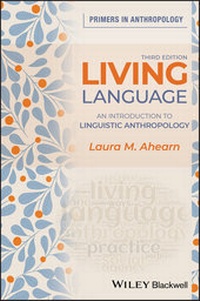
Living Language
Description

A new, fully revised edition of this bestselling textbook in linguistic anthropology, updated to address the impacts of globalization, pandemics, and other contemporary socio-economic issues in the study of language
Living Language: An Introduction to Linguistic Anthropology has introduced thousands of students to the engaging and compelling field of linguistic anthropology. Now in a new, fully updated and revised third edition, this bestselling textbook provides a student-friendly exploration of language as a social and cultural practice. Covering both theory and real-world practice, this clear and highly accessible textbook examines the relationship between language and social context while highlighting the advantages of an ethnographic approach to the study of language. The third edition includes a timely new chapter that investigates how technologies such as social media and online meetings have changed language. The new edition also considers the impact of the COVID-19 pandemic on linguistic practices, ensuring that this text will be a valuable resource for students for years to come. This insightful text:
- Offers an engaging introduction to the field of linguistic anthropology
- Features all-new material covering contemporary technologies and global developments
- Explains how language use is studied as a form of social action
- Covers nonverbal and multimodal communication, language acquisition and socialization, the relationship between language and thought, and language endangerment and revitalization
- Explores various forms of linguistic and social communities, and discusses social and linguistic differentiation and inequality along racial, ethnic, and gender dimensions
Requiring no prior knowledge in linguistics or anthropology, Living Language: An Introduction to Linguistic Anthropology, Third Edition, is the perfect textbook for undergraduate and graduate courses in introductory linguistic anthropology as well as related courses in sociolinguistics, sociology, and communication.
More details
Other editions
Additional editions
Person
Laura M. Ahearn is a linguistic and cultural anthropologist who has conducted research in Nepal on agency, language, and changing marriage practices. Formerly a tenured professor at Rutgers University, she is currently a Senior Learning Advisor at Social Impact, a global development management consulting firm, where she studies and supports the implementation of USAID's Digital Development Strategy. She is the author of Invitations to Love: Literacy, Love Letters, and Social Change in Nepal.
Content
List of Figures ix
List of Tables xi
Preface xiii
Acknowledgments xix
Part I Language: Some Basic Questions 1
1 The Socially Charged Life of Language 3
So, What Do You Need to Know in Order to "Know" a Language? 9
Examples of Linguistic Diversity 13
Examples of Diversity in Research Topics in Linguistic Anthropology 17
Keith Basso 18
Marjorie Harness Goodwin 18
Bonnie Urciuoli 19
Alessandro Duranti 20
Kathryn A. Woolard 20
James M. Wilce 21
Key Terms in Linguistic Anthropology 21
Multifunctionality 22
Language Ideologies 24
Practice 26
Indexicality 29
The Inseparability of Language, Culture, and Social Relations 33
2 Gestures, Sign Languages, and Multimodality 35
Bakhtin's Double-Voiced Discourse 37
Goffman's Participation Framework and Production Format 38
Speech and the Analysis of Conversation 39
Gestures and Other Forms of Embodied Communication 42
Sign Languages 47
Poetry, Whistled Languages, Song, and Images 50
3 The Research Process in Linguistic Anthropology 54
What Kinds of Research Questions Do Linguistic Anthropologists Formulate? 55
What Kinds of Data Do Linguistic Anthropologists Collect, and with What Methods? 57
Participant Observation 58
Interviews 58
Surveys and Questionnaires 60
Naturally Occurring Conversations 60
Experimental Methods 62
Matched Guise Tests 63
Written Texts 64
How Do Linguistic Anthropologists Analyze Their Data? 64
What Products Do Linguistic Anthropologists Generate from their Research? 67
What Sorts of Ethical Issues Do Linguistic Anthropologists Face? 68
4 Language Acquisition and Socialization 72
Language Acquisition and the Socialization Process 74
Gaps in the "Language Gap" Approach 78
Language Socialization in Bilingual or Multilingual Contexts 81
Language Socialization throughout the Lifespan 84
Conclusion 88
5 Language, Thought, and Culture 90
A Hundred Years of Linguistic Relativity 91
The Sapir-Whorf Hypothesis 94
Investigating the Effects of Language on Thought 97
Language-in-General 98
Linguistic Structures 102
Color 106
Space 108
Time 110
Language Use 111
Conclusion 117
Part II Global Communities of Speakers, Hearers, Readers, and Writers 121
6 Global Communities of Multilingual Language Users 123
Defining "Speech Community" 124
Size and Location of the Community 124
What Is Shared by the Members of a Speech Community? 125
The Type of Interactions that Speech Community Members Have 125
Alternatives to the Concept of "Speech Community" 129
Speech Areas 129
Speech Networks 130
Communities of Practice 132
Multilingual and Transnational Linguistic Practices 136
Diglossia, Code-Mixing, and Code-Switching 144
Diglossia 145
Code-Switching 146
Code-Mixing 148
Heteroglossia 151
Conclusion 152
7 Literacy Practices 153
Literacy Events vs. Literacy Practices 155
"Autonomous" vs. "Ideological" Approaches to Studying Literacy 156
Some Examples of Situated Literacy Research 158
Preschool Literacy Practices in the Southeastern United States 158
Pema Kumari's letter 162
Love-letter Writing in Nepal 164
Instant Messaging: More like Speech or Writing? 166
8 Online Communities and Internet Linguistic Practices 170
Online Literacy Practices 171
Capitalization, Punctuation, and Emojis 172
Online Communities, Relationships, and Social Media 175
Who's Zoomin' Who? 177
Online Avatars 179
So Close and yet so Far 183
Conclusion 185
9 Performance, Performativity, and the Constitution of Communities 186
Performance Defined in Opposition to Competence 188
Performativity 189
Performance as a Display of Verbal Artistry 197
Ethnographies of Performance and Performativity 200
VIII Contents Part III Language, Power, and Social Differentiation 211
10 Language and Gender 213
What is Gender, and How Does it Relate to Language? 215
Do Men and Women Speak Alike or Differently? 221
Do Women and Men of All Ages and All Ethnic, Racial, and Cultural Backgrounds Share the Same Gendered Differences in Their Language Use? 233
Some Thoughts on Myths and Realities 237
11 Language, Race, and Ethnicity 240
Defining Race and Ethnicity 241
The Rule-Governed Nature of African American English 246
Invariant or Habitual "Be" 248
Copula Deletion 249
Double Negatives 250
The Reduction of Final Consonants 251
Pronouncing the Word "Ask" as "Aks" 252
Racist Language and Racism in Language 253
Language and Racial/Ethnic Identities 258
Conclusion 261
12 Language Endangerment and Revitalization 262
Enumerating the Crisis: How Many Endangered Languages are There? 265
What Dies When a Language Dies? 270
Why Do Languages Die? 276
Can Endangered Languages Be Saved? 278
Conclusion 280
13 Conclusion: Language, Power, and Agency 281
What Is Power? 283
Hegemony 284
Foucault's Power Relations and Discourse 285
Practice Theory and Power 287
Agency 298
The Grammatical Encoding of Agency 302
Talk About Agency: Meta-Agentive Discourse 305
Power and Agency In/through/by/of Language 310
Notes 313
References 328
Index 364
Preface
Language, especially as it is used in real-life social contexts, can be absolutely fascinating but rather challenging to study. Linguistic anthropology as a discipline offers a set of concepts and tools for undertaking this challenge. My goal in this book is to provide an accessible introduction to the main principles and approaches of linguistic anthropology without overly simplifying the complex contributions of scholars in the field. To the degree that this book succeeds in accomplishing this goal, it will be useful not just to graduate and undergraduate students studying linguistic anthropology for the first time (to whom I very much hope to communicate my enthusiasm for the field) but also to all sorts of other readers who might, for various reasons, be interested in "living language." These readers might include, for example, cultural anthropologists, practicing anthropologists, sociologists, or political scientists who have never looked closely at language in their work but could benefit from doing so. I also hope the book will be of value to linguists whose work thus far has been more technical and abstract in nature but who would like to turn their attention to the study of actual instances of linguistic practice. And finally, I hope the book will appeal to anyone who has a natural curiosity about the central role language plays in shaping and reflecting cultural norms and social interactions.
Within the United States, linguistic anthropology is one of the four traditional fields of anthropology: archaeology, biological (also called physical) anthropology, cultural anthropology, and linguistic anthropology. When Franz Boas helped to establish the discipline of anthropology in the United States more than one hundred years ago, most anthropologists were trained in all four of these fields and often conducted research in more than one of them. As scholarship became more specialized over the past century, however, such breadth became much rarer. One of my main purposes in writing this book is to convince anthropologists in other subfields, especially cultural anthropology, of the advantages of becoming well-trained in linguistic anthropology as well as in their "home" subdiscipline. After all, much of the data collected by cultural anthropologists (and by many researchers in other fields) is linguistic in nature. Linguistic anthropologists (e.g., Briggs 1986:22) have argued that such data should not be treated as a transparent window through which the researcher can reach to obtain facts or information. Rather, interviews and other sources of data for social scientists should be considered as communicative events in which meanings are co-constructed and interwoven with various forms of context. This book will, I hope, provide useful tools and examples of analyses that help researchers produce nuanced analyses of many different kinds of social and linguistic practices.
I should say a few words about nomenclature and the sometimes arbitrary nature of disciplinary boundaries. Anthropology, as a discipline, is not found in every university in the United States and certainly not in every country around the world. Sometimes, it is subsumed under sociology; other times individual anthropologists work in academic departments ranging from political science to educational psychology. And, increasingly, anthropologists (including me) work outside of academia, in the private sector, in government, or in nonprofit organizations. In these institutions, they may not be labeled as anthropologists but instead as generic social scientists or specialists in other areas of expertise, such as cross-cultural communication or monitoring and evaluation.
Linguistic anthropology, as a subdiscipline, is quite specific to the United States and is rarely identified as such in other countries. And yet, the core themes and approaches of linguistic anthropology as set forth in this book are ever more commonly at the forefront of cutting-edge research in many different fields internationally, even when "linguistic anthropology" as such is not the label under which the research takes place. In the United Kingdom, for example, "linguistic ethnography" has become increasingly popular as a term describing the work of scholars who study language ethnographically, as linguistic anthropologists generally do (cf. Creese 2008, Copland and Creese 2015). Some sociolinguists, who usually hold PhDs in the discipline of linguistics rather than anthropology or sociology (though there are exceptions), also produce scholarship very much in keeping with the approaches I describe in this book. In addition, linguistic anthropologists themselves have sometimes used other terms to label what they do, such as anthropological linguistics, ethnolinguistics, or "anthropolitical" linguistics. Moreover, many researchers produce important and relevant work in other related fields such as pragmatics, sociopolitical linguistics, discourse analysis, rhetoric, applied linguistics, or communication (Duranti 1997, 2003, 2011; Zentella 1996). I draw upon the work of many of these scholars in this book, along with researchers in other fields. While I consider myself firmly rooted in linguistic anthropology, I share with Mary Bucholtz and Kira Hall (2008) a desire to take an "all of the above" approach to the study of linguistic practices in real-life social contexts. There is nothing to be lost and everything to be gained, in my opinion, from engaging in a cross-disciplinary dialogue.
As valuable as I find much of the research on language from all these different fields, I do attempt to differentiate the approach I advocate from an approach that considers language solely as an abstract set of grammatical rules, detached from any actual linguistic interaction. Linguistic structure and the insights surrounding it that have emerged from the discipline of linguistics since first Ferdinand de Saussure and then Noam Chomsky began to dominate the field so many decades ago are extremely important to most linguistic anthropologists, but as Chomsky's hegemonic grip on linguistics as a discipline has begun to weaken, there is even more reason to offer the approach presented in this book - that of treating language use as a form of social action - as an alternative that can either complement or cause a reconceptualization of Chomsky's perspective on language. Ideally, scholars who consider linguistic practices to be a form of social action will be able to make use of the most valuable findings on linguistic structure conducted in a Chomskyan manner while also paying close attention to the ways in which such practices are embedded in webs of social hierarchies and identities. This is a challenging task. As Michael Silverstein has noted, it can lead to "the same feeling one has in that sitcom situation of standing with one foot on the dock and another in the boat as the tide rushes away from shore" (2006:275). Silverstein goes on to state the following:
The serious metaphorical point here is that it takes a great deal of bodily force to keep standing upright, with one foot firmly planted in language as a structured code and the other in language as a medium of the various sociocultural lifeways of human groups and their emergently precipitated sociohistorical macrostructures at several orders of magnitude. (2006:275)
The goal of this book is to provide some concrete assistance in the form of theoretical insights, methodological tools, and ethnographic examples for those who would like to remain standing upright - those who wish to look closely at language both in terms of its grammatical patterning and in terms of its role in the shaping of social life.
This new third edition of Living Language has a brand new chapter (Chapter 8, "Online Communities and Internet Linguistic Practices"), and I have updated each of the other chapters, combining and revising two chapters from the previous edition to form Chapter 6, "Global Communities of Multilingual Language Users." The book is divided into three parts. In the first part, "Language: Some Basic Questions," I explain how language use can be conceived of, and productively studied as, a form of social action. The introductory chapter, "The Socially Charged Life of Language," presents four key terms that will act as anchors for readers as they proceed through the ensuing chapters. These four key terms - multifunctionality, language ideologies, practice, and indexicality - can be applied in many different social contexts to obtain a deeper understanding of how language works. Chapter 2, "Gestures, Sign Languages, and Multimodality," describes some of the ways in which linguistic meanings can be conveyed through hand gestures, eye gaze, facial expressions, and other forms of embodiment. The chapter argues for the importance of analyzing multiple semiotic modalities for both signed and spoken languages. Chapter 3, "The Research Process in Linguistic Anthropology," describes the many different methods linguistic anthropologists use to conduct their research and discusses some of the practical and ethical dilemmas many researchers face when studying language in real-life situations. Chapter 4, "Language Acquisition and Socialization," focuses on the way that linguistic anthropologists study how young children learn their first language(s) at the same time that they are being socialized into appropriate cultural practices. This way of understanding linguistic and cultural...
