

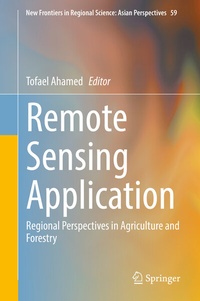
Remote Sensing Application
Description

This book focuses solely on the issues of agriculture and forest productivity analysis with advanced modeling approaches to bring solutions to food-insecure regions of South and Southeast Asia. Advanced modeling tools and their use in regional planning provide an outstanding opportunity to contribute toward food production and environments. In this book, leading-edge research methodologies related to remote sensing and geospatial variability of soil, water, and regional agricultural production indicators and their applications are introduced together-a unique feature of the book is the domain of regional policy perspectives and allied fields. In regional policy planning, agriculture and forestry have a key role in food security and environmental conservation that depends on the geo-spatial variability of these factors. Over the years, nature and climate have determined the variability of soil type, soil quality, geographical deviation for habitat, water quality, water sources, urban influences, population growth, carbon stock levels, and water resources with rain-fed or irrigated land use practices. In addition, human nutritional values and dietary habits have brought cultural adaptation of either mono- or multi-cropping patterns in the region.
To encompass all these above mentioned factors and classify regional variability for policy planning, satellite remote sensing and geographical information systems have the immense potential to increase agricultural and forest productivity to ensure the resilience of its sustainability. Therefore, the 13 chapters presented in this book introduce modeling techniques using the signatures of vegetation and water indices, land use and land change dynamics, climatic, and socioeconomic criteria through spatial, temporal, and statistical analysis. As well, remote sensing and in-depth GIS analysis are integrated with machine and deep learning algorithms to address natural uncertainties such as flash floods, droughts, and cyclones in agricultural production management.
More details
Other editions
Additional editions
Person
Tofael Ahamed is an associate professor from University of Tsukuba, Japan and recognized as one of the best faculty members of the university. His research focuses on smart application of remote sensing and AI-IoT technology in agriculture. Dr. Ahamed leads research supported by the Japanese Society for Promotion Science, University of Tsukuba and international companies. Most of his research articles are published in Transactions of ASABE, Biosystems Engineering, Computer and Electronics in Agriculture, Sensors, Remote Sensing and Asia-Pacific Journal of Regional Science. He is also the author of several textbooks: Bioproduction Engineering for Precision Agronomics, Sustainability and Data to Knowledges for Agricultural Research Methodologies.
