

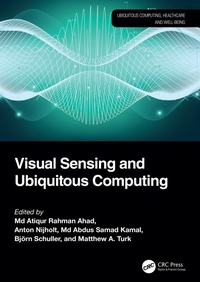
Visual Sensing and Ubiquitous Computing
1st Edition
Published on 20. May 2026
184 pages
978-1-040-34345-6 (ISBN)
Description

Visual Sensing and Ubiquitous Computing explores applied machine learning and deep learning in the field of sensing, vision and sensor-based applications. It includes a series of methodologies, exploration of new applications, presentations on relevant datasets, challenging applications, guidelines, ideas and future scopes.
Edited by leading experts in these arenas, the book will be of great interest to academic researchers, graduate students, and industry professionals in the fields of machine learning, deep learning, artificial intelligence (AI), sensing, computer vision, and sensors.
Edited by leading experts in these arenas, the book will be of great interest to academic researchers, graduate students, and industry professionals in the fields of machine learning, deep learning, artificial intelligence (AI), sensing, computer vision, and sensors.
Reviews / Votes
"This book highlights the cutting-edge research that bridges theoretical advancements with impactful real-world applications. Edited by a highly accomplished team, they have together ensured a well-rounded and visionary exploration of this evolving field. A defining strength of this volume lies in its focus on methodological advancements. Chapters explore cutting-edge techniques, showcasing their practical utility in diverse domains. By applying these advanced methodologies to real-world problems, the book offers readers a clear understanding of both current trends and future opportunities in the field. This volume offers a comprehensive and forward-looking perspective on the integration of computer vision with the complexities of modern interconnected systems. It will undoubtedly inspire researchers and practitioners to push the boundaries of what is possible, transforming these innovations into solutions that shape the future."--Professor Philip H. S. Torr, University of Oxford, UK
More details
Series
Edition
1. Auflage
Language
English
Place of publication
London
United Kingdom
Publishing group
Taylor & Francis Ltd
Target group
Professional and scholarly
College/higher education
Illustrations
36 Tables, black and white; 22 Line drawings, black and white; 51 Halftones, black and white; 73 Illustrations, black and white
File size
31,52 MB
ISBN-13
978-1-040-34345-6 (9781040343456)
Copyright in bibliographic data and cover images is held by Nielsen Book Services Limited or by the publishers or by their respective licensors: all rights reserved.
Schweitzer Classification
Other editions
Additional editions
Md Atiqur Rahman Ahad | Anton Nijholt | Md Abdus Samad Kamal
Visual Sensing and Ubiquitous Computing
Book
05/2026
1st Edition
CRC Press
€185.50
Shipment within 10-20 days
Persons
Md Atiqur Rahman Ahad, Ph.D. (SMIEEE, SMOPTICA) is a Professor of Artificial Intelligence (AI), University of East London (UEL); Guest Professor of Kyushu Institute of Technology (KyuTech), Japan; Visting Academic Staff of The University of Osaka, Japan; Associate Staff Member, Artificial Intelligence & Health Technologies, Rix Inclusive Research Institute, UEL; and Expert Contributor & Member, Safer Agentic AI Criteria Development Community of Practice. He has previously served at The University of Osaka, University of Dhaka (DU), Aoyama Gakuin University, and UCSI University. He works on AI on healthcare (antimicrobial resistance, Parkinson's Disease, well-being, rehabilitation, autism), AI & cyber safety, and gait-biometrics. He studied at KyuTech (Ph.D.), UNSW (MCompSc), and DU (BSc (Honors), MSc). He received 60 awards/recognitions, acquired grants from Innovate UK, UKRI, NIHR, OfS, etc. He has published 20 authored/edited books and over 240 peer-reviewed papers and book chapters. Ahad has been a keynote/invited speaker more than 170 times at various conferences and universities. He has supervised or co-supervised over 150 Ph.D. students and other researchers. He is an Associate Editor, Pattern Recognition; Editorial Board Member, Scientific Reports, Nature; General Chair, 8th Intl. Conf. on Activity & Behavior Computing (ABC), 2026. His leadership focuses on growing interdisciplinary strength, elevating REF performance, and transforming academic excellence into measurable societal benefit. More: https://ahadVisionLab.com
Anton Nijholt is interested in non-traditional human-computer interaction issues. These issues
include irrational behavior, deception, food, and humor. They are included in research on
entertainment computing, augmented reality, brain-computer interfacing, multimodal
interaction, affective interaction, and modelling interactions in smart environments, including
human-human interaction, human-robot interaction, human-virtual agent interaction, and
playable cities.
He has been program chair or general chair of the main international conferences of affective
computing (ACII), entertainment computing (ACE, INTETAIN, ICEC), virtual agents (IVA), faces
& gestures (FG), and some others. He organised many workshops on related topics, such as
multisensorial augmented reality, humor engineering, human-food interaction, playable cities,
and brain-computer interfacing. Recent edited books are "Playable Cities: The City as a Digital
Playground", "Making Smart Cities more Playable", and "Brain Art: Brain-Computer Interfaces
for Artistic Expression".
Nijholt held positions at various universities in Belgium and the Netherlands. He acted as
supervisor for about fifty Ph.D. students. During some years Nijholt was scientific advisor of
Philips Research, Eindhoven. He has been research-fellow at McMaster University (Canada), the
Netherlands Institute for Advanced Study in the Humanities and Social Sciences, the
Imagineering Institute in Malaysia, and member of Microsoft's Technical Leadership Advisory
Board. Nijholt is Chief Editor of the section Human-Media Interaction of Frontiers in Psychology
and Frontiers in Computer Science, Springer Book Series Editor Gaming Media and Social Effects,
and many editorial boards.
Md Abdus Samad Kamal is working at the Cluster of Electronics and Mechanical Engineering,
Graduate School of Science and Technology Gunma University, Japan. His details are in
https://www.mst.st.gunma-u.ac.jp/kamal/biog.html
Bjoern W. Schuller received his diploma, doctoral degree, habilitation, and Adjunct Teaching
Professor in Machine Intelligence and Signal Processing all in EE/IT from TUM in
Munich/Germany. He is Full Professor of Artificial Intelligence and the Head of GLAM - the
Group on Language, Audio, & Music - at Imperial College London/UK, Full Professor and Chair
of Embedded Intelligence for Health Care and Wellbeing at the University of
Augsburg/Germany, co-founding CEO and current CSO of audEERING - an Audio Intelligence
company based near Munich and in Berlin/Germany, and permanent Visiting Professor at
HIT/China amongst other Professorships and Affiliations. Previous stays include Full Professor
at the University of Passau/Germany, Key Researcher at Joanneum Research in Graz/Austria,
and the CNRS-LIMSI in Orsay/France. He is a Fellow of the IEEE and Golden Core Awardee of
the IEEE Computer Society, Fellow of the BCS, Fellow of the ISCA, Fellow and President-
Emeritus of the AAAC, and Senior Member of the ACM. He (co-)authored 1,000+ publications
(40k+ citations, h-index=100+), is Field Chief Editor of Frontiers in Digital Health and was Editor
in Chief of the IEEE Transactions on Affective Computing amongst manifold further
commitments and service to the community. His 40+ awards include having been honoured as
one of 40 extraordinary scientists under the age of 40 by the WEF in 2015. First-in-the-field of
Affective Computing and Sentiment analysis challenges such as AVEC, ComParE, or MuSe have
been initiated and by now organised overall more than 30 times by him. He is an ERC Starting
and DFG Reinhart-Koselleck Grantee, and consultant of companies such as Barclays, GN,
Huawei, Informatics, or Samsung.
Matthew Turk is the third President of TTIC. He earned a PhD from the Massachusetts Institute
of Technology, an MS from Carnegie Mellon University, and a BS from Virginia Tech.
Prior to joining TTIC in 2019, Turk was a full professor at the University of California, Santa
Barbara, where he continues as Professor Emeritus. His primary appointment was in the
Department of Computer Science, where he served as Department Chair from 2017 to 2019, with
a secondary appointment in Media Arts and Technology, where he served as Chair from 2005 to
2010. He also had affiliate appointments in Electrical and Computer Engineering and the
Dynamical Neuroscience Program and was involved in several interdisciplinary organizations
across campus.
Turk's primary research interests are in computer vision and machine learning, augmented and
mixed reality, and human-computer interaction. He has received several best paper awards and
has been general or program chair of several major conferences, including CVPR, WACV, ACM
Multimedia, IEEE Face and Gesture Recognition, and International Conference on Multimodal
Interaction (ICMI).
He brings a dynamic background of academic, industry, and entrepreneurial experience to the
role of President. In 2000, Turk helped to found the Vision Technology Group at Microsoft
Research, and he brings additional industry experience gained in working with a small Silicon
Valley company and a large aerospace company. In 2014, he co-founded a startup company that
spun out from NSF-funded research in his lab and was acquired in 2016. He is a Fellow of the
ACM, the IEEE, and the IAPR and was the Fulbright-Nokia Distinguished Chair in Information
and Communications Technologies.
Anton Nijholt is interested in non-traditional human-computer interaction issues. These issues
include irrational behavior, deception, food, and humor. They are included in research on
entertainment computing, augmented reality, brain-computer interfacing, multimodal
interaction, affective interaction, and modelling interactions in smart environments, including
human-human interaction, human-robot interaction, human-virtual agent interaction, and
playable cities.
He has been program chair or general chair of the main international conferences of affective
computing (ACII), entertainment computing (ACE, INTETAIN, ICEC), virtual agents (IVA), faces
& gestures (FG), and some others. He organised many workshops on related topics, such as
multisensorial augmented reality, humor engineering, human-food interaction, playable cities,
and brain-computer interfacing. Recent edited books are "Playable Cities: The City as a Digital
Playground", "Making Smart Cities more Playable", and "Brain Art: Brain-Computer Interfaces
for Artistic Expression".
Nijholt held positions at various universities in Belgium and the Netherlands. He acted as
supervisor for about fifty Ph.D. students. During some years Nijholt was scientific advisor of
Philips Research, Eindhoven. He has been research-fellow at McMaster University (Canada), the
Netherlands Institute for Advanced Study in the Humanities and Social Sciences, the
Imagineering Institute in Malaysia, and member of Microsoft's Technical Leadership Advisory
Board. Nijholt is Chief Editor of the section Human-Media Interaction of Frontiers in Psychology
and Frontiers in Computer Science, Springer Book Series Editor Gaming Media and Social Effects,
and many editorial boards.
Md Abdus Samad Kamal is working at the Cluster of Electronics and Mechanical Engineering,
Graduate School of Science and Technology Gunma University, Japan. His details are in
https://www.mst.st.gunma-u.ac.jp/kamal/biog.html
Bjoern W. Schuller received his diploma, doctoral degree, habilitation, and Adjunct Teaching
Professor in Machine Intelligence and Signal Processing all in EE/IT from TUM in
Munich/Germany. He is Full Professor of Artificial Intelligence and the Head of GLAM - the
Group on Language, Audio, & Music - at Imperial College London/UK, Full Professor and Chair
of Embedded Intelligence for Health Care and Wellbeing at the University of
Augsburg/Germany, co-founding CEO and current CSO of audEERING - an Audio Intelligence
company based near Munich and in Berlin/Germany, and permanent Visiting Professor at
HIT/China amongst other Professorships and Affiliations. Previous stays include Full Professor
at the University of Passau/Germany, Key Researcher at Joanneum Research in Graz/Austria,
and the CNRS-LIMSI in Orsay/France. He is a Fellow of the IEEE and Golden Core Awardee of
the IEEE Computer Society, Fellow of the BCS, Fellow of the ISCA, Fellow and President-
Emeritus of the AAAC, and Senior Member of the ACM. He (co-)authored 1,000+ publications
(40k+ citations, h-index=100+), is Field Chief Editor of Frontiers in Digital Health and was Editor
in Chief of the IEEE Transactions on Affective Computing amongst manifold further
commitments and service to the community. His 40+ awards include having been honoured as
one of 40 extraordinary scientists under the age of 40 by the WEF in 2015. First-in-the-field of
Affective Computing and Sentiment analysis challenges such as AVEC, ComParE, or MuSe have
been initiated and by now organised overall more than 30 times by him. He is an ERC Starting
and DFG Reinhart-Koselleck Grantee, and consultant of companies such as Barclays, GN,
Huawei, Informatics, or Samsung.
Matthew Turk is the third President of TTIC. He earned a PhD from the Massachusetts Institute
of Technology, an MS from Carnegie Mellon University, and a BS from Virginia Tech.
Prior to joining TTIC in 2019, Turk was a full professor at the University of California, Santa
Barbara, where he continues as Professor Emeritus. His primary appointment was in the
Department of Computer Science, where he served as Department Chair from 2017 to 2019, with
a secondary appointment in Media Arts and Technology, where he served as Chair from 2005 to
2010. He also had affiliate appointments in Electrical and Computer Engineering and the
Dynamical Neuroscience Program and was involved in several interdisciplinary organizations
across campus.
Turk's primary research interests are in computer vision and machine learning, augmented and
mixed reality, and human-computer interaction. He has received several best paper awards and
has been general or program chair of several major conferences, including CVPR, WACV, ACM
Multimedia, IEEE Face and Gesture Recognition, and International Conference on Multimodal
Interaction (ICMI).
He brings a dynamic background of academic, industry, and entrepreneurial experience to the
role of President. In 2000, Turk helped to found the Vision Technology Group at Microsoft
Research, and he brings additional industry experience gained in working with a small Silicon
Valley company and a large aerospace company. In 2014, he co-founded a startup company that
spun out from NSF-funded research in his lab and was acquired in 2016. He is a Fellow of the
ACM, the IEEE, and the IAPR and was the Fulbright-Nokia Distinguished Chair in Information
and Communications Technologies.
Content
Chapter 1 A Biologically Inspired Model for Perception of Flicker Wheel Illusion. Chapter 2 Facial Expression Editing of Untrained Subject Image Using Landmarks. Chapter 3 Simulator-based Dataset Generator for Pothole Detection in Autonomous Driving. Chapter 4 Chicken Behavior Analysis Using Computer Vision Techniques. Chapter 5 Similarity Fusion: Camera-LiDAR Vision Similarity Fusion for 3D Object Detection. Chapter 6 Residual Learning and Filtering Networks for End-to-End Lossless Video Compression. Chapter 7 Nuclei Instance Segmentation of Cryosectioned H&E Stained Histological Images Using Triple U-Net Architecture. Chapter 8 Enhancing Glaucoma Prediction Performance in OCT Images Using Machine Learning Based on HOG Features. Chapter 9 Low-profile Wideband 1x2 Array Antenna for IEEE 802.11a/h/j/n/ac/ax WLAN Applications. Chapter 10 Spectral Amplitude Coding for Secure Multichannel Communication: An Advanced Investigation on AND Subtraction Based SAC-OCDMA. Chaoter 11 Edge-Fog-Cloud Based Hierarchical Communication Network for Traffic Management System. Chapter 12 Network Dynamics of Bangladesh Inland Waterways Augmented with Complex Network Analysis of Vessels and Connectivity. Chapter 13 Convolutional Neural Network-based Secure Spectrum Sensing in CR-IoT Networks.
