

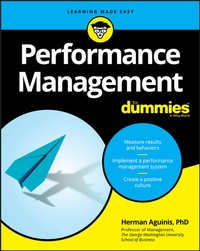
Performance Management For Dummies
Description

Performance Management For Dummies is the definitive guide to infuse performance management with your organization's strategic goals and priorities. It provides the nuts and bolts of how to define and measure performance in terms of what employees do (i.e., behaviors) and the outcome of what they do (i.e., results) --both for individual employees as well as teams.
Inside, you'll find a new multi-step, cyclical process to help you keep track of your employees' work, identify where they need to improve and how, and ensure they're growing with the organization--and helping the organization succeed. Plus, it'll show managers to C-Suites how to use performance management not just as an evaluation tool but, just as importantly, to help employees grow and improve on an ongoing basis so they are capable and motivated to support the organization's strategic objectives.
* Understand if your performance management system is working
* Make fixes where needed
* Get performance evaluation forms, interview protocols, and scripts for feedback meetings
* Grasp why people make some businesses more successful than others
* Make performance management a useful rather than painful management tool
Get ready to define performance, measure it, help employees improve it, and align employee performance with the strategic goals and priorities of your organization.
More details
Other editions
Additional editions
Content
Chapter 1
Introducing Performance Management
IN THIS CHAPTER
Using performance management to create a competitive advantage
Making performance management work
Designing and implementing a performance management system
The organizational success equation is quite simple. Organizations that have more and better resources are more successful compared to those that don't. This applies to large corporations, small start-ups, not-for-profits, and to organizations of every size and in every type of industry.
Here's the complicated part. In today's globalized and hyper competitive world, it is relatively easy to gain access to the same resources as your competitors - particularly when it comes to technology and products. For example, most banks offer the same products such as different types of savings accounts and investment opportunities. If a particular bank decides to offer a new product or service, such as an improved mobile phone app, the competitors offer precisely the same product.
But, a key differentiating resource is people. Organizations with engaged, motivated, and talented employees offering outstanding service to customers and coming up with creative ideas pull ahead of the competition, even if the products offered are similar to those offered by the competitors. Performance management is the ideal tool to have this type of workforce.
Why Do You Need Performance Management? To Succeed (of Course)
There are 100s of books on talent management. Why? If you manage your talent right, you create a sustainable competitive advantage.
A performance management system is a key tool to transform people's talent and motivation into a strategic business advantage.
Performance management is a continuous process of identifying, measuring, and developing the performance of individuals and teams and aligning their performance with the strategic goals of the organization.
Let's take a look at the two main components of the definition of performance management:
- Continuous process: Performance management is ongoing. It involves a never-ending process of setting goals and objectives, observing performance, and giving and receiving ongoing coaching and feedback.
- Alignment with strategic goals: Performance management requires that managers link employees' activities and outputs with the organization's goals. Making this connection helps the organization gain a competitive advantage because performance management creates a direct link between employee and team performance and organizational goals, and makes the employees' contributions to the organization explicit.
Why performance management is alive and well
Because performance management plays such a key rote, many companies, including GE, Microsoft, Google, Yahoo!, Adobe, and Accenture, are going through a similar process of transitioning from a performance appraisal to a performance management system. In other words, they are moving away from a dreaded once-a-year review to ongoing evaluation and feedback.
Contrary to a trend described in the media with such headlines as "Performance Evaluation is Dead" and "The End of Performance Reviews," the evaluation of performance is not going away. In fact, performance assessment and review are becoming a normal, routine, built-in, and ever-present aspect of work in all types of organizations.
It is not the case that companies are abandoning ratings and performance measurement and evaluation. They are actually implementing performance systems more clearly aligned with best practices, as described in this book, that involve and ongoing evaluation of and conversation about performance.
Many companies are getting rid of the labels "performance evaluation," "performance review," and even "performance management." Instead, they use labels such as "performance achievement," "talent evaluation and advancement," "check-ins," and "employee development." But they still implement performance management, but use new, more fashionable, and perhaps less threatening labels.
Everyone does performance management one way or another. Results of a survey of about 1,000 HR professionals in Australia showed that 96 percent of companies implement some type of performance management system. And, results of a survey of 278 organizations, about two-thirds of which are multinational corporations from 15 different countries, showed that about 91 percent of organizations implement a formal performance management system.
PERFORMANCE MANAGEMENT PAYS OFF
A study by Development Dimensions International (DDI), a global human resources consulting firm specializing in leadership and selection, showed that performance management pays off. Organizations with formal and systematic performance management systems are 51 percent more likely to perform better than the others financially, and 41 percent more likely to perform better on customer satisfaction, employee retention, and other important metrics.
Performance management systems are a key tool that organizations use to translate business strategy into business results by influencing "financial performance, productivity, product or service quality, customer satisfaction, and employee job satisfaction." 79 percent of the CEOs surveyed in this study said that the performance management system implemented in their organizations drives the "cultural strategies that maximize human assets."
Based on these results, it is not surprising that senior executives of companies listed in the Sunday Times list of best employers in the United Kingdom believe that performance management is one of the top two most important HR management priorities in their organizations.
Paraphrasing Mark Twain, I can tell you with certainty that the death of performance has been vastly exaggerated.
Imagining an organization without performance management
Imagine an organization without a performance management system. Not a pretty picture. You cannot do any of the things that are critical for talent management and the success of your organization:
- Connect the behaviors and results produced by employees to your organization's strategic priorities.
- Make fair and appropriate administrative decisions such as promotions, salary adjustments, and terminations.
- Inform employees about how they are doing and provide them with information on specific areas that need improvement.
- Give employees information on expectations of peers, supervisors, customers, and the organization, and what aspects of work are most important.
- Give employees information about themselves that can help them individualize their career paths. For example, if they don't know their strengths, they cannot chart a more successful path for their future.
- Learn who are your high-potential and star performing employees.
- Anticipate where you will need to hire people and with which particular skill set.
- Evaluate the effectiveness of HR initiatives. For example, you don't have accurate data on employee performance to evaluate whether employees perform at higher levels after participating in a training program.
Making Performance Management Work in Your Business
Do you want to make sure performance management works in your business? It should be clear by now that performance management is much more than just performance appraisal.
Distinguishing performance management from performance appraisal
Many organizations have what is labeled a "performance management" system. But it actually is a performance appraisal system. And performance appraisal is not the same thing as performance management.
A system that involves employee evaluations once a year without an ongoing effort to provide feedback and coaching so that performance can be improved is not a true performance management system. This performance appraisal system is the measurement and description of an employee's strengths and weaknesses. And while performance appraisal is an important component of performance management, it is just a part of a bigger whole because performance management is much more than just performance measurement.
Much like those that focus on performance appraisal only, "performance management" systems that don't make explicit the employee contribution to the organizational goals are not true performance management systems. When you make an explicit link between employee and team performance objectives and the organizational goals also you are establishing a shared understanding about what is to be achieved and how it is to be achieved.
Table 1-1 summarizes main differences between performance management and performance appraisal. Think about the system at your organization. Is it truly performance management, or performance appraisal?
TABLE 1-1 Performance Management versus Performance Appraisal
Performance Management
Performance Appraisal
Driven by the line manager
Driven by the HR function
Strategic business purpose
Mostly administrative...
