

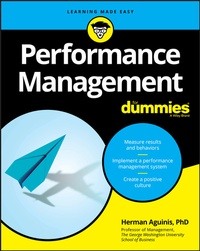
Performance Management For Dummies
1st Edition
Published on 7. May 2019
368 pages
978-1-119-55766-1 (ISBN)
Description

Implement best-in-class performance management systems
Performance Management For Dummies is the definitive guide to infuse performance management with your organization's strategic goals and priorities. It provides the nuts and bolts of how to define and measure performance in terms of what employees do (i.e., behaviors) and the outcome of what they do (i.e., results) --both for individual employees as well as teams.
Inside, you'll find a new multi-step, cyclical process to help you keep track of your employees' work, identify where they need to improve and how, and ensure they're growing with the organization--and helping the organization succeed. Plus, it'll show managers to C-Suites how to use performance management not just as an evaluation tool but, just as importantly, to help employees grow and improve on an ongoing basis so they are capable and motivated to support the organization's strategic objectives.
* Understand if your performance management system is working
* Make fixes where needed
* Get performance evaluation forms, interview protocols, and scripts for feedback meetings
* Grasp why people make some businesses more successful than others
* Make performance management a useful rather than painful management tool
Get ready to define performance, measure it, help employees improve it, and align employee performance with the strategic goals and priorities of your organization.
Performance Management For Dummies is the definitive guide to infuse performance management with your organization's strategic goals and priorities. It provides the nuts and bolts of how to define and measure performance in terms of what employees do (i.e., behaviors) and the outcome of what they do (i.e., results) --both for individual employees as well as teams.
Inside, you'll find a new multi-step, cyclical process to help you keep track of your employees' work, identify where they need to improve and how, and ensure they're growing with the organization--and helping the organization succeed. Plus, it'll show managers to C-Suites how to use performance management not just as an evaluation tool but, just as importantly, to help employees grow and improve on an ongoing basis so they are capable and motivated to support the organization's strategic objectives.
* Understand if your performance management system is working
* Make fixes where needed
* Get performance evaluation forms, interview protocols, and scripts for feedback meetings
* Grasp why people make some businesses more successful than others
* Make performance management a useful rather than painful management tool
Get ready to define performance, measure it, help employees improve it, and align employee performance with the strategic goals and priorities of your organization.
More details
Other editions
Additional editions
Herman Aguinis
Performance Management for Dummies
Book
05/2019
1st Edition
Wiley
€28.50
Shipment within 15-20 days
Content
- Intro
- Title Page
- Copyright Page
- Table of Contents
- Introduction
- About This Book
- Foolish Assumptions
- Icons Used in This Book
- Beyond the Book
- Where to Go from Here
- Part 1 Getting Started with Performance Management
- Chapter 1 Introducing Performance Management
- Why Do You Need Performance Management? To Succeed (of Course)
- Why performance management is alive and well
- Imagining an organization without performance management
- Making Performance Management Work in Your Business
- Distinguishing performance management from performance appraisal
- Adapting performance management to today's reality
- Adapting performance management for different generations
- Designing and Implementing a Performance Management System
- Step 1: Establishing prerequisites
- Step 2: Planning performance
- Step 3: Executing performance
- Step 4: Assessing performance
- Step 5: Reviewing performance
- Chapter 2 Making the Case for Performance Management
- Using Performance Management to Achieve Multiple Purposes
- Strategic objectives
- Administrative objectives
- Informational objectives
- Developmental objectives
- Organizational maintenance objectives
- Documentation objectives
- Answering the "What's in It for Me" Question
- Convincing top management of performance management's value
- Building support in the entire organization
- Realizing the awesome benefits of performance management
- What an Ideal Performance Management System Looks Like
- Contextual issues: Making everything fit
- Practical issues: Striving for effectiveness and fairness
- Technical issues: Sweating the details
- Taking Care of Talent Management Functions
- Training and development
- Workforce planning
- Compensation
- Chapter 3 Designing and Implementing Effective Performance Management
- Ensuring Performance Management Delivers Strategic Value
- Key ingredients of a strategic recipe
- Making performance management strategic
- Developing Performance Management Leadership Skills
- Becoming an effective coach
- Giving effective feedback
- Defining and Measuring Performance
- Measuring performance as behaviors
- Measuring performance as results
- Developing Employee Performance
- Creating development plans
- Implementing development plans
- Assessing Performance Management Effectiveness
- Using quantitative measures
- Using qualitative measures
- Chapter 4 Anticipating and Minimizing Negative Consequences
- Anticipating Damage Caused by Flawed Performance Management
- Damage caused to employees
- Damage caused to managers
- Damage caused to relationships
- Damage caused to the organization
- Learning from Flawed Performance Ratings
- Why Performance Ratings Are Here to Stay
- Setting Up an Appeals Process
- Dealing with judgmental and administrative issues
- Setting up a three-level appeals process
- Setting Up a Communication Plan and Dealing with Resistance to Change
- Questions that your communication plan should answer
- Dealing with cognitive biases
- Part 2 Designing an Effective Performance Management System
- Chapter 5 Delivering Strategic Business Results
- Linking Performance Management with Strategic Business Objectives
- Making sure the strategic plan does what it is supposed to do
- Making sure HR does what it is supposed to do
- Conducting an External and Internal Analysis of Strengths, Weaknesses, Opportunities, and Threats
- Analyzing the external environment
- Analyzing the internal environment
- Conducting a gap analysis
- Creating and Understanding Your Organization's Mission and Vision
- Creating your mission
- Creating your vision
- Setting Up Objectives and Strategies Based on Your Mission and Vision
- Setting up objectives
- Setting up strategies
- Linking Your Organization's and Unit's Strategic Plans with Job Descriptions
- Linking the strategy of the organization and its units
- Linking the organization and units with job descriptions
- Chapter 6 Becoming a Performance Management Leader
- Becoming an Effective Coach
- Four guiding principles of effective coaches
- Seven behaviors of effective coaches
- Understanding your coaching style
- Observing and Documenting Performance
- Why documenting performance is so important
- Documenting performance accurately
- Giving Feedback Effectively
- Making sure feedback serves a purpose
- Avoiding the very high cost of NOT providing feedback
- Making sure feedback is beneficial
- An example of effective feedback
- Giving praise
- An example of effective praise
- Giving constructive feedback
- Giving feedback to Millennials, Post Millennials, and Baby Boomers
- Chapter 7 Defining Performance
- Performance Is All about Behaviors and Results
- Defining performance as behaviors
- Defining performance as results
- Causes for Excellent and Poor Performance
- How individual differences affect performance
- How knowledge and skills affect performance
- How context affects performance
- Anticipating performance problems
- Focusing on Four Different Performance Dimensions
- Task and contextual performance
- Key differences between task and contextual performance
- Counterproductive performance
- Adaptive performance
- When to Define Performance as Behaviors or Results and Why
- When to define performance as behaviors
- When to define performance as results
- Chapter 8 Measuring Performance as Results
- Measuring Performance as Results
- Determining accountabilities and their importance
- Determining objectives
- Choosing a Measurement System Congruent with Context
- Considering the role of organizational culture
- Considering the role of industry trends
- Considering the role of leadership
- Chapter 9 Measuring Performance as Behaviors
- Measuring Competencies
- Measuring two types of competencies
- Describing competencies
- Measuring Behaviors Using Comparative Systems
- Rank order
- Alternation rank order
- Paired comparisons
- Relative percentile
- Forced distribution
- Considering Advantages and Disadvantages of Comparative Systems
- Anticipating problems caused by forced distributions
- Understanding the shape of the performance distribution and producing star performers
- Measuring Behaviors Using Absolute Systems
- Essays
- Behavior checklists
- Using a graphic rating scale system
- Chapter 10 Using Performance Management Analytics
- The Jury Is Out: All Firms Collect Performance Data
- Why all organizations collect performance data
- Setting the evaluation period
- Including Critical Components in Effective Performance Appraisal Forms
- Saying goodbye to paper performance evaluation forms
- Nine critical components of effective evaluation forms
- Evaluating the components of a sample evaluation form
- Including Critical Characteristics to Make Evaluation Forms Effective
- Eight critical characteristics of effective evaluation forms
- Evaluating the characteristics of a sample evaluation form
- Computing Overall Performance Score
- Using judgmental and mechanical procedures to compute overall score
- Using Multiple Performance Touchpoints
- Using supervisors
- Using peers
- Using direct reports
- Using employees themselves
- Using customers
- Using electronic performance monitoring
- Chapter 11 Minimizing Rating Distortion
- Dealing with Disagreements across Performance Touchpoints
- Why disagreements across performance touchpoints is not always a problem
- Dealing with disagreements when giving feedback
- Minimizing Intentional Rating Distortion
- Understanding rater motivation
- Why raters inflate ratings
- Why raters deflate ratings
- Increasing accountability in performance ratings
- Minimizing Unintentional Rating Distortion
- Designing rater error training
- Designing frame of reference training
- Designing behavioral observation training
- Part 3 Implementing Performance Management Effectively
- Chapter 12 Creating and Implementing Personal Development Plans
- Creating Personal Development Plans
- Using development plans to answer four key career questions
- Using development plans to improve your short- and long-term career goals
- Using development plans for succession planning
- Setting your development plan objectives
- Setting the content of your development plan
- Setting the activities of a development plan
- Facilitating Employee Development
- Performing five functions in the development process
- Using the feedforward interview
- Motivating supervisors to facilitate employee development
- Using Multisource Feedback Systems in Implementing Development Plans
- Maximizing benefits of multisource feedback systems
- Minimizing risks of multisource feedback systems
- Deciding whether a multisource feedback systems will work in your organization
- Implementing a state-of-the-science multisource feedback system
- Chapter 13 Conducting Effective Review, Disciplinary, and Termination Meetings
- Conducting Effective Review Meetings
- Setting up review meetings
- Implementing an optimal sequence for review meetings
- Dealing with employee defensiveness
- Making the Tough Calls: Disciplinary Process and Organizational Exit
- Offering decision-making leave
- Avoiding five common pitfalls in the disciplinary process
- Dealing with terminations
- Chapter 14 Implementing Team Performance Management
- Not All Teams Are Created Equal
- Reasons why teams exist in all organizations
- Designing a State-of-the Science System
- Anticipating dangers of poorly designed systems
- Setting necessary conditions for an effective system
- Implementing a system for virtual teams
- Accountability as a key purpose of team performance management
- Implementing a State-of-the-Science System
- Step 1: Establishing prerequisites
- Step 2: Performance planning
- Step 3: Performance execution
- Step 4: Performance assessment
- Step 5: Performance review
- Connecting team performance management with team rewards
- Chapter 15 Evaluating Your System
- Pilot Testing the Performance Management System
- Reasons for doing a pilot test
- Selecting the pilot test group
- Ongoing Monitoring and Evaluation of the Performance Management System
- What to measure
- How to measure
- Part 4 Connecting Performance Management with Rewards and the Law
- Chapter 16 Offering Financial and Nonfinancial Rewards
- Not All Rewards Are Created Equal
- Financial rewards
- Nonfinancial rewards
- Different Types of Financial Rewards
- Base pay
- Cost-of-living adjustments and contingent pay
- Short-term incentives
- Long-term incentives
- Income protection
- Allowances
- Different Types of Nonfinancial Rewards
- Relational
- Work-life focus
- Linking Performance Management with Different Types of Rewards
- Rewards with low dependency on performance management
- Rewards with high dependency on performance management
- Rewards with moderate dependency on performance management
- Chapter 17 Setting Up an Effective Pay System
- Setting Up Traditional and Contingent Pay Plans
- Traditional pay plans
- Contingent pay plans
- Implementing Contingent Pay Plans
- The benefits of CP plans
- Reasons why contingent pay plans fail
- Selecting a Contingent Pay Plan
- Traditional versus involvement cultures
- Strategic direction
- What pay can and cannot do about improving performance
- Turning recognition and other nonfinancial incentives into rewards
- Chapter 18 Staying on the Right Side of the Law
- Implementing the Golden Rule
- Implementing the golden rule around the world
- When the golden rule breaks down
- Six Legal Principles Affecting Performance Management
- Employment at will
- Negligence
- Defamation
- Misrepresentation
- Adverse impact/unintentional discrimination
- Illegal discrimination/disparate treatment
- Laws Affecting Performance Management
- Laws affecting performance management around the world
- Lawful performance management in global organizations
- Putting it all together: A legally defensible performance management system
- Part 5 The Part of Tens
- Chapter 19 Ten Reasons for Implementing Effective Performance Management
- Six Useful Purposes
- Self-Insights, Development, Motivation, and Self-Esteem
- Better Understanding of Job Requirement
- More Employee Engagement and Voice Behavior
- Improved Commitment and Decreased Turnover
- Early Detection of Performance Declines and Less Employee Misconduct
- Differentiation between Good and Poor Performers
- Common Understanding of What Is Good Performance
- More Fair and Legally Defensible Administrative Decisions
- Easier Organizational Change
- Chapter 20 Ten Key Factors for Delivering Outstanding Results
- Congruence with Strategy and Context
- Thoroughness and Inclusiveness
- Meaningfulness
- Practicality
- Reliability, Validity, and Specificity
- Identification of Effective and Ineffective Performance
- Standardization and Thoroughness
- Openness
- Correctability
- Acceptability, Fairness, and Ethicality
- Chapter 21 Ten Tips for Becoming a Great Performance Management Leader
- Become an Effective Coach
- Develop a Good Coaching Relationship and Facilitate Employee Growth
- Understand Your Own Coaching Style
- Make the Employee the Director of Change
- Learn How to Evaluate Performance Accurately
- Document Performance Accurately
- Give Feedback Effectively
- Conduct Effective Performance Review Meetings
- Be Fair and Direct in the Disciplinary Process
- Be Fair and Direct in the Termination Process
- Index
- EULA
