

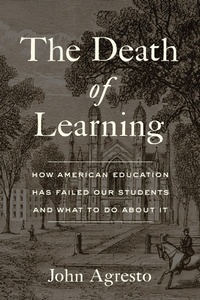
The Death of Learning
Description

The liberal arts are dying. They are dying because most Americans don't see the point of them. Americans don't understand why anyone would study literature or history or the classics?or, more contemporarily, feminist criticism, whiteness studies, or the literature of postcolonial states?when they can get an engineering or business degree.
Even more concerning is when they read how ?Western civilization? has become a term
of reproach at so many supposedly thoughtful institutions; or how fanatical political correctness works hard to silence alternative viewpoints; or, more generally, how liberal studies have become scattered, narrow, and small. In this atmosphere, it's hard to convince parents or their progeny that a liberal education is all that wonderful or that it's even worthy of respect.
Over sixty years ago, we were introduced to the idea of ?the two cultures? in higher education? that is, the growing rift in the academy between the humanities and the sciences, a rift wherein neither side understood the other, spoke to the other, or cared for the other. But this divide in the academy, real as it may be, is nothing compared to another great divide?the rift today between our common American culture and the culture of the academy itself.
So, how can we rebuild the notion that a liberal education is truly of value, both to our students and to the nation? Our highest hopes may be not to ?restore? the liberal arts to what they looked like fifty or a hundred years ago but to ask ourselves what a true contemporary American liberal education at its best might look like.
Remedying this situation will involve knowing clearly where we wish to go and then understanding how we might get there. For those objectives, this book is meant to be the beginning.
More details
Person
John Agresto has taught at the University of Toronto, Kenyon College, Duke University, Wabash College, and the New School University. He was a scholar at the National Humanities Center in North Carolina and later served in senior positions at the National Endowment for the Humanities. He was president of St. John's College in Santa Fe for 11 years.
In 2003, Agresto went to Iraq as the Senior Advisor for Higher Education and Scientific Research for the Coalition Provisional Authority. Between 2007 and 2010, he occupied roles including academic dean, provost, and chancellor at the American University of Iraq. He has also been the Lilly Senior Research Fellow at Wabash College, scholar-in-residence at Hampden-Sydney College, and fellow at the James Madison Program in American Ideals and Institutions at Princeton University.
Agresto has authored five books and edited three others, including Rediscovering America; Mugged by Reality; The Supreme Court and Constitutional Democracy; The Humanist as Citizen; a cookbook; and a political/religious thriller under a pen name. His essays have appeared in the New York Times, Wall Street Journal, and Washington Post, among others.
Though recently retired as the probate judge of Santa Fe County, Agresto remains president of John Agresto & Associates, an educational consulting company.
