

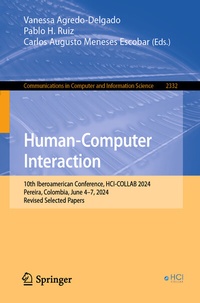
Human-Computer Interaction
Description

This book constitutes the refereed proceedings of the 10th Iberoamerican Conference on Human-Computer Interaction, HCI-COLLAB 2024, held in Pereira, Colombia, during June 4-7, 2024.
The 26 full papers presented here were carefully selected and reviewed from 85 submissions. Among the topics addressed in this edition were key areas such as accessibility, usability, video games and gamification, computational thinking, Internet of Things (IoT), software engineering, information and communication technologies (ICT) in education, virtual, augmented and mixed reality applied to education, artificial intelligence in HCI, industry 4.0, infotainment systems, collaborative work and learning, cognition and interaction. The diversity and topicality of these topics reflect the breadth of the discipline and its relevance to meet the technological and social challenges of today's world.
More details
Other editions
Additional editions
Content
.- A Maturity Model for Evaluating the Use of Artificial Intelligence in the Context of Industry 4.0.
.- A methodological overview about hand tracking and cognitive influences in virtual reality.
.- A usable usability test: a practical and visual approach for carrying out moderate usability testing.
.- Advancing AI Incidents Classification: Leveraging LLMs with Strategic Prompting.
.- Bibliometric Analysis: The need for collaboration in the context of children diagnosed with autism spectrum disorder.
.- Characterization of interactive multimedia experiences in inclusive school contexts considering learning analytics.
.- Development of a Low-Cost Myoelectric Prosthesis for Upper Limbs Using Rapid Prototyping Aimed at the Brazilian Scenario: An Initial Study.
.- Development of a wearable device for use in gametherapy sessions for rehabilitation of manual function.
.- Evaluation Heuristics to Improve Usability in Ecommerce Platforms.
.- Evaluation process application of playability and fun in pervasive game experiences oriented to older adults.
.- Exploring Accessibility: The First Interaction of Visually Impaired Users with the UNAD Virtual Campus.
.- Exploring the Feasibility of Virtual Reality in Post-Stroke Rehabilitation: Medical Perspectives on Motion Health VR.
.- Financial fraud detection through the application of machine learning techniques with an anomaly-based approach.
.- Gamified interactive multimedia experiences in the organizational context: a systematic review.
.- Guide for strengthening the building of shared understanding in requirements engineering activities.
.- Hola: Proposal of a social network for interaction and socialization of people with Autism Spectrum Disorder.
.- Immersive representation of an artwork for people with visual impairment: A systematic mapping of the literature.
.- Measure of Coolness on the Blind User Experience.
.- Navegue Fácil: Promoting Web Accessibility Targeted at the Older Adults' Population.
.- Prompt Engineering-Based Video Prototyping for Immersive Interaction Design: Limits, Opportunities and Perspectives.
.- Sign Language to Colombian Formal Language Translator Software.
.- SME users in Industry 4.0 Study of the Metalworking Industry in Argentina.
.- Thermo Racing: Multimedia System for support learning the first and second law of thermodynamic.
.- Usability and accessibility evaluation in small software development companies: a bibliometric analysis.
.- Videogames and addiction: Strategies for a Healthy Gameplay.
.- Writing UX requirements in acceptance criteria: a case study in startups.
