

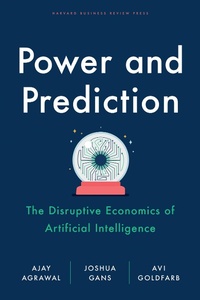
Power and Prediction
Description

Disruption resulting from the proliferation of AI is coming. The authors of the bestselling Prediction Machines can help you prepare.
Artificial intelligence (AI) has impacted many industries around the world?banking and finance, pharmaceuticals, automotive, medical technology, manufacturing, and retail. But it has only just begun its odyssey toward cheaper, better, and faster predictions that drive strategic business decisions. When prediction is taken to the max, industries transform, and with such transformation comes disruption.
What is at the root of this? In their bestselling first book, Prediction Machines, eminent economists Ajay Agrawal, Joshua Gans, and Avi Goldfarb explained the simple yet game-changing economics of AI. Now, in Power and Prediction, they go deeper, examining the most basic unit of analysis: the decision. The authors explain that the two key decision-making ingredients are prediction and judgment, and we perform both together in our minds, often without realizing it. The rise of AI is shifting prediction from humans to machines, relieving people from this cognitive load while increasing the speed and accuracy of decisions.
This sets the stage for a flourishing of new decisions and has profound implications for system-level innovation. Redesigning systems of interdependent decisions takes time?many industries are in the quiet before the storm?but when these new systems emerge, they can be disruptive on a global scale. Decision-making confers power. In industry, power confers profits; in society, power confers control. This process will have winners and losers, and the authors show how businesses can leverage opportunities, as well as protect their positions.
Filled with illuminating insights, rich examples, and practical advice, Power and Prediction is the must-read guide for any business leader or policymaker on how to make the coming AI disruptions work for you rather than against you.
More details
Other editions
Additional editions
Persons
Ajay Agrawal is Professor of Strategic Management and the Geoffrey Taber Chair in Entrepreneurship and Innovation at the University of Toronto's Rotman School of Management. He is founder of the Creative Destruction Lab and the Metaverse Mind Lab and cofounder of NEXT Canada and Sanctuary.
Joshua Gans is the Jeffrey S. Skoll Chair of Technical Innovation and Entrepreneurship and Professor of Strategic Management at Toronto's Rotman School of Management. He is Chief Economist of the Creative Destruction Lab, department editor (Strategy) at Management Science, and cofounder and managing director of Core Economic Research.
Avi Goldfarb is the Rotman Chair in Artificial Intelligence and Healthcare and Professor of Marketing at Toronto's Rotman School of Management. He is also Chief Data Scientist at the Creative Destruction Lab, a fellow at Behavioral Economics in Action at Rotman, and a faculty affiliate at the Vector Institute for Artificial Intelligence.
Content
- Intro
- Contents
- Preface
- Part 1: The Between Times
- Ch. 1: A Parable of Three Entrepreneurs
- Ch. 2: AI's System Future
- Ch. 3: AI Is Prediction Technology
- Part 2: Rules
- Ch. 4: To Decide or Not to Decide
- Ch. 5: Hidden Uncertainty
- Ch. 6: Rules Are Glue
- Part 3: Systems
- Ch. 7: Glued versus Oiled Systems
- Ch. 8: The System Mindset
- Ch. 9: The Greatest System of All
- Part 4: Power
- Ch. 10: Disruption and Power
- Ch. 11: Do Machines Have Power?
- Ch. 12: Accumlating Power
- Part 5: How AI Disrupts
- Ch. 13: A Great Decoupling
- Ch. 14: Thinking Probabilistically
- Ch. 15: The New Judges
- Part 6: Envisaging New Systems
- Ch. 16: Designing Reliable Systems
- Ch. 17: The Blank Slate
- Ch. 18: Anticipating System Change
- Epilogue
- Notes
- Index
- Acknowledgments
- About the Authors
