

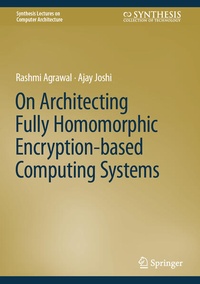
On Architecting Fully Homomorphic Encryption-based Computing Systems
Description

This book provides an introduction to the key concepts of Fully Homomorphic Encryption (FHE)-based computing, and discusses the challenges associated with architecting FHE-based computing systems. Readers will see that due to FHE's ability to compute on encrypted data, it is a promising solution to address privacy concerns arising from cloud-based services commonly used for a variety of applications including healthcare, financial, transportation, and weather forecasting. This book explains the fundamentals of the FHE operations and then presents an architectural analysis of the FHE-based computing. The authors also highlight challenges associated with accelerating FHE on various commodity platforms and argue that the FPGA platform provides a sweet spot in making privacy-preserving computing plausible.
Reviews / Votes
"This book must be considered a game changer in the field of data security and privacy. Itis a true testament to the boundless potential of technology when put in the hands of brilliant minds. . The book has a meticulous approach to both theoretical and practical aspects. . The clarity of the research, the concise presentation of key concepts, and the well-structured arguments make it a valuable resource for anyone interested in this cutting-edge field." (Mihailescu Marius Iulian, Computing Reviews, October 16, 2023)More details
Other editions
Additional editions
Persons
Rashmi Agrawal received her M.S. degree in Computer Engineering from Boston University, Boston, USA in 2017. She is currently a Ph.D. candidate in ECE department at Boston University. She is a member of the Integrated Circuits and System Group (ICSG) and is advised by Prof. Ajay Joshi. She received best paper awards at GLVLSI 2020 and ICCD 2020. Her research interests include designing efficient architectures and co-processors for post-quantum cryptography and hardware acceleration of privacy-preserving computing using fully homomorphic encryption.
Ajay Joshi received PhD from Georgia Institute of Technology in 2006. He was a Post-Doctoral Researcher at Massachusetts Institute of Technology from 2006 to 2009 and a Visiting Research Scientist at Google from 2017 to 2018. He is currently a Professor with the Department of Electrical and Computer Engineering (ECE) at Boston University (BU). He received the Google Faculty Research Award 2018 and 2019, Best Paper Award at ASIACCS 2018, the BU ECE's award for Teaching Excellence in 2014, and NSF CAREER award in 2012. Broadly, his research interests include computer architecture, security, digital VLSI, and silicon photonics.
Content
Introduction.- The CKKS FHE Scheme.- Architectural Analysis of CKKS Scheme.- Limits and opportunities for designing CKKS-based computing systems.- Summary and Future Perspectives.
