

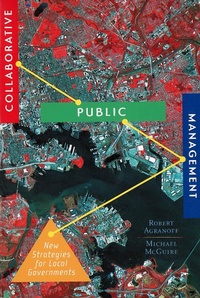
Collaborative Public Management
Description

Local governments do not stand alone-they find themselves in new relationships not only with state and federal government, but often with a widening spectrum of other public and private organizations as well. The result of this re-forming of local governments calls for new collaborations and managerial responses that occur in addition to governmental and bureaucratic processes-as-usual, bringing locally generated strategies or what the authors call "jurisdiction-based management" into play.
Based on an extensive study of 237 cities within five states, Collaborative Public Management provides an in-depth look at how city officials work with other governments and organizations to develop their city economies and what makes these collaborations work. Exploring the more complex nature of collaboration across jurisdictions, governments, and sectors, Agranoff and McGuire illustrate how public managers address complex problems through strategic partnerships, networks, contractual relationships, alliances, committees, coalitions, consortia, and councils as they function together to meet public demands through other government agencies, nonprofit associations, for-profit entities, and many other types of nongovernmental organizations.
Beyond the "how" and "why," Collaborative Public Management identifies the importance of different managerial approaches by breaking them down into parts and sequences, and describing the many kinds of collaborative activities and processes that allow local governments to function in new ways to address the most nettlesome public challenges.
More details
Other editions
Additional editions

Person
Robert Agranoff is professor emeritus in the School of Public and Environmental Affairs at Indiana University-Bloomington, and since 1990, he has been affiliated with the Instituto Universitario Ortega y Gasset in Madrid. His writings include Dimensions of Human Services Integration, Intergovernmental Management: Human Services Problem Solving in Six Metropolitan Areas, and New Governance for Rural America: Creating Intergovernmental Partnerships.
Michael McGuire is an associate professor, Department of Public Administration, at the University of North Texas and has studied interorganizational and intergovernmental collaboration, rural policy, and economic development strategy. His current work focuses on the skills and behaviors of managers who operate in collaborative settings.
Content
Preface
1. Collaboration at the Core
2. Managing in an Age of Collaboration
3. Models of Collaborative Management
4. Collaborative Activity and Strategy
5. Linkages in Collaborative Management
6. Policy Design and Collaborative Management
7. Jurisdiction-Based Management
8. The Future of Public Management and the Challenge of Collaboration
Appendixes
A. Survey Design and Administration
B. Economic Characteristics of the Sample Cities
References
Index
