

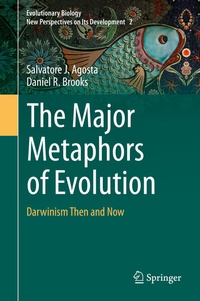
The Major Metaphors of Evolution
Description

This book presents a unified evolutionary framework based on three sets of metaphors that will help to consolidate discussions on evolutionary transitions.
Evolution is the unifying principle of life, making identifying ways to apply evolutionary principles to tackle existence-threatening crises such as climate change crucial. A more cohesive evolutionary framework will further the discussions in this regard and also accelerate the process itself.
This book lays out a framework based on three dualistic classes of metaphors - time, space, and conflict resolution. Evolutionary transitions theory shows how metaphors can help us understand selective diversification, as Darwin described with his "tree of life". Moreover, the recently proposed Stockholm paradigm demonstrates how metaphors can help shed light on the emergence of complex ecosystems that Darwin highlighted with his "tangled bank" metaphor. Taken together, these ideas offer proactive measures for coping with existential crises for humanity, such as climate change.
The book will appeal to biologists, philosophers and historians alike.
More details
Other editions
Additional editions
Persons
Sal Agosta is an Associate Professor, Virginia Commonwealth University. He received a PhD in Biology from the University of Pennsylvania in 2007, after which he was awarded a Postdoctoral Fellowship in Ecology and Evolutionary Biology from the University of Toronto followed by a Howard Hughes Medical Institute Postdoctoral Fellowship from Wilkes University. Sal is an ecologist and evolutionary biologist whose work ranges from field and laboratory studies of animal-plant interactions in both temperate and tropical habitats to theoretical studies of foundational concepts in ecology and evolution. His current research focuses on the physiological ecology of plant-feeding insects, particularly in the context of biological invasions and climate change.
Daniel R Brooks
is Professor Emeritus, University of Toronto. He is a Fellow of the Royal Society of Canada (Academy of Science) and Fellow of the Linnaean Society of London and has been awarded honorary doctorates fromStockholm University and the University of Nebraska. He has been a Senior Visiting Fellow of the Collegium Budapest, Stellenbosch Institute of Advanced Study,Institute of Advanced Studies, Köszeg, and the Hungarian National Institute of Ecology. Dan is an evolutionary biologist whose more than 375 scientific publications, including half a dozen books, ranges from field studies of the evolution of host-pathogen systems in tropical wildlands to foundational studies of evolutionary theory. His current focus is integrating evolutionary principles into developing proactive public policy for coping with global climate change, with an emphasis on the emerging disease crisis.
