

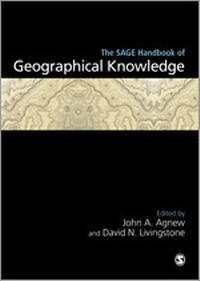
The SAGE Handbook of Geographical Knowledge
1st Edition
Published on 17. February 2011
656 pages
978-1-4462-0954-7 (ISBN)
Description

A refreshingly innovative approach to charting geographical knowledge. A wide range of authors trace the social construction and contestation of geographical ideas through the sites of their production and their relational geographies of engagement. This creative and comprehensive book offers an extremely valuable tool to professionals and students alike.
- Victoria Lawson, University of Washington
"A Handbook that recasts geograph's history in original, thought-provoking ways. Eschewing the usual chronological march through leading figures and big ideas, it looks at geography against the backdrop of the places and institutional contexts where it has been produced, and the social-cum-intellectual currents underlying some of its most important concepts."
- Alexander B. Murphy, University of Oregon
The SAGE Handbook of Geographical Knowledge is a critical inquiry into how geography as a field of knowledge has been produced, re-produced, and re-imagined. It comprises three sections on geographical orientations, geography's venues, and critical geographical concepts and controversies. The first provides an overview of the genealogy of "geography". The second highlights the types of spatial settings and locations in which geographical knowledge has been produced. The third focuses on venues of primary importance in the historical geography of geographical thought.
Orientations includes chapters on: Geography - the Genealogy of a Term; Geography's Narratives and Intellectual History
Geography's Venues includes chapters on: Field; Laboratory; Observatory; Archive; Centre of Calculation; Mission Station; Battlefield; Museum; Public Sphere; Subaltern Space; Financial Space; Art Studio; Botanical/Zoological Gardens; Learned Societies
Critical concepts and controversies - includes chapters on: Environmental Determinism; Region; Place; Nature and Culture; Development; Conservation; Geopolitics; Landscape; Time; Cycle of Erosion; Time; Gender; Race/Ethnicity; Social Class; Spatial Analysis; Glaciation; Ice Ages; Map; Climate Change; Urban/Rural.
Comprehensive without claiming to be encyclopedic, textured and nuanced, this Handbook will be a key resource for all researchers with an interest in the pasts, presents and futures of geography.
- Victoria Lawson, University of Washington
"A Handbook that recasts geograph's history in original, thought-provoking ways. Eschewing the usual chronological march through leading figures and big ideas, it looks at geography against the backdrop of the places and institutional contexts where it has been produced, and the social-cum-intellectual currents underlying some of its most important concepts."
- Alexander B. Murphy, University of Oregon
The SAGE Handbook of Geographical Knowledge is a critical inquiry into how geography as a field of knowledge has been produced, re-produced, and re-imagined. It comprises three sections on geographical orientations, geography's venues, and critical geographical concepts and controversies. The first provides an overview of the genealogy of "geography". The second highlights the types of spatial settings and locations in which geographical knowledge has been produced. The third focuses on venues of primary importance in the historical geography of geographical thought.
Orientations includes chapters on: Geography - the Genealogy of a Term; Geography's Narratives and Intellectual History
Geography's Venues includes chapters on: Field; Laboratory; Observatory; Archive; Centre of Calculation; Mission Station; Battlefield; Museum; Public Sphere; Subaltern Space; Financial Space; Art Studio; Botanical/Zoological Gardens; Learned Societies
Critical concepts and controversies - includes chapters on: Environmental Determinism; Region; Place; Nature and Culture; Development; Conservation; Geopolitics; Landscape; Time; Cycle of Erosion; Time; Gender; Race/Ethnicity; Social Class; Spatial Analysis; Glaciation; Ice Ages; Map; Climate Change; Urban/Rural.
Comprehensive without claiming to be encyclopedic, textured and nuanced, this Handbook will be a key resource for all researchers with an interest in the pasts, presents and futures of geography.
Reviews / Votes
If we are to take seriously the idea that events, practices, and ideas should not be divorced from their historical and geographical context, then geographical knowledge itself needs to be temporally and spatially situated. Motivated by that proposition, Agnew and Livingston have put together a Handbook that recasts geography's history in original, thought-provoking ways. Eschewing the usual chronological march through leading figures and big ideas, the Handbook looks at geography against the backdrop of the places and institutional contexts where it has been produced, and the social-cum-intellectual currents underlying some of its most important concepts. The result is a book that fleshes out often-neglected aspects of the discipline's history, even as it consistently encourages thinking about the relationship between geographical practices and the places, circumstances, and understandings in which those practices are embeddedAlexander B. Murphy
Department of Geography, University of Oregon
The Handbook provides a refreshingly innovative approach to charting geographical knowledge. A wide range of authors trace the social construction and contestation of geographical ideas through the sites of their production and their relational geographies of engagement. This creative and comprehensive book offers an extremely valuable tool to professionals and students alike
Victoria Lawson
University of Washington
All prices
More details
Language
English
Place of publication
London
United Kingdom
Target group
Professional and scholarly
ISBN-13
978-1-4462-0954-7 (9781446209547)
Copyright in bibliographic data and cover images is held by Nielsen Book Services Limited or by the publishers or by their respective licensors: all rights reserved.
Schweitzer Classification
Other editions
Additional editions
John Agnew | David N. Livingstone
The SAGE Handbook of Geographical Knowledge
Book
02/2011
1st Edition
SAGE Publications Inc
€202.20
Shipment within 10-20 days
Persons
Agnew is currently Distinguished Professor of Geography at the University of California, Los Angeles(UCLA). From 1975 until 1995 he was a professor at Syracuse University in New York. Dr. Agnew teachescourses on political geography, the history of geography, European cities, and the Mediterranean World. My research interests congregate around several related themes: the histories of geographical knowledge, the spatiality of scientific culture, and the historical geographies of science and religion. I am currently involved in writing a social history of climatic determinism from Herodotus to Global Warming under the working title 'The Empire of Climate''. This project is funded by a Leverhulme Trust Major Fellowship.
Content
Introduction - John A. Agnew and David N. Livingstone
PART ONE: ORIENTATIONS
Geography's Geneologies - Robert J. Mayhew
Geography's Narratives and Intellectual History - Charles W. J. Withers
PART TWO: GEOGRAPHY'S VENUES
The Field - Keith Richards
Museums - Simon Naylor and Jude Hill
Laboratory/Observatory - Scott Kirsch
Archive - Miles Ogborn
Botanical Gardens and Zoos - Nuala C. Johnson
Learned Societies - Michael Heffernan
Geography Information Systems Laboratory - Michael F. Goodchild
Art Studio - Stephen Daniels
The Weather Station and the Meteorological Office - Keith Richards
Centre of Circulation - Heike Joens
Remote Sensing - Yongwei Sheng
Spaces of Hegemony? Circuits of Value, Finance Capital and Places of Financial Knowledge - Roger Lee
The Mission - Georgina Endfield
Battlefield - Gerard Toal/Gearoid O Tuathail
Making Mathematical Models Perform in Geographical Space(s) - Stuart N. Lane
Subaltern Space - Daniel Clayton
Public Sphere - Mustafa Dikec
The Role of Geography and Geographers in Policy and Government Departments - Tim Unwin
PART THREE: CRITICAL CONCEPTS AND CONTROVERSIES
Nature and Society - Noel Castree
Landscape - John Wylie
Space and Place - John Agnew
Time - Mike Crang
Region and Regionalism - J. Nicholas Entrikin
Map - Anne Godlewska and Jason Grek Martin
Environmental Determinism - David N. Livingstone
Spatial Analysis - Trevor J. Barnes
Dynamics and Complexity - Christopher J. Keylock
Social Class - Eric Sheppard and James Glassman
Race/Ethnicity - Caroline Bressey
Gender - Joanne Sharp
The Idea of Evolution in Geographical Thought - Neil Roberts
Ecosystem - George P. Malanson
Landform - Nick Spedding
The Cycle of Erosion: Changing Times, Changing Science - Antony R. Orme
Glaciation and Ice Ages - Bryan Mark
Rivers and Drainage Basins - Nick Clifford
Environmental Change - Andrew Goudie
Global Climate Change - Glen M. Macdonald
The City - Phil Hubbard
Urban-Rural - Paul Cloke
Mobility - Tim Cresswell
Conservation and Environmental Concern - Michael Williams
Development - Robert B. Potter and Dennis Conway
Geopolitics - Gerry Kearns
PART ONE: ORIENTATIONS
Geography's Geneologies - Robert J. Mayhew
Geography's Narratives and Intellectual History - Charles W. J. Withers
PART TWO: GEOGRAPHY'S VENUES
The Field - Keith Richards
Museums - Simon Naylor and Jude Hill
Laboratory/Observatory - Scott Kirsch
Archive - Miles Ogborn
Botanical Gardens and Zoos - Nuala C. Johnson
Learned Societies - Michael Heffernan
Geography Information Systems Laboratory - Michael F. Goodchild
Art Studio - Stephen Daniels
The Weather Station and the Meteorological Office - Keith Richards
Centre of Circulation - Heike Joens
Remote Sensing - Yongwei Sheng
Spaces of Hegemony? Circuits of Value, Finance Capital and Places of Financial Knowledge - Roger Lee
The Mission - Georgina Endfield
Battlefield - Gerard Toal/Gearoid O Tuathail
Making Mathematical Models Perform in Geographical Space(s) - Stuart N. Lane
Subaltern Space - Daniel Clayton
Public Sphere - Mustafa Dikec
The Role of Geography and Geographers in Policy and Government Departments - Tim Unwin
PART THREE: CRITICAL CONCEPTS AND CONTROVERSIES
Nature and Society - Noel Castree
Landscape - John Wylie
Space and Place - John Agnew
Time - Mike Crang
Region and Regionalism - J. Nicholas Entrikin
Map - Anne Godlewska and Jason Grek Martin
Environmental Determinism - David N. Livingstone
Spatial Analysis - Trevor J. Barnes
Dynamics and Complexity - Christopher J. Keylock
Social Class - Eric Sheppard and James Glassman
Race/Ethnicity - Caroline Bressey
Gender - Joanne Sharp
The Idea of Evolution in Geographical Thought - Neil Roberts
Ecosystem - George P. Malanson
Landform - Nick Spedding
The Cycle of Erosion: Changing Times, Changing Science - Antony R. Orme
Glaciation and Ice Ages - Bryan Mark
Rivers and Drainage Basins - Nick Clifford
Environmental Change - Andrew Goudie
Global Climate Change - Glen M. Macdonald
The City - Phil Hubbard
Urban-Rural - Paul Cloke
Mobility - Tim Cresswell
Conservation and Environmental Concern - Michael Williams
Development - Robert B. Potter and Dennis Conway
Geopolitics - Gerry Kearns
