

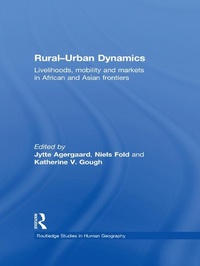
Rural-Urban Dynamics
Livelihoods, mobility and markets in African and Asian frontiers
1st Edition
Published on 11. September 2009
232 pages
978-1-135-25698-2 (ISBN)
Description

It has increasingly been recognised that rural and urban areas are inextricably interlinked. This book adopts a fresh approach to the issue of rural-urban dynamics through a study of the changing nature of livelihoods, mobility and markets in ten study sites across four countries of Africa and Asia. Building on detailed fieldwork conducted in Ghana, Tanzania, Vietnam and Thailand, the authors explore how settlements and livelihoods are being transformed as long-term inhabitants and recent migrants embrace new economic activities many of which are linked to global markets.
The book is structured around the concept of 'frontier' which is conceptualized as being a dynamic space where the forces of economic, demographic and social change are brought to bear. The study sites include agricultural frontiers (coffee, cocoa, pineapples and fresh fruit), handicraft and manufacturing frontiers, and mining frontiers (gold and diamonds). In all of the cases, global value chain dynamics have played a pivotal role in shaping local livelihoods. Some settlements are developing into new urban centres whilst others are suffering from a boom and bust experience due to the unreliability of export markets. The similarities and differences between the frontier settlements are drawn out by comparing frontiers of similar types and by highlighting the theoretical and policy implications of the findings from all the frontier types.
The originality of the book lies in its combination of conceptual clarity, methodological coherence and empirical richness. By combining detailed empirical findings with theoretical insight from debates on livelihoods, global value chains, mobility patterns, settlement dynamics and rural-urban relations, the book sheds new light on these issues within an overall framework of development trajectories in Africa and Asia. Given scholars' and international agencies' current interest in the spatial dimensions of economic development, this contribution is particularly timely with its fresh geographical approach to development issues; this book is a pertinent and authoritative read for anyone researching or learning in the field of development.
The book is structured around the concept of 'frontier' which is conceptualized as being a dynamic space where the forces of economic, demographic and social change are brought to bear. The study sites include agricultural frontiers (coffee, cocoa, pineapples and fresh fruit), handicraft and manufacturing frontiers, and mining frontiers (gold and diamonds). In all of the cases, global value chain dynamics have played a pivotal role in shaping local livelihoods. Some settlements are developing into new urban centres whilst others are suffering from a boom and bust experience due to the unreliability of export markets. The similarities and differences between the frontier settlements are drawn out by comparing frontiers of similar types and by highlighting the theoretical and policy implications of the findings from all the frontier types.
The originality of the book lies in its combination of conceptual clarity, methodological coherence and empirical richness. By combining detailed empirical findings with theoretical insight from debates on livelihoods, global value chains, mobility patterns, settlement dynamics and rural-urban relations, the book sheds new light on these issues within an overall framework of development trajectories in Africa and Asia. Given scholars' and international agencies' current interest in the spatial dimensions of economic development, this contribution is particularly timely with its fresh geographical approach to development issues; this book is a pertinent and authoritative read for anyone researching or learning in the field of development.
More details
Series
Language
English
Place of publication
London
United Kingdom
Publishing group
Taylor & Francis Ltd
Target group
College/higher education
Product notice
Reflowable
Illustrations
38 s/w Abbildungen, 29 s/w Tabellen, 18 s/w Photographien bzw. Rasterbilder, 20 s/w Zeichnungen
29 Tables, black and white; 20 Line drawings, black and white; 18 Halftones, black and white; 38 Illustrations, black and white
File size
3,89 MB
ISBN-13
978-1-135-25698-2 (9781135256982)
Copyright in bibliographic data and cover images is held by Nielsen Book Services Limited or by the publishers or by their respective licensors: all rights reserved.
Schweitzer Classification
Other editions
Additional editions

Jytte Agergaard | Niels Fold | Katherine Gough
Rural-Urban Dynamics
Livelihoods, mobility and markets in African and Asian frontiers
Book
04/2015
1st Edition
Routledge
€71.30
Shipment within 10-20 days

Rural-Urban Dynamics
Livelihoods, Mobility and Markets in African and Asian Frontiers
Book
09/2009
Routledge
€119.04
No shipping information available
Jytte Agergaard | Niels Fold | Katherine Gough
Rural-Urban Dynamics
Livelihoods, mobility and markets in African and Asian frontiers
Book
09/2009
1st Edition
Routledge
€230.70
Shipment within 15-20 days
Persons
Jytte Agergaard is Associate Professor at the Department of Geography and Geology, University of Copenhagen. Much of her research has focused on Nepal where she has carried out extensive fieldwork for research on various aspects of social development including gender inequalities, migration and mobility dynamics/patterns and education. She has also been concerned with recent trends in human geography, especially current trends in social geography and geographies of globalisation. She is a member of a number of networks on development research in Denmark and abroad.
Niels Fold is Professor at the Department of Geography and Geology, University of Copenhagen. He has recently participated in a research programme on globalisation and economic restructuring in Africa, in which he worked on global agro-industrial chains with relevance for perennial crops in Ghana (cocoa, oil palm, shea nuts). Previously Niels has worked on industrial development in Malaysia, both on upgrading processes in the palm oil industry and on local industrialisation trajectories (Penang). His current research interests include a comparison of the dynamics of cross-continental food commodity chains.
Katherine V. Gough is a British trained geographer who is employed as Associate Professor in the Department of Geography and Geology, University of Copenhagen. Her main research focus is urbanisation in developing countries with a focus on urban land and housing markets, urban governance and civil society, home-based enterprises and urban youth. Her principle research areas are Latin America and West Africa, especially Ghana where she has been mainly working in the peri-urban area of Accra. As part of a comparative project on urban youth she will conduct research in Hanoi in spring 2004. Katherine works in an advisory capacity to Danida on urban issues and together with Cecilia Tacoli has run a workshop for Danida employees on rural-urban linkages.
Niels Fold is Professor at the Department of Geography and Geology, University of Copenhagen. He has recently participated in a research programme on globalisation and economic restructuring in Africa, in which he worked on global agro-industrial chains with relevance for perennial crops in Ghana (cocoa, oil palm, shea nuts). Previously Niels has worked on industrial development in Malaysia, both on upgrading processes in the palm oil industry and on local industrialisation trajectories (Penang). His current research interests include a comparison of the dynamics of cross-continental food commodity chains.
Katherine V. Gough is a British trained geographer who is employed as Associate Professor in the Department of Geography and Geology, University of Copenhagen. Her main research focus is urbanisation in developing countries with a focus on urban land and housing markets, urban governance and civil society, home-based enterprises and urban youth. Her principle research areas are Latin America and West Africa, especially Ghana where she has been mainly working in the peri-urban area of Accra. As part of a comparative project on urban youth she will conduct research in Hanoi in spring 2004. Katherine works in an advisory capacity to Danida on urban issues and together with Cecilia Tacoli has run a workshop for Danida employees on rural-urban linkages.
Content
1. Introduction (Jytte Agergaard, Niels Fold and Katherine V. Gough) 2. Conceptualizing and Performing Comparison of Rural-urban Dynamics (Gough, Agergaard, Fold and Lasse Moller-Jensen) 3. Small Town Development in the Ghanaian Cocoa Frontier (Michael Helt Knudsen) 4. Living From Coffee in Vietnam's Central Highlands: Susceptible Livelihoods and Diverse Settlement Transformation (Agergaard) 5. Rise and Fall of Smallholder Pineapple Production in Ghana: Changing Global Markets, Livelihoods and Settlement Growth (Gough and Fold) 6. Transforming Livelihoods and Settlements: Fruit Production and Urbanization in Vitenam's Mekong Delta (Xuan Thanh Hoang and Cecilia Tacoli) 7. Agricultural Frontier Settlements: Markets, Livelihood Diversification and Small Town Development (Fold and Tacoli) 8. Handicrafts in Vietnam: Rural Urbanization in the Red River Delta (Gough and Dang Nguyen Anh) 9. A Revolution in the Thai Handicraft Industry? Handicrafts, Integration and Rural Development in Northern Thailand (Jonathan Rigg, Suriya Veeravongs, Piyawadee Rohitarachoon and Lalida Veeravongs) 10. From Farm to Factory: Village Change in a Rice Growing Region
(Rigg, Veeravongs, Rohitarachoon and Veeravongs) 11. Handicraft and Manufacturing Frontier: Transforming Livelihoods, Re-shaping Settlements (Gough and Rigg) 12. Rural Urban Transitions in Tanzania's Northwest Mining Frontier (Deborah Fahy Bryceson and Rosemarie Mwaipopo) 13. The Dynamics of the Gold Mining Industry and its Effects on Settlements and Livelihoods in Wassa West District, Ghana (Yankson) 14. Frontier Mining Settlements: Livelihood Promises and Predicaments (Bryceson and Yankson) 15. Conclusion (Fold, Gough and Agergaard)
(Rigg, Veeravongs, Rohitarachoon and Veeravongs) 11. Handicraft and Manufacturing Frontier: Transforming Livelihoods, Re-shaping Settlements (Gough and Rigg) 12. Rural Urban Transitions in Tanzania's Northwest Mining Frontier (Deborah Fahy Bryceson and Rosemarie Mwaipopo) 13. The Dynamics of the Gold Mining Industry and its Effects on Settlements and Livelihoods in Wassa West District, Ghana (Yankson) 14. Frontier Mining Settlements: Livelihood Promises and Predicaments (Bryceson and Yankson) 15. Conclusion (Fold, Gough and Agergaard)
