

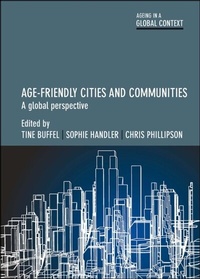
Age-Friendly Cities and Communities
A Global Perspective
Policy Press
1st Edition
Published on 17. January 2018
276 pages
978-1-4473-3132-2 (ISBN)
Description

As the drive towards creating age-friendly cities grows, this important book provides a comprehensive survey of theories and policies aimed at improving the quality of life of older people living in urban areas.
In this book, part of the Ageing in a Global Context series, leading international researchers critically assess the problems and the potential of designing age-friendly environments. The book considers the different ways in which cities are responding to population ageing, the different strategies for developing age-friendly communities, and the extent to which older people themselves can be involved in the co-production of age-friendly policies and practices.
The book includes a manifesto for the age-friendly movement, focused around tackling social inequality and promoting community empowerment.
In this book, part of the Ageing in a Global Context series, leading international researchers critically assess the problems and the potential of designing age-friendly environments. The book considers the different ways in which cities are responding to population ageing, the different strategies for developing age-friendly communities, and the extent to which older people themselves can be involved in the co-production of age-friendly policies and practices.
The book includes a manifesto for the age-friendly movement, focused around tackling social inequality and promoting community empowerment.
Reviews / Votes
"This important new collection should be read by planners, place makers, gerontologists and urban sociologists, everyone, in short, who is concerned with urban areas and how they might respond to demographic change. (It is) a fresh politicised approach to the AFC discussion... this book offers inspiration to those looking to understand and implement change in the complexity of the city." International Journal of Housing Policy "An invaluable resource for anybody interested in the global age-friendly movement and a clear and insightful agenda for future action." Alana Officer, responsible for the World Health Organization's Global Network for Age-friendly Cities and Communities "Useful for second and third year undergraduates and especially in modules with international context and a focus on older citizens. A welcome addition to our curriculum." Paul Simpson, Edgehill UniversityMore details
Series
Edition
First Edition
Language
English
Place of publication
Bristol
United Kingdom
Publishing group
Bristol University Press
Target group
Professional and scholarly
Illustrations
Not illustrated
ISBN-13
978-1-4473-3132-2 (9781447331322)
DOI
https://doi.org/10.51952/9781447331322
Copyright in bibliographic data and cover images is held by Nielsen Book Services Limited or by the publishers or by their respective licensors: all rights reserved.
Schweitzer Classification
Other editions
Additional editions
Age-Friendly Cities and Communities
A Global Perspective
Book
02/2019
1st Edition
Policy Press
€47.20
Shipment within 15-20 days
Tine Buffel | Sophie Handler | Chris Phillipson
Age-Friendly Cities and Communities
A Global Perspective
Book
01/2018
1st Edition
Policy Press
€103.40
Shipment within 15-20 days
Age-Friendly Cities and Communities
A Global Perspective
E-Book
01/2018
1st Edition
Policy Press
€52.49
Available for download
Persons
Tine Buffel is Professor of Sociology and Social Gerontology at the University of Manchester. She has published extensively on age-friendly issues and the impact of urban change and community life in old age.
Sophie Handler is an urban researcher currently working together with the University of Manchester and Age-friendly Manchester to help develop its Age-friendly strategy. She is the author of the Alternative Age-friendly Handbook.
Chris Phillipson is Professor of Sociology and Social Gerontology in the School of Social Sciences at the University of Manchester. He has published a number of general books in the field of ageing as well as a number of papers on age-friendly issues.
Sophie Handler is an urban researcher currently working together with the University of Manchester and Age-friendly Manchester to help develop its Age-friendly strategy. She is the author of the Alternative Age-friendly Handbook.
Chris Phillipson is Professor of Sociology and Social Gerontology in the School of Social Sciences at the University of Manchester. He has published a number of general books in the field of ageing as well as a number of papers on age-friendly issues.
Contributions
KU Leuven
University of Hong Kong, Pokfulam, Hong Kong
Senior Lecturer in Health, The Open University
Faculty of Health and Social Care, The Open University
Faculty of Health and Social Care, The Open University
The Open University
Manchester City Council
Manchester School of Architecture.
Manchester School of Architecture.
Centre for Research on Ageing, health and Wellbeing, ARC Centre for Excellence in Population Ageing Research, The Australian National University.
Content
Part One:Age-friendly cities and communities; background, theory and development
Introduction ~ Tine Buffel, Sophie Handler and Chris Phillipson;
The development of age-friendly cities and communities ~ Samuele Remillard-Boilard;
Neighbourhood change, social inequalities and age-friendly communities ~ Fleur Thomese,Tine Buffel and Chris Phillipson;
Addressing erasure, microfication and social change: age-friendly initiatives and environmental gerontology in the 21st century ~ Jessica A. Kelley, Dale Dannefer and Luma Issa Al Masarweh;
Part Two: Case studies from Europe, Asia and Australia;
Age and gentrification in Berlin: urban ageing policy and the experiences of disadvantaged older people ~ Meredith Dale, Josefine Heusinger and Birgit Wolter;
Towards an "active caring community" in Brussels ~ An-Sofie Smetcoren, Liesbeth De Donder, Daan Duppen, Nico De Witte, Olivia Vanmechelen and Dominique Verte;
Exploring the age-friendliness of Hong Kong: opportunities, initiatives and challenges in an ageing Asian city ~ David Phillips, Jean Woo, Francis Cheung, Moses Wong and Pui Hing Chau;
Creating an age-friendly county in Ireland: stakeholders' perspectives on implementation ~ Bernard McDonald, Thomas Scharf and Kieran Walsh;
Implementing age-friendly cities in Australia ~ Hal Kendig, Cathy Gong and Lisa Cannon;
Part Three: Age-friendly policies, urban design and a manifesto for change;
From representation to active ageing in a Manchester neighbourhood: designing the age-friendly city ~ Stefan White and Mark Hammond;
Alternative age-friendly initiatives: redefining age-friendly design ~ Sophie Handler;
Developing age-friendly policies for cities: strategies, challenges and reflections ~ Paul McGarry;
The age-friendly community: a test for inclusivity ~ Sheila Peace, Jeanne Katz, Caroline Holland and Rebecca L. Jones;
Age-friendly cities and communities: a manifesto for change ~ Tine Buffel, Sophie Handler and Chris Phillipson.
Introduction ~ Tine Buffel, Sophie Handler and Chris Phillipson;
The development of age-friendly cities and communities ~ Samuele Remillard-Boilard;
Neighbourhood change, social inequalities and age-friendly communities ~ Fleur Thomese,Tine Buffel and Chris Phillipson;
Addressing erasure, microfication and social change: age-friendly initiatives and environmental gerontology in the 21st century ~ Jessica A. Kelley, Dale Dannefer and Luma Issa Al Masarweh;
Part Two: Case studies from Europe, Asia and Australia;
Age and gentrification in Berlin: urban ageing policy and the experiences of disadvantaged older people ~ Meredith Dale, Josefine Heusinger and Birgit Wolter;
Towards an "active caring community" in Brussels ~ An-Sofie Smetcoren, Liesbeth De Donder, Daan Duppen, Nico De Witte, Olivia Vanmechelen and Dominique Verte;
Exploring the age-friendliness of Hong Kong: opportunities, initiatives and challenges in an ageing Asian city ~ David Phillips, Jean Woo, Francis Cheung, Moses Wong and Pui Hing Chau;
Creating an age-friendly county in Ireland: stakeholders' perspectives on implementation ~ Bernard McDonald, Thomas Scharf and Kieran Walsh;
Implementing age-friendly cities in Australia ~ Hal Kendig, Cathy Gong and Lisa Cannon;
Part Three: Age-friendly policies, urban design and a manifesto for change;
From representation to active ageing in a Manchester neighbourhood: designing the age-friendly city ~ Stefan White and Mark Hammond;
Alternative age-friendly initiatives: redefining age-friendly design ~ Sophie Handler;
Developing age-friendly policies for cities: strategies, challenges and reflections ~ Paul McGarry;
The age-friendly community: a test for inclusivity ~ Sheila Peace, Jeanne Katz, Caroline Holland and Rebecca L. Jones;
Age-friendly cities and communities: a manifesto for change ~ Tine Buffel, Sophie Handler and Chris Phillipson.
