

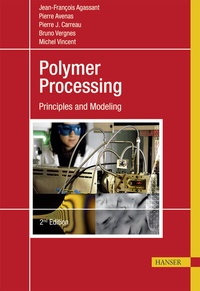
Polymer Processing
Principles and Modeling
2nd Edition
Published on 10. April 2017
888 pages
978-1-56990-606-4 (ISBN)
Description

Engineering of polymers is not an easy exercise: with evolving technology, it often involves complex concepts and processes. This book is intended to provide the theoretical essentials: understanding of processes, a basis for the use of design software, and much more.
The necessary physical concepts such as continuum mechanics, rheological behavior and measurement methods, and thermal science with its application to heating-cooling problems and implications for flow behavior are analyzed in detail. This knowledge is then applied to key processing methods, including single-screw extrusion and extrusion die flow, twin-screw extrusion and its applications, injection molding, calendering, and processes involving stretching.
With many exercises with solutions offered throughout the book to reinforce the concepts presented, and extensive illustrations, this is an essential guide for mastering the art of plastics processing. Practical and didactic, Polymer Processing: Principles and Modeling is intended for engineers and technicians of the profession, as well as for advanced students in Polymer Science and Plastics Engineering.
More details
Other editions
Additional editions

Jean-François Agassant | Pierre Avenas | Pierre J. Carreau
Polymer Processing
Principles and Modeling
E-Book
08/2017
2nd Edition
Hanser Publications
€249.99
Available for download

Jean-François Agassant | Pierre Avenas | Pierre J. Carreau
Polymer Processing
Principles and Modeling
Book
04/2017
2nd Edition
Hanser Publications
€249.99
Available immediately
Persons
Author
Content
- Intro
- Contents
- Foreword to the English Edition
- Preface to the Third French Edition
- Acknowledgements
- Introduction
- 1 Continuum Mechanics: Review of Principles
- 1.1 Strain and Rate-of-Strain Tensor
- 1.1.1 Strain Tensor
- 1.1.1.1 Phenomenological Definitions
- 1.1.1.1.1 Extension (or Compression)
- 1.1.1.1.2 Pure Shear
- 1.1.1.2 Displacement Gradient
- 1.1.1.3 Deformation or Strain Tensor e
- 1.1.1.4 Volume Variation During Deformation
- 1.1.2 Rate-of-Strain Tensor
- 1.1.3 Continuity Equation
- 1.1.3.1 Mass Balance
- 1.1.3.2 Incompressible Materials
- 1.1.4 Problems
- 1.1.4.1 Analysis of Simple Shear Flow
- 1.1.4.2 Study of Several Simple Shear Flows
- 1.1.4.2.1 Flow between Parallel Plates (Figure?1.6)
- 1.1.4.2.2 Flow in a Circular Tube (Figure?1.7)
- 1.1.4.2.3 Flow between Two Parallel Disks
- 1.1.4.2.4 Flow between a Cone and a Plate
- 1.1.4.2.5 Couette Flow
- 1.1.4.3 Pure Elongational Flow
- 1.1.4.3.1 Simple Elongation
- 1.1.4.3.2 Biaxial Stretching: Bubble Inflation
- 1.2 Stresses and Force Balances
- 1.2.1 Stress Tensor
- 1.2.1.1 Phenomenological Definitions
- 1.2.1.1.1 Extension (or Compression) (Figure?1.13)
- 1.2.1.1.2 Simple Shear (Figure?1.14)
- 1.2.1.2 Stress Vector
- 1.2.1.3 Stress Tensor
- 1.2.1.4 Isotropic Stress or Hydrostatic Pressure
- 1.2.1.5 Deviatoric Stress Tensor
- 1.2.2 Equation of Motion
- 1.2.2.1 Force Balances
- 1.2.2.2 Torque Balances
- 1.2.3 Problems
- 1.2.3.1 Shear Stress at the Surface of a Tube
- 1.2.3.2 Stresses in a Shell
- 1.3 General Equations of Mechanics
- 1.3.1 General Case
- 1.3.2 Incompressibility
- 1.3.3 Planar Flow
- 1.3.4 Problem: Stress Tensor in Simple Shear Flow
- 1.4 Appendices
- 1.4.1 Appendix?1: Basic Formulae
- 1.4.1.1 Cylindrical Coordinates
- 1.4.1.2 Spherical Coordinates
- 1.4.2 Appendix?2: Invariants of a Tensor
- 1.4.2.1 Definitions
- 1.4.2.2 Invariants Used in Fluid Mechanics
- References
- 2 Rheological Behavior of Molten Polymers
- 2.1 Viscosity: Equations for Newtonian Fluids
- 2.1.1 Basic Experiment of Newtonian Behavior
- 2.1.1.1 Phenomenological Definition of Newton (1713)
- 2.1.1.2 Experiment of Trouton: Concept of Elongational Viscosity
- 2.1.2 Generalization to Three Dimensions
- 2.1.2.1 Constitutive Equation
- 2.1.2.2 Simple Shear Flow
- 2.1.2.3 Uniaxial Extensional Flow
- 2.1.3 Magnitudes of the Forces Involved
- 2.1.3.1 Units of Viscosity and Orders of Magnitude
- 2.1.3.2 Reynolds Number
- 2.1.3.3 Effect of Gravity
- 2.1.4 Navier-Stokes Equations
- 2.1.5 Problems
- 2.1.5.1 Simple Shear Flow
- 2.1.5.2 Planar Pressure Flow
- 2.1.5.3 Superposition of a Simple Shear Flow and a Planar Pressure Flow
- 2.1.5.4 Pressure Flow in a Tube
- 2.1.5.5 Simple Shear between Two Parallel Disks
- 2.1.5.6 Couette Flow
- 2.1.5.7 Flow in a Dihedron
- 2.1.5.8 Flow in a Cone
- 2.2 Shear-Thinning Behavior
- 2.2.1 Phenomenological Description
- 2.2.2 Rheological Models in One Dimension
- 2.2.2.1 Power-Law Model
- 2.2.2.2 Cross Model
- 2.2.2.3 Carreau Model
- 2.2.3 Physical Explanation of the Shear-Thinning Behavior of Polymers
- 2.2.4 Three-Dimensional Constitutive Equations
- 2.2.5 Applications of the Power Law to Simple Flows
- 2.2.5.1 Simple Shear Flow
- 2.2.5.2 Pressure Flow in a Tube
- 2.2.6 Problems in Power-Law Fluids
- 2.2.6.1 Simple Shear Flow between Parallel Plates
- 2.2.6.2 Pressure Flow in a Tube
- 2.2.6.3 Planar Pressure Flow
- 2.2.6.4 Superposition of a Simple Shear Flow and a Planar Pressure Flow
- 2.2.6.5 Simple Shear Flow between Disks
- 2.2.6.6 Couette Flow
- 2.3 Behavior of Filled Polymers
- 2.3.1 Rheological Behavior of Suspensions
- 2.3.1.1 Dilute Suspensions of Spheres
- 2.3.1.2 Concentrated Suspensions of Spheres
- 2.3.1.3 Special Case of Fibers
- 2.3.1.3.1 Orientation
- 2.3.1.3.2 Rheological Behavior
- 2.3.2 Yield Stress Fluids
- 2.3.3 Problem: Pressure Flow of a Yield Stress Fluid in a Pipe
- 2.4 Viscoelastic Behavior
- 2.4.1 Physical Phenomena
- 2.4.1.1 Extrudate Swell
- 2.4.1.2 Weissenberg Effect
- 2.4.1.3 Time-Dependent Behavior
- 2.4.1.3.1 Stress Retardation and Relaxation
- 2.4.1.3.2 Recovery of Deformation after Cessation of Stress
- 2.4.1.3.3 Response of a Polymer to a Sinusoidal Motion
- 2.4.2 Linear Viscoelasticity and the Maxwell Model
- 2.4.2.1 General Information on Linear Viscoelastic Models
- 2.4.2.2 Behavior of a Maxwell Element
- 2.4.2.3 Qualitative Interpretation of Time-Dependent Phenomena
- 2.4.2.3.1 Stress Relaxation (Figure?2.30)
- 2.4.2.3.2 Stress Retardation (Figure?2.31)
- 2.4.2.3.3 Strain Recovery
- 2.4.2.3.4 Response to a Periodic Strain
- 2.4.3 Normal Stress Difference in Simple Shear
- 2.4.4 Extrudate Swell
- 2.4.5 Convected Maxwell Model
- 2.4.5.1 Transient Behavior
- 2.4.5.2 Viscometric Functions
- 2.4.5.3 Elongational Viscosity
- 2.4.6 Viscoelastic Dimensionless Numbers
- 2.4.7 Physical Interpretation of the Viscoelastic Behavior of Polymer Melts
- 2.4.7.1 Rouse Model (1953)
- 2.4.7.2 Temporary Network Models
- 2.4.7.3 Models of Cooperative Motion of a Chain and Its Neighbors
- 2.4.7.4 Reptation Models
- 2.4.7.5 Pom-Pom Models
- 2.4.8 Some Viscoelastic Constitutive Equations
- 2.4.8.1 Different Types of Viscoelastic Constitutive Equations
- 2.4.8.1.1 Equations with Memory Function or Integral Constitutive?Equations
- 2.4.8.1.2 Differential Constitutive Equations
- 2.4.8.2 Choice of a Rheological Model
- 2.4.9 Problems in the Convected Maxwell Model
- 2.4.9.1 Maxwell Fluid in Simple Shear
- 2.4.9.2 Shear Flow of a Maxwell Fluid between Parallel Disks
- 2.4.9.3 Couette Flow of a Maxwell Fluid
- 2.4.9.4 Stretching of a Maxwell Fluid
- 2.5 Measurement of the Rheological Behavior of Polymer Melts
- 2.5.1 Capillary Rheometer: Viscosity Measurements
- 2.5.1.1 Principle of the Measurements
- 2.5.1.2 Obtaining a Viscosity Curve
- 2.5.1.3 Influence of Temperature
- 2.5.1.3.1 Arrhenius Equation
- 2.5.1.3.2 WLF Equation
- 2.5.1.3.3 Master Curves
- 2.5.1.4 Influence of Pressure
- 2.5.2 Slit Die Rheometer
- 2.5.3 Flow with a Wall Slip
- 2.5.4 Cone-and-Plate Rheometer
- 2.5.4.1 Presentation of the Cone-and-Plate Rheometer
- 2.5.4.2 Steady Shear
- 2.5.4.3 Oscillatory Shear (SAOS)
- 2.5.4.4 Transient Modes
- 2.5.5 Parallel-Plate Rheometer
- 2.5.5.1 Steady Shear
- 2.5.5.2 Oscillatory Shear (SAOS)
- 2.5.6 Elongational Rheometry
- 2.5.6.1 Difficulties in Elongational Viscosity Measurements
- 2.5.6.2 Elongational Rheometers
- 2.5.6.3 Other Measurement Methods
- 2.5.6.3.1 Isothermal Stretching
- 2.5.6.3.2 Converging Flows
- 2.5.7 Notions of Rheo-optics
- 2.5.7.1 Flow Birefringence
- 2.5.7.1.1 Measurement Principle and Experimental Setup
- 2.5.7.1.2 Example of Experimental Results
- 2.5.7.2 Laser Doppler Velocimetry
- 2.5.7.2.1 Measurement Principle and Experimental Setup
- 2.5.7.2.2 Example of Results
- 2.5.8 Perspective
- 2.6 Appendices
- 2.6.1 Appendix?1: Physics of Viscosity
- 2.6.1.1 Eyring Theory
- 2.6.1.2 Molecular Weight Dependence of the Viscosity of Polymers
- 2.6.1.2.1 Viscosity of Polymers Having a Molecular Weight Less?than?Mc
- 2.6.1.2.2 Viscosity of Polymers Having a Molecular Weight Higher?than?Mc
- 2.6.1.3 Free Volume Theory
- 2.6.2 Appendix?2: An Approach to Viscoelasticity: Elastic?Dumbbell?Model
- 2.6.2.1 Interest of the Dumbbell Models
- 2.6.2.2 Model Description
- 2.6.2.3 Dumbbell in Simple Shear
- 2.6.2.3.1 Hydrodynamic Actions
- 2.6.2.3.2 Force due to Brownian Motion
- 2.6.2.3.3 Balance of Forces and Conservation of the Number of Molecules
- 2.6.2.3.4 Average Deformation of the Macromolecule
- 2.6.2.3.5 Comments
- 2.6.2.4 Macromolecule Deformation in Complex Flows
- 2.6.2.5 Macromolecule Deformation in Planar Extension
- 2.6.2.6 Concluding Remarks
- 2.6.3 Appendix?3: Material and Convected Derivatives
- 2.6.3.1 Substantial or Material Derivative of a Tensor
- 2.6.3.2 Convected Derivative of a Tensor
- 2.6.3.3 Special Case of the Rotation of a Disk about Its Axis
- 2.6.4 Appendix?4: Rabinowitsch Correction (Rabinowitsch, 1929)
- 2.6.5 Appendix?5: Flow of a Viscoelastic Fluid in a Cone-and-Plate Geometry
- 2.6.5.1 Kinematics Hypotheses
- 2.6.5.2 Viscometric Functions
- 2.6.5.3 Dynamic Equilibrium of the System
- 2.6.5.4 Small Cone Angle Limit
- 2.6.6 Appendix?6: Viscometric Flows
- References
- 3 Energy and Heat Transfer in Polymer Processes
- 3.1 Basic Notions on Heat Transfer
- 3.1.1 First Law of Thermodynamics
- 3.1.2 Heat Received by the System
- 3.1.3 Power Generated by Internal Forces
- 3.1.3.1 Work Done by Deformation
- 3.1.3.1.1 Extension or compression
- 3.1.3.1.2 Simple Shear
- 3.1.3.2 Generalization
- 3.1.3.3 Power Generated by Internal Forces (Dissipated Power)
- 3.1.3.4 Newtonian and Shear-Thinning, Power-Law Liquids
- 3.1.4 Equation of Energy
- 3.1.5 Internal Energy
- 3.1.5.1 Temperature-Dependent Internal Energy, e
- 3.1.5.2 Compressible Materials
- 3.1.5.3 Change of State or Chemical Reaction
- 3.1.6 Boundary Conditions
- 3.1.6.1 Mathematical Conditions
- 3.1.6.2 Conditions Depending on the Environment
- 3.1.6.2.1 Polymer in Contact with a Metallic Surface
- 3.1.6.2.2 Polymer in Contact with a Fluid (Air or Water)
- 3.1.7 Solutions of the Heat Transfer Equation
- 3.2 Cooling in Molds, in Air, and in Water
- 3.2.1 Context
- 3.2.2 Heat Transfer Equation
- 3.2.2.1 Body at Rest
- 3.2.2.2 Body in Motion
- 3.2.3 Heat Penetration Thickness
- 3.2.4 Interfacial Temperature
- 3.2.4.1 Conductive Heat Transfer: Notion of Effusivity
- 3.2.4.2 Conductive and Convective Heat Transfer
- 3.2.5 Heating (or Cooling) of a Plate
- 3.2.5.1 Isothermal Boundary Conditions
- 3.2.5.1.1 Exact Solution
- 3.2.5.1.2 Approximate Solution
- 3.2.5.2 Convective Boundary Conditions
- 3.2.5.2.1 Exact Solution
- 3.2.5.2.2 Approximate Solution
- 3.3 Polymer Flow and Heat Transfer
- 3.3.1 Importance of Viscous Heating: The Brinkman Number
- 3.3.2 Notion of a Thermal Regime
- 3.3.3 The Equations
- 3.3.3.1 Energy Equation
- 3.3.3.2 Calculation of the Dissipated Heat,
- 3.3.3.2.1 Newtonian Behavior
- 3.3.3.2.2 Shear-Thinning, Power-Law Behavior
- 3.3.4 Equilibrium Regime
- 3.3.4.1 Equilibrium Regime for a Newtonian Polymer
- 3.3.4.1.1 Constant Temperature at the Walls,
- 3.3.4.1.2 Convective Boundary Condition
- 3.3.4.2 Equilibrium Regime for a Power-Law Polymer and a Constant Wall Temperature
- 3.3.5 Adiabatic Regime
- 3.3.6 Transition Regime for a Newtonian Fluid
- 3.3.6.1 Average Temperature with a Convective Boundary Condition
- 3.3.6.2 Evaluation of the Nusselt Number (or?of?the?Heat?Transfer?Coefficient)
- 3.3.6.2.1 Expression for Nueq
- 3.3.6.2.2 Control Temperature Equal to the Initial Polymer Temperature
- 3.3.6.2.3 Control Temperature Different from the Initial Polymer Temperature
- 3.3.7 Transition Regime with a Power-Law Fluid
- 3.3.8 Comparison with an Exact Solution
- 3.3.8.1 Calculations without Mechanical-Thermal Coupling
- 3.3.8.1.1 Newtonian Polymer
- 3.3.8.1.2 Shear-Thinning Polymer
- 3.3.8.2 Computations with Thermal Coupling
- 3.3.9 Other Flow Geometries
- 3.3.9.1 Simple Shear Flow between Parallel Plates
- 3.3.9.1.1 Thermal Equilibrium Regime
- 3.3.9.1.2 Adiabatic Regime
- 3.3.9.1.3 Transition Regime
- 3.3.9.2 Heat Generation in Planar Pressure Flow
- 3.3.10 Application to Flat Die Extrusion
- 3.3.11 Conclusion
- 3.4 Appendices
- 3.4.1 Appendix?1: Convective Heat Transfer
- 3.4.1.1 Free and Forced Convection
- 3.4.1.2 The Bénard Problem
- 3.4.1.2.1 Description of the Experiments
- 3.4.1.2.2 Determination of DTc (Rayleigh, 1916)
- 3.4.1.3 Heat Transfer by Free Convection
- 3.4.1.3.1 General Principles
- 3.4.1.3.2 Horizontal Cylinder
- 3.4.1.3.3 Vertical Plate or Cylinder
- 3.4.1.3.4 Horizontal Plate
- 3.4.1.4 Example: Determination of the Heat Transfer Coefficient in?Free?Convection
- 3.4.1.4.1 Introduction
- 3.4.1.4.2 Physical Properties of Air and Water
- 3.4.1.4.3 Example
- 3.4.1.5 Forced Convection
- 3.4.1.5.1 Introduction
- 3.4.1.5.2 General Relationships
- 3.4.1.5.3 Sphere
- 3.4.1.5.4 Cylinder Perpendicular to the Flow Stream
- 3.4.1.5.5 Plate or Cylinder Parallel to the Flow Stream
- 3.4.1.5.6 Example: Determination of the Heat Transfer Coefficient in?Forced?Convection
- 3.4.2 Appendix?2: Radiation Heat Transfer
- 3.4.2.1 Blackbody
- 3.4.2.2 Nonblackbodies
- 3.4.2.2.1 Absorption of Nonblackbodies
- 3.4.2.2.2 Radiation Emitted by a Nonblackbody
- 3.4.2.3 Radiation Heat Exchange between Gray Bodies
- 3.4.2.3.1 Generalities
- 3.4.2.3.2 Examples
- 3.4.2.4 Determination of Radiation Heat Transfer Coefficient
- 3.4.3 Appendix?3: Internal Energy for Compressible Materials
- References
- 4 Approximations and Calculation Methods
- 4.1 Equations for Polymer Processing
- 4.2 Choice of a Relevant Rheological Constitutive Equation
- 4.3 Choice of Boundary Conditions
- 4.3.1 Kinematics Boundary Conditions
- 4.3.2 Heat Transfer Boundary Conditions
- 4.3.3 Inlet Conditions
- 4.3.4 Exit Conditions
- 4.4 Approximation Methods
- 4.4.1 Approximations Concerning the Geometry of the Flow
- 4.4.1.1 Unwinding or Flattening of an Annular or a Helical Geometry
- 4.4.1.2 Decomposition of Complex Flow Geometry in Several Simple Flows
- 4.4.2 Kinematics Approximations
- 4.4.2.1 Lubrication Approximations
- 4.4.2.2 Hele-Shaw Approximations
- 4.4.2.3 Approximation of a Slender Body (or Thin Film)
- 4.4.2.4 Important Remark
- 4.4.3 Approximations for the Temperature
- 4.4.4 Conclusion and Application Example
- 4.4.5 Problems
- 4.4.5.1 Flow in a Dihedron
- 4.4.5.2 Flow in a Cone
- 4.5 Pressure Buildup in Polymer Flows: Hydrodynamics Bearings
- 4.5.1 Introduction
- 4.5.2 Qualitative Analysis of Some Hydrodynamics Bearings
- 4.5.2.1 Rayleigh Bearing
- 4.5.2.2 Reynolds Bearing
- 4.5.2.3 Flow between Two Rolls
- 4.5.3 Pressure Generated by a Sudden Flow Restriction (Rayleigh?Bearing)
- 4.5.4 Flow Calculation in a Bearing of Variable Gap: the?Reynolds?Equation
- 4.5.5 Problem: Reynolds Bearing
- 4.6 Calculation Methods
- 4.6.1 Calculation Methods as Functions of the Type of Flow
- 4.6.1.1 Simple Shear or Simple Stretching Isothermal Flows
- 4.6.1.2 Unidirectional Isothermal Flows
- 4.6.1.3 Nonisothermal Shear or Elongation Unidirectional Flows
- 4.6.1.4 Bidirectional Thin Layer Flows (Isothermal?or?Nonisothermal)
- 4.6.1.5 2D or 3D Flows
- 4.6.2 Solution of Unidirectional Flows: Slab Method (or?Incremental?Method)
- 4.6.3 Solution of the Hele-Shaw Equations
- 4.6.3.1 Newtonian Isothermal Case
- 4.6.3.2 Non-Newtonian Isothermal Viscous Case
- 4.6.3.3 Nonisothermal Case (Average Temperature Solution)
- 4.6.4 2D and 3D Viscous Flow Calculations with a Finite Elements Method
- 4.6.4.1 Mechanical Equations
- 4.6.4.2 Meshing
- 4.6.4.3 Finite Elements Solution
- 4.6.4.4 Finite Elements Solution of the Energy Equation
- 4.6.5 Isothermal Flow Viscoelastic Computations
- 4.6.5.1 Direct Solution Methods
- 4.6.5.2 Iterative Methods
- 4.7 Appendix
- 4.7.1 Appendix?1: Analysis of the Lubrication Approximations
- 4.7.1.1 Introduction
- 4.7.1.2 Analysis of the Relative Weight of the Terms of the Rate-of-Strain Tensor
- 4.7.1.3 Simplification of the Equations of Motion
- 4.7.1.4 Validity of the Lubrication Approximations
- References
- 5 Single-Screw Extrusion and Die?Flows
- 5.1 Single-Screw Extrusion
- 5.1.1 Geometric and Kinematic Description
- 5.1.1.1 The Different Zones of the Extruder
- 5.1.1.2 Geometry of the Screw
- 5.1.1.3 Description of the Screw Channel
- 5.1.1.4 Classical Approximations
- 5.1.1.4.1 Approximation of a Fixed Barrel and a Rotating Screw
- 5.1.1.4.2 Unwound Screw Channel
- 5.1.1.4.3 Relative Velocity of the Barrel
- 5.1.1.5 Reference Extruder
- 5.1.2 Feeding Zone
- 5.1.2.1 Solid Polymer Conveying
- 5.1.2.2 Polymer-Metal Friction
- 5.1.2.3 Archimedes' Screw
- 5.1.2.4 Model of Darnell and Moll (1956)
- 5.1.2.5 Flow Rate Calculation and Optimization
- 5.1.2.6 Role of Pressure
- 5.1.2.7 Technological Consequences
- 5.1.2.8 Model Improvements
- 5.1.3 Melting Zone
- 5.1.3.1 Physical Description of the Phenomena
- 5.1.3.1.1 Experimental Observations
- 5.1.3.1.2 Delay Zone (Kacir and Tadmor, 1972)
- 5.1.3.1.3 Initiation of the Melting by Melt Pool
- 5.1.3.1.4 Melting Mechanism by Melt Pool
- 5.1.3.2 Initiation of the Melting Process by Melt Pool
- 5.1.3.3 Melting Model of Tadmor and Klein (1970)
- 5.1.3.3.1 Melting Rate
- 5.1.3.3.2 Changes Induced by the Clearance between the Screw and?the?Barrel
- 5.1.3.3.3 Length of the Melting Zone
- Role of Compression
- 5.1.3.4 Other Models
- 5.1.3.5 Technological Consequences: Barrier Screws
- 5.1.4 Flow of the Molten Polymer
- 5.1.4.1 Pumping Zone
- 5.1.4.1.1 Review of the Geometry
- 5.1.4.1.2 Flow Equations
- 5.1.4.1.3 Study of the Transverse Flow
- 5.1.4.1.4 Study of the Longitudinal Flow
- 5.1.4.1.5 Concept of Residence Time Distribution
- 5.1.4.2 Compression Zone
- 5.1.4.3 Role of the Screw/Barrel Clearance
- 5.1.4.4 Study of Thermal Phenomena
- 5.1.4.5 Concept of Characteristic curves
- 5.1.4.6 Model Improvements
- 5.1.4.7 Technological Consequences
- 5.1.4.7.1 Degassing Extruders (Two-Stage Vented Screws)
- 5.1.4.7.2 Mixing Elements
- 5.1.5 Overall Model of Single-Screw Extrusion
- 5.1.5.1 Introduction
- 5.1.5.2 Examples of Results
- 5.1.5.2.1 Reference Extruder
- 5.1.5.2.2 Optimization of the Pumping Zone
- 5.1.5.3 Conclusions
- 5.1.6 Extrusion Problems
- 5.1.6.1 Initiation of the Melting by Melt Pool
- 5.1.6.2 Melting Regime by Melt Pool
- 5.1.6.3 Criteria for Choosing an Extruder
- 5.2 Extrusion Dies
- 5.2.1 Introduction: Role of an Extrusion Die
- 5.2.2 Description of the Encountered Geometries
- 5.2.2.1 Film-Blowing Dies
- 5.2.2.2 Pipe Dies
- 5.2.2.3 Plate Dies (or Flat Dies)
- 5.2.2.4 Profile Dies
- 5.2.2.5 Wire-Coating Dies
- 5.2.3 Assumptions and Calculation Methods Revisited
- 5.2.4 Examples of Results
- 5.2.4.1 Film-Blowing Dies
- 5.2.4.2 Pipe Dies
- 5.2.4.3 Flat Dies
- 5.2.4.4 Wire-Coating Dies
- 5.2.4.5 Profile Dies
- 5.2.5 Conclusion
- 5.2.6 Die Problems
- 5.2.6.1 Flow in a Flat T-die
- 5.2.6.2 Flow in a Flat Coat-Hanger Die
- 5.3 Multilayer Flows
- 5.3.1 Interest of Multilayer Flows and Related Problems
- 5.3.2 Study of the Steady Flow of Two Viscous Fluids between Parallel Plates
- 5.3.2.1 Continuity Conditions at the Interface
- 5.3.2.2 Isothermal Newtonian Two-Layer Flow
- 5.3.2.3 Generalization to Power-Law Behavior
- 5.3.3 Flat Die Coextrusion
- 5.3.3.1 Process Description
- 5.3.3.2 One-Dimensional Approach
- 5.3.3.3 Two-Dimensional Approach
- 5.3.3.4 Two-Dimensional Hele-Shaw Approach
- 5.3.4 Coextrusion Die Problems
- 5.3.4.1 Three-Layer Coextrusion Flow between Parallel Plates
- 5.3.4.2 Coextrusion Flow in a Capillary
- 5.4 Appendix
- 5.4.1 Appendix?1: Calculation of Solid Velocity in Single-Screw Extrusion
- References
- 6 Twin-Screw Extrusion and Applications
- 6.1 General Description of Twin-Screw Extrusion Process
- 6.1.1 Different Types of Twin-Screw Extruders
- 6.1.2 Flow Types
- 6.1.3 Specific Features of Corotating Twin-Screw Extrusion
- 6.1.4 Geometry of Screws and Barrel
- 6.1.5 Classical Approximations
- 6.1.6 Different Modeling Approaches
- 6.1.7 Reference Extruder
- 6.2 Solid Conveying and Melting
- 6.2.1 Solid Conveying Zone
- 6.2.2 Melting Zone
- 6.3 Melt Flow
- 6.3.1 Right- and Left-Handed Screw Elements
- 6.3.1.1 One-Dimensional Models
- 6.3.1.2 Two-Dimensional Models
- 6.3.1.3 Three-Dimensional Models
- 6.3.1.4 Thermal Effects
- 6.3.2 Mixing Elements
- 6.3.2.1 One-Dimensional Models
- 6.3.2.2 Two-Dimensional Models
- 6.3.2.3 Three-Dimensional Models
- 6.4 Global Model of Twin-Screw Extrusion
- 6.4.1 General Description
- 6.4.2 Residence Time Distribution
- 6.4.3 Examples of Results
- 6.5 Application to the Production of Polymer Blends
- 6.5.1 Basic Mechanisms
- 6.5.1.1 Mechanisms of Rupture
- 6.5.1.2 Mechanisms of Coalescence
- 6.5.2 Modeling along the Extruder and Examples of Results
- 6.6 Application to Compounding Operations
- 6.6.1 Different Types of Mixing
- 6.6.2 Distributive Mixing
- 6.6.3 Dispersive Mixing: Application to the Production of?Nanocomposites
- 6.7 Application to Reactive Extrusion
- 6.8 Optimization and Scale-Up
- 6.9 Conclusion
- 6.10 Problem: Simplified Model of the Flow around a Kneading Disk
- References
- 7 Injection Molding
- 7.1 Description
- 7.2 Filling Stage
- 7.2.1 Peculiarities of the Filling Phase
- 7.2.2 Main Hypotheses and Governing Equations
- 7.2.2.1 Purely Viscous Flow Behavior
- 7.2.2.2 Incompressibility
- 7.2.2.3 Negligible Gravitational and Inertial Forces
- 7.2.2.4 Equations
- 7.2.3 Unidirectional Flows
- 7.2.3.1 Introduction
- 7.2.3.2 Filling of a Center-Gated Disk Mold
- 7.2.3.2.1 Newtonian Isothermal Behavior
- 7.2.3.2.2 Isothermal Shear-Thinning Behavior
- 7.2.3.2.3 Nonisothermal Generalized Newtonian Behavior
- 7.2.4 Thin Flow or Hele-Shaw Models
- 7.2.5 3D Computations
- 7.3 Packing and Holding Phase
- 7.3.1 Introduction
- 7.3.2 Simplified Calculations of the Packing Phase
- 7.3.3 Physical Data for the Packing-Holding Calculations
- 7.3.3.1 Measurements of PVT Data
- 7.3.3.2 Modeling
- 7.3.4 Calculations
- 7.3.4.1 Thin-Flow Approaches
- 7.3.4.2 3D Computations
- 7.3.5 Conclusions
- 7.4 Residual Stresses and Deformations
- 7.4.1 Introduction
- 7.4.2 Main Physical Phenomena Involved
- 7.4.2.1 Thermal Shrinkage
- 7.4.2.2 Frozen-In Stresses
- 7.4.3 Measurement of Residual Stresses
- 7.4.4 Calculations of Residual Stresses
- 7.5 Nonstandard Injection-Molding Techniques
- 7.5.1 Gas-Assisted Injection Molding (GAIM)
- 7.5.2 Water-Assisted Injection Molding (WAIM)
- 7.5.3 Multicomponent Injection Molding
- 7.6 Injection of Short Fiber Reinforced Polymers
- 7.7 Conclusion
- 7.8 Problems
- 7.8.1 Filling of a Center-Gated Disk
- 7.8.2 Balancing of a Multicavity Mold
- References
- 8 Calendering
- 8.1 Introduction
- 8.2 Rigid Film Calendering Process
- 8.2.1 Presentation
- 8.2.2 Calendering Problems
- 8.2.3 Aim of Calendering Process Modeling
- 8.2.4 Kinematics of Calendering
- 8.2.5 Isothermal Newtonian Model Based on Lubrication Approximations
- 8.2.5.1 Reynolds Equation
- 8.2.5.2 Spread Height Calculation
- 8.2.5.3 Roll Separating Force and Torque Exerted on the Roll
- 8.2.6 More General Newtonian Models
- 8.2.6.1 Two-Dimensional Model
- 8.2.6.2 Influence of Slippage between the Polymer and the Rolls
- 8.2.6.3 Calendering Analysis When Introducing a Velocity Differential between the Rolls
- 8.2.6.4 Conclusions of the Different Newtonian Models
- 8.2.7 Shear-Thinning Calendering Model
- 8.2.7.1 Generalized Reynolds Equation
- 8.2.7.2 Integrated Generalized Reynolds Equation
- 8.2.8 Thermal Effects in Calendering
- 8.2.9 Viscoelastic Models
- 8.2.10 Use of Calendering Models
- 8.3 Postextrusion Calendering Process
- 8.3.1 Presentation
- 8.3.2 Process Modeling
- 8.3.2.1 Pressure Field Calculations
- 8.3.2.2 Temperature Field Calculations
- 8.4 Appendix
- 8.4.1 Appendix?1: Calculations of Two-Dimensional Flow in the Calender?Bank by a Finite Element Method
- 8.4.1.1 The Stokes Equations in Terms of the Stream and Vorticity?Functions
- 8.4.1.2 Solving the Stream and Vorticity Equations for the 2D Calendering Problem (Agassant and Espy, 1985)
- References
- 9 Polymer Stretching Processes
- 9.1 Introduction
- 9.2 Fiber Spinning
- 9.2.1 Different Fiber Spinning Situations
- 9.2.2 Isothermal Melt Spinning of a Newtonian Fluid
- 9.2.2.1 Kinematics Hypotheses
- 9.2.2.2 Set of Equations
- 9.2.2.3 Solution for Isothermal Newtonian Fiber Spinning
- 9.2.2.4 Application Examples
- 9.2.2.5 Validity of the Approximations Used
- 9.2.2.5.1 Neglecting the Shear Component
- 9.2.2.5.2 Neglecting the Gravitational (Mass) Force
- 9.2.2.5.3 Neglecting the Inertia Force
- 9.2.3 Isothermal Melt Spinning of a Viscoelastic Fluid
- 9.2.3.1 Equations
- 9.2.3.2 Dimensionless Equations
- 9.2.3.3 Solution
- 9.2.3.4 Results
- 9.2.4 Drawing of a Viscous Fluid in Nonisothermal Conditions
- 9.2.4.1 Mechanical Equations
- 9.2.4.1.1 Equations of Motion
- 9.2.4.1.2 Force Balance at the Filament Surface
- 9.2.4.1.3 Newtonian Hypothesis
- 9.2.4.2 Heat Transfer Equation
- 9.2.4.2.1 Forced Convection Term
- 9.2.4.2.2 Radiative Heat Transfer Coefficient
- 9.2.4.2.3 Viscous Dissipation Rate during Drawing
- 9.2.4.3 Solution for the Momentum and Heat Transfer Equations
- 9.2.4.4 Results
- 9.2.5 More General Models of Fiber Spinning
- 9.3 Biaxial Drawing
- 9.3.1 Introduction
- 9.3.2 Biaxial Stretching of a Newtonian Liquid
- 9.4 Cast-Film Process
- 9.4.1 Presentation
- 9.4.2 Different Kinematics Approaches
- 9.4.2.1 Two-Dimensional Membrane Approach
- 9.4.2.2 One-Dimensional Membrane Approach
- 9.4.2.3 One-Dimensional Approach
- 9.4.3 One-Dimensional Newtonian Model
- 9.4.4 One-Dimensional Membrane Model
- 9.4.4.1 Equations of the Newtonian Model
- 9.4.4.1.1 Stress Tensor
- 9.4.4.1.2 Equations
- 9.4.4.1.3 Boundary Conditions
- 9.4.4.2 Results of the One-Dimensional Newtonian Membrane Model
- 9.4.4.3 Equations of a Viscoelastic Model
- 9.4.4.4 Results of the One-Dimensional Viscoelastic Membrane Model
- 9.4.5 Two-Dimensional Membrane Model
- 9.4.5.1 Equations of the Problem
- 9.4.5.2 Results of the Two-Dimensional Membrane Model
- 9.4.5.3 Nonisothermal Model
- 9.4.6 Conclusions
- 9.4.7 Problems
- 9.4.7.1 Drawing of a Constant-Width Film
- 9.4.7.2 Extrusion of Tubes
- 9.5 Film-Blowing Process
- 9.5.1 Process Description
- 9.5.2 Film Geometry
- 9.5.3 Equations of the Film-Blowing Process
- 9.5.3.1 Kinematics of Bubble Formation
- 9.5.3.2 Stresses Acting on the Bubble
- 9.5.3.2.1 Force Balance in the Drawing Direction and Meridian Stress
- 9.5.3.2.2 Force Balance Perpendicular to the Film
- 9.5.3.2.3 Order of Magnitude of the Stress Components
- 9.5.3.3 Heat Balance Equations
- 9.5.4 Nonisothermal Newtonian Model
- 9.5.4.1 Equations
- 9.5.4.2 Examples of Results
- 9.5.5 Nonisothermal Viscoelastic Model
- 9.5.5.1 Equations
- 9.5.5.2 Examples of Results
- 9.5.6 A Semiempirical Model of the Blown-Film Process
- 9.5.7 Conclusions
- 9.6 Manufacture of Hollow Plastic Bodies
- 9.6.1 Various Blow-Molding Processes
- 9.6.1.1 Extrusion Blow Molding
- 9.6.1.2 Stretch Blow-Molding Process
- 9.6.1.3 Problems Encountered in Blow Molding
- 9.6.2 Modeling of Extrusion Blow Molding
- 9.6.2.1 Membrane or Thick Shell?
- 9.6.2.2 Choice of Rheological Behavior
- 9.6.2.3 Application to the Blowing of a Complex Hollow Part
- 9.6.2.3.1 Curvilinear Coordinates
- 9.6.2.3.2 Dynamic Equilibrium of the Membrane
- 9.6.2.3.3 Boundary Conditions for the Pressure
- 9.6.2.3.4 Example
- 9.6.3 Stretch Blow-Molding Process
- 9.6.3.1 Introduction
- 9.6.3.2 Process Modeling
- 9.6.3.2.1 Model
- 9.6.3.2.2 Boundary Conditions
- 9.6.3.2.3 Numerical Solution
- 9.6.3.3 Example
- 9.6.4 Conclusions
- 9.6.5 Problems
- 9.6.5.1 Inflation of a Newtonian Spherical Membrane
- 9.6.5.2 Blowing of a Tubular Newtonian Membrane of Constant Length
- 9.6.5.3 Blowing of a Thick Newtonian Tube of Constant Length
- 9.7 Appendices
- 9.7.1 Appendix?1: Solution of the Isothermal Cast-Film Equations
- 9.7.1.1 One-Dimensional Membrane Model, Newtonian Case
- 9.7.1.1.1 Equations
- 9.7.1.1.2 Dimensionless Variables
- 9.7.1.1.3 Solution
- 9.7.1.2 Two-Dimensional Membrane Model: Viscoelastic Case
- 9.7.1.2.1 Dimensionless Variables
- 9.7.1.2.2 Solution
- 9.7.1.3 Two-Dimensional Membrane Model
- 9.7.2 Appendix?2: Cooling of Films in Air or Water
- 9.7.2.1 Problem Statement
- 9.7.2.2 Solution
- 9.7.2.3 Cooling of the Film in Air
- 9.7.2.3.1 Heat Transfer Coefficient by Convection
- 9.7.2.3.2 Heat Transfer Coefficient by Radiation
- 9.7.2.3.3 Cooling Calculations
- 9.7.2.3.4 Results
- 9.7.2.4 Cooling of the Film in Water
- 9.7.3 Appendix?3: Solving the Film Blowing Equations
- 9.7.3.1 Newtonian Case
- 9.7.3.1.1 Equations and Unknowns
- 9.7.3.1.2 Dimensionless Variables
- 9.7.3.1.3 Solution
- 9.7.3.2 Viscoelastic Case
- 9.7.3.2.1 Equations and Unknowns
- 9.7.3.2.2 Dimensionless Variables
- 9.7.3.2.3 Solution
- References
- 10 Flow Instabilities
- 10.1 Extrusion Defects
- 10.1.1 Description of the Various Defects Observed in Capillary Rheometry
- 10.1.2 Extrusion Defects of Linear Polymers
- 10.1.2.1 Sharkskin Defect
- 10.1.2.1.1 Description
- 10.1.2.1.2 Defect Quantification
- 10.1.2.1.3 Key Parameters
- 10.1.2.1.4 Interpretation
- 10.1.2.1.5 Remedies
- 10.1.2.2 Oscillating Defect
- 10.1.2.2.1 Presentation
- 10.1.2.2.2 Key Parameters
- 10.1.2.2.3 Bagley Corrections
- 10.1.2.2.4 Stress at the Walls
- 10.1.2.2.5 Description of the Oscillating Cycle
- 10.1.2.2.6 Interpretation and Mechanisms
- 10.1.2.2.7 Molecular Interpretation
- 10.1.2.2.8 Example of Descriptive Model
- 10.1.2.2.9 Remedies
- 10.1.3 Extrusion Defects of Branched Polymers
- 10.1.3.1 Description
- 10.1.3.2 Wall Shear Stress
- 10.1.3.3 Influence of Geometry
- 10.1.3.4 Interpretation
- 10.1.3.4.1 Remedies
- 10.1.4 Summary and Outlook
- 10.2 Coextrusion Defects
- 10.2.1 Investigation of Coextrusion Instabilities
- 10.2.1.1 Influence of the Flow Configuration
- 10.2.1.2 Analysis of the Flow within a Coextrusion Die
- 10.2.2 Modeling Coextrusion Instabilities
- 10.2.2.1 Convective Stability Investigation
- 10.2.2.1.1 Asymptotic Stability Analysis
- 10.2.2.1.2 Convective Stability Analysis
- 10.2.2.2 Direct Numerical Simulation
- 10.2.3 Conclusions
- 10.3 Calendering Defects
- 10.3.1 Different Types of Defects
- 10.3.2 Analysis of the Matteness Defect
- 10.3.3 Analysis of the V-Shaped Defect
- 10.3.4 Analysis of the Rocket Defect
- 10.3.5 Conclusions
- 10.4 Drawing Instabilities
- 10.4.1 Description of Drawing Instabilities
- 10.4.1.1 Example of Fiber Spinning
- 10.4.1.2 Example of the Cast-Film Process
- 10.4.1.3 Example of the Film-Blowing Process
- 10.4.1.4 Conclusions
- 10.4.2 Modeling Fiber Spinning Instability
- 10.4.2.1 Stretching of a Newtonian Fluid under Isothermal Conditions
- 10.4.2.2 Influence of Thermal Phenomena
- 10.4.2.3 Influence of Viscoelasticity
- 10.4.3 Modeling Cast-Film Instability
- 10.4.3.1 Stability of a Constant Film Width Stretching Model
- 10.4.3.2 Stability of a 1D Membrane Model Accounting for Neck-In
- 10.4.3.3 Stability of the 2D Membrane Model
- 10.4.4 Modeling Film-Blowing Instabilities
- 10.4.5 Conclusion
- References
- Notations
- Color Supplement
- Subject Index
Introduction
Chapter 1: Continuum mechanics - Review of principles
Strain and rate of strain
Stress and force balance
General equations of mechanics
Chapter 2: Rheological behaviour of molten polymers
The Newtonian behaviour, Navier-Stokes equation
Shear Thinning behaviour
Behaviour of filled polymers
Viscoelasticity of polymeric liquids
Measurements of rheological behaviour
Chapter 3: Energy and heat transfer in polymer processing
Basic notions of energy
Heating and cooling cases
Temperature changes in polymer flows
Chapter 4: Approximation and computation methods
General equations for polymer processing
How to choose a relevant constitutive equation
Boundary conditions
Approximation methods
Pressure build-up mechanisms
Computation methods
Chapter 5: Single screw extrusion and die flows
Single screw extrusion
Extrusion dies
Coextrusion
Chapter 6: Twin-screw extrusion: description and application
General description of the twin-screw extrusion process
Solid conveying and melting
Molten polymer flow
Global model of the twin-screw process
Polymer blend processing
Compounding
Reactive processing
Optimization and scale-up
Conclusion
Exercise: simplified calculation of the flow in a mixing element
Chapter 7: Injection moulding
Presentation
Filling stage
Packing stage
Residual stresses and strains
Non-standard injection moulding processes
Injection moulding of short fibres reinforced thermoplastics
Conclusions
Exercises
Chapter 8: Calendering
Introduction
Thermo-mechanical analysis
Post-extrusion calendering
Chapter 9: Polymer fibres and films
Introduction
Fibre spinning
Biaxial stretching
Cast-film process
Blown film
Blow moulding
Chapter 10: Flow instabilities in polymer processes
Extrusion instabilities
Coextrusion instabilities
Calendering instabilities
Drawing instabilities
