

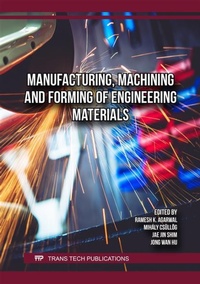
Manufacturing, Machining and Forming of Engineering Materials
Published on 30. June 2025
146 pages
978-3-0364-1846-9 (ISBN)
Description

This special edition presents a multidisciplinary view of emerging trends in materials science, technology development, manufacturing, and production equipment. It is intended for a broad audience, including researchers, engineers, and graduate students engaged in materials and technology development, biomedical engineering, and sustainable construction.
More details
Language
English
Place of publication
Zurich
Switzerland
Target group
Professional and scholarly
Illustrations
Illustrations
File size
20,95 MB
ISBN-13
978-3-0364-1846-9 (9783036418469)
DOI
10.4028/b-UYE4i2
Copyright in bibliographic data and cover images is held by Nielsen Book Services Limited or by the publishers or by their respective licensors: all rights reserved.
Schweitzer Classification
Other editions
Additional editions

Ramesh K. Agarwal | Mihaly Csuelloeg | Jae Jin Shim
Manufacturing, Machining and Forming of Engineering Materials
Book
approx. 07/2025
Trans Tech Publications Ltd
€173.32
Not yet published
Content
Preface
Chapter 1: Machining and Forming
Analysis of Grinding Technology of Spiroid Worm on a Classical Grinding Machine
Dependence of Quality and Productivity on the Type of Wire Electrode in WEDM of HSS
Evaluation of Thickness Distribution during Single Point Incremental Forming of Pure Aluminum Alloy Al1050
Chapter 2: Additive Manufacturing
On the Impact of Process Parameters and Ambient Temperature on Tensile Strength and Fatigue Behaviour of SLS-Built Polyamide-12
Evaluation of Tensile Behavior of 3D-Printed Fiberglass-Reinforced Nylon Composites
Optimization of Strength & Roughness for Vapor Smoothened FDM Fabricated PLA Parts through Exposure Time and Temperature
Characterization of Cellulose Nanocrystals (CNC) and its Reinforcing Impact as an Additive for PLA-TPU 3D Printing Filament
Chapter 3: Materials for Biomedical Applications
A Kinetic Study on Starch Digestibility and Polyphenol Release of Different Physically Modified Riceberry Flours during In Vitro Stimulated Gastrointestinal Digestion
Ibuprofen-Loaded PEGDMA/CNS Nanocomposite Hydrogels: A Drug Release Study
Chapter 4: Engineering of Technological Machines and Equipment
3D Printed Connection System for Bamboo Structure Construction
CAD Modelling and 3D Scanning of the Elements of the Wire Bending Mechanical Machine
CAD Modeling and Surface Roughness Measurement of the Gear Pair in the Wire Bending Machine
Chapter 5: Green Building Materials
Improving the Properties of the Masonry Produced Using Hemp Stalk with Bark Fibre to Meet Standard Strength and Properties of Energy Conserving Construction Material
Microstructure and Engineering Properties of New and Aged Bamboo as a Construction Material: The Effects of Borax/Boric Solution Treatment
Enhancing Hempcrete and Hemp Concrete Properties through Surface Treatment and Additives
Investigation of Optimal Ratios of EPS Foam Waste and Solvents as Alternative Green Polymer-Based Additives for Enhancing Cement Properties
Estimating the Parameters of a Structure by Using its Dynamic Response: A Study Based on a Cantilever Beam
Chapter 1: Machining and Forming
Analysis of Grinding Technology of Spiroid Worm on a Classical Grinding Machine
Dependence of Quality and Productivity on the Type of Wire Electrode in WEDM of HSS
Evaluation of Thickness Distribution during Single Point Incremental Forming of Pure Aluminum Alloy Al1050
Chapter 2: Additive Manufacturing
On the Impact of Process Parameters and Ambient Temperature on Tensile Strength and Fatigue Behaviour of SLS-Built Polyamide-12
Evaluation of Tensile Behavior of 3D-Printed Fiberglass-Reinforced Nylon Composites
Optimization of Strength & Roughness for Vapor Smoothened FDM Fabricated PLA Parts through Exposure Time and Temperature
Characterization of Cellulose Nanocrystals (CNC) and its Reinforcing Impact as an Additive for PLA-TPU 3D Printing Filament
Chapter 3: Materials for Biomedical Applications
A Kinetic Study on Starch Digestibility and Polyphenol Release of Different Physically Modified Riceberry Flours during In Vitro Stimulated Gastrointestinal Digestion
Ibuprofen-Loaded PEGDMA/CNS Nanocomposite Hydrogels: A Drug Release Study
Chapter 4: Engineering of Technological Machines and Equipment
3D Printed Connection System for Bamboo Structure Construction
CAD Modelling and 3D Scanning of the Elements of the Wire Bending Mechanical Machine
CAD Modeling and Surface Roughness Measurement of the Gear Pair in the Wire Bending Machine
Chapter 5: Green Building Materials
Improving the Properties of the Masonry Produced Using Hemp Stalk with Bark Fibre to Meet Standard Strength and Properties of Energy Conserving Construction Material
Microstructure and Engineering Properties of New and Aged Bamboo as a Construction Material: The Effects of Borax/Boric Solution Treatment
Enhancing Hempcrete and Hemp Concrete Properties through Surface Treatment and Additives
Investigation of Optimal Ratios of EPS Foam Waste and Solvents as Alternative Green Polymer-Based Additives for Enhancing Cement Properties
Estimating the Parameters of a Structure by Using its Dynamic Response: A Study Based on a Cantilever Beam
