

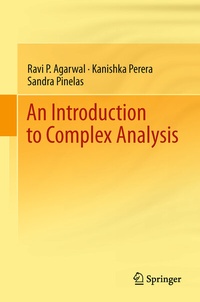
An Introduction to Complex Analysis
Description

Reviews / Votes
From the reviews:
"This work, directed toward majors in the applied sciences, is presented as a series of 50 lectures on standard topics in introductory complex analysis. Agarwal and Perera (both, Florida Institute of Technology) and Pinelas (Azores Univ., Portugal) have organized each lecture/chapter around certain theorems and their proofs and accompany each with a problem set and solutions. . Summing Up: Recommended. Upper-division undergraduates and graduate students." (D. Robbins, Choice, Vol. 49 (5), January, 2012)
"This volume provides a compact and thorough introduction to complex analysis. The text takes account of varying needs and backgrounds and provides a self-study text for students in mathematics, science and engineering. . This concise text not only provides efficient proofs but also shows students how to derive them. The excellent exercises are accompanied by selected solutions. . The exposition is clear, concise, and lively. The book is mainly addressed to undergraduate and graduate students interested in complex analysis." (Teodora-Liliana Radulescu, Zentralblatt MATH, Vol. 1230, 2012)
"It consists of 50 'class-tested lectures' in which the subject matter has been organized in the form of theorems, proofs and examples. Most of the lectures are . followed by graded exercises that go from the routine to the richly informative. Solutions and hints are provided for nearly all of these, which means that the book is highly suited for self-tuition purposes. . it is also suited to the needs of non-specialists, such as those concerned with the applied sciences." (P. N. Ruane, The Mathematical Association of America, October, 2011)
More details
Other editions
Additional editions
Content
Preface.-Complex Numbers.-Complex Numbers II .- Complex Numbers III.-Set Theory in the Complex Plane.-Complex Functions.-Analytic Functions I.-Analytic Functions II.-Elementary Functions I.- Elementary Functions II.- Mappings by Functions.- Mappings by Functions II.- Curves, Contours, and Simply Connected Domains.- Complex Integration.- Independence of Path.- Cauchy-Goursat Theorem.- Deformation Theorem.- Cauchy's Integral Formula.- Cauchy's Integral Formula for Derivatives.- Fundamental Theorem of Algebra.- Maximum Modulus Principle.- Sequences and Series of Numbers.- Sequences and Series of Functions.- Power Series.- Taylor's Series.- Laurent's Series.- Zeros of Analytic Functions.- Analytic Continuation.- Symmetry and Reflection.- Singularities and Poles I.- Singularities and Poles II.- Cauchy's Residue Theorem.- Evaluation of Real Integrals by Contour Integration I.- Evaluation of Real Integrals by Contour Integration II.- Indented Contour Integrals.- Contour Integrals Involving Multi-valued Functions .- Summation of Series. Argument Principle and Rouch´e and Hurwitz Theorems.- Behavior of Analytic Mappings.- Conformal Mappings.- Harmonic Functions.- The Schwarz-Christoffel Transformation.- Infinite Products.- Weierstrass's Factorization Theorem.- Mittag-Leffler's Theorem.- Periodic Functions.- The Riemann Zeta Function.- Bieberbach's Conjecture.- The Riemann Surface.- Julia and Mandelbrot Sets.- History of Complex Numbers.- References for Further Reading.- Index.
