

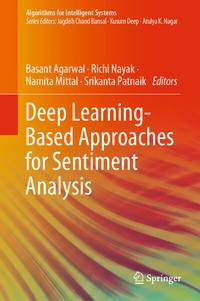
Deep Learning-Based Approaches for Sentiment Analysis
Description

This book covers deep-learning-based approaches for sentiment analysis, a relatively new, but fast-growing research area, which has significantly changed in the past few years. The book presents a collection of state-of-the-art approaches, focusing on the best-performing, cutting-edge solutions for the most common and difficult challenges faced in sentiment analysis research. Providing detailed explanations of the methodologies, the book is a valuable resource for researchers as well as newcomers to the field.
More details
Other editions
Additional editions
Persons
Dr. Basant Agarwal is an Assistant Professor at the Indian Institute of Information Technology Kota (IIIT-Kota), India. He holds a Ph.D. from MNIT Jaipur, and worked as a Postdoc Research Fellow at the Norwegian University of Science and Technology (NTNU), Norway, under the prestigious ERCIM (European Research Consortium for Informatics and Mathematics) fellowship in 2016. He has also worked as a Research Scientist at Temasek Laboratories, National University of Singapore (NUS), Singapore.
Dr. Richi Nayak holds an M.E. degree from the Indian Institute of Technology, Roorkee, India, and received her Ph.D. in Computer Science from the Queensland University of Technology (QUT), Brisbane, Australia, in 2001. She is currently an Associate Professor of Computer Science at QUT, where she is also Head of Data Science. She has been successful in attaining over $4 million in external research funding in the area of text mining over the past ten years. She is a consultant to anumber of government agencies in the area of data, text, and social media analytics projects. She is member of the steering committee of Australasian Data Mining in Australia (AusDM). She is the founder and leader of the Applied Data Mining Research Group at QUT. She has received a number of awards and nominations for teaching, research, and other activities.Dr. Namita Mittal is an Associate Professor at the Department of Computer Science and Engineering, MNIT Jaipur, India. She is a recipient of the Career Award for Young Teachers (CAYT) by AICTE. She has published numerous research papers in respected international conferences and journals, and has also authored a book on the topic of sentiment analysis in the Springer book series "Socio-Affective Computing". She is an SMIEEE, and a member of ACM, CCICI, and SCRS. She has been involved in various FDPs/conferences/workshops, like the Ph.D. Colloquium FIRE 2017, and International Workshop on Text Analytics and Retrieval(WI 2018) in conjunction with Web Intelligence (WI), USA, to name a few.
Dr. Srikanta Patnaik is a Professor at the Department of Computer Science and Engineering, Faculty of Engineering and Technology, SOA University, Bhubaneswar, India. He received his Ph.D. in Computational Intelligence from Jadavpur University, India, in 1999. Dr. Patnaik was the Principal Investigator of the AICTE-sponsored TAPTEC project "Building Cognition for Intelligent Robot" and the UGC-sponsored Major Research Project "Machine Learning and Perception using Cognition Methods". He is the Editor-in-Chief of the International Journal of Information and Communication Technology and the International Journal of Computational Vision and Robotics. Dr. Patnaik is also the Editor of the Journal of Information and Communication Convergence Engineering, published by the Korean Institute of Information and Communication Engineering. He is also the Editor-in-Chief of Springer book series "Modeling andOptimization in Science and Technology".
