

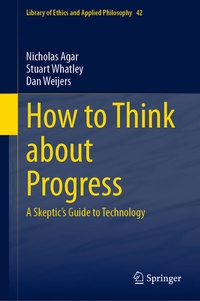
How to Think about Progress
Description

How to Think about Progress is an interdisciplinary work exploring whether optimistic claims about technology's potential stand up to humanity's most difficult challenges. Will technology solve the problems of climate change, pandemics, cancer, loneliness, unhappiness, and even death? The authors show that techno-hype is all too often accepted because of the horizon bias, i.e. the modern propensity to believe that any problem that can be solved with technology will be solved in the very near future. The authors situate their analysis in a broad context, drawing on history, literature, and popular culture to emphasize their case against techno-hype. They also draw on a wide range of research, including that of biologists, philosophers of science and of language, psychologists, theorists of technological change, specialists on digital technologies, historians of ideas, and economists. As a corrective to much mainstream "futurism," the book offers principles for seeing through much of the techno-hype that circulates online and in best-selling books. The authors share insights (without the jargon) from a variety of academic disciplines, making this book an engaging read for all audiences. Readers will find a balanced framework for thinking and writing about technological progress in the face of truly vexing challenges like cancer, climate change, and colonizing mars.
More details
Other editions
Additional editions
Persons
Nick Agar is Professor of Ethics at the University of Waikato. His principal focus has been on the ethical implications of technological change. Agar's most recent books are Dialogues on Human Enhancement (Routledge, 2024) and How to be Human in the Digital Economy (MIT Press, 2019). His 2004 book Liberal Eugenics (Wiley-Blackwell) has been widely cited and discussed. His 2010 and 2013 books on the enhancement debate, Humanity's End and Truly Human Enhancement , both with MIT Press, address reasons for doubt about the radical enhancement of our capacities. The doubts expressed in this book can be viewed as continuations of this reasoning about human enhancement technologies.
Stuart Whatley is Senior Editor at the influential international media organization Project Syndicate, where he oversees PS Quarterly and regularly edits many of the world's leading thinkers, including multiple Nobel laureate economists. His writing on technology and related topics has appeared at CNN and in Unherd, Democracy: A Journal of Ideas, The Hedgehog Review, The Los Angeles Review of Books, The Baffler, The Christian Science Monitor, The Guardian, The American Prospect, Free Inquiry , and other outlets.
Dan Weijers is Senior Lecturer at the University of Waikato (New Zealand). He researches wellbeing and the ethics of new technologies. He is Editor-in-Chief of the International Journal of wellbeing. His wellbeing policy advice has been commissioned by the New Zealand Treasury, the City Government of Dubai, and a High-Level Meeting of the United Nations.
Content
Preface.- Introduction.- The Rise of the Futurists.- The Horizon Bias.- The End of Disease.- Onward, to Mars.- But, What about Exponential Progress.- The Hand-off.- Waiting for the Techno Rapture.
