

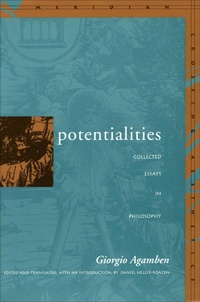
Potentialities
Collected Essays in Philosophy
1st Edition
Published on 25. May 2023
328 pages
978-0-8047-6407-0 (ISBN)
Description

This book collects fifteen major philosophical essays spanning more than twenty years by acclaimed Italian philosopher and author of
State of Exception.
Giorgio Agamben is one of contemporary philosophy's most influential thinkers on the subjects of language, power, society. This collection of essays opens with an enlightening introduction by the translator Daniel Heller-Roazen, who situates Agamben's work with respect to both the history of philosophy and contemporary European thought.
The essays that follow articulate a series of theoretical confrontations with privileged figures in the history of philosophy, politics, and criticism, from Plato to Spinoza, Aristotle to Deleuze, Carl Schmitt to Benjamin, Hegel to Aby Warburg, and Heidegger to Derrida.
Three fundamental concepts organize the collection as a whole: the existence of language; the nature of history; and the problem of potentiality in metaphysics, ethics, and the philosophy of language. All these topics converge in the final part of the book, in which Agamben offers an extensive reading of Melville's short story "Bartleby the Scrivener" as a work that puts potentiality and actuality, possibility and reality, in a new light.
Giorgio Agamben is one of contemporary philosophy's most influential thinkers on the subjects of language, power, society. This collection of essays opens with an enlightening introduction by the translator Daniel Heller-Roazen, who situates Agamben's work with respect to both the history of philosophy and contemporary European thought.
The essays that follow articulate a series of theoretical confrontations with privileged figures in the history of philosophy, politics, and criticism, from Plato to Spinoza, Aristotle to Deleuze, Carl Schmitt to Benjamin, Hegel to Aby Warburg, and Heidegger to Derrida.
Three fundamental concepts organize the collection as a whole: the existence of language; the nature of history; and the problem of potentiality in metaphysics, ethics, and the philosophy of language. All these topics converge in the final part of the book, in which Agamben offers an extensive reading of Melville's short story "Bartleby the Scrivener" as a work that puts potentiality and actuality, possibility and reality, in a new light.
All prices
More details
Other editions
Additional editions
Book
01/2000
Stanford University Press
€33.00
Shipment within 15-20 days
Book
01/2000
Stanford University Press
€86.96
Article exhausted; check different version
Persons
Content
- Potentialities
- Contents
- EditorÌs Note
- Potentialities
- EditorÌs Introduction
- The Thing Itself
- The Idea of Language
- Language and History:
- Linguistic and Historical Categories
- in BenjaminÌs Thought
- Philosophy and Linguistics
- Kommerell, or On Gesture
- Aby Warburg and the Nameless Science
- Tradition of the Immemorial
- Se : Hegel's Absolute and
- Heidegger's
- Walter Benjamin and the Demonic:
- Happiness and Historical Redemption
- The Messiah and the Sovereign:
- Problem of Law in Walter Benjamin
- On Potentiality
- The Passion of Facticity
- : The Writing of Potentiality
- Absolute Immanence
- Bartleby, or On Contingency
- Notes
- Index of Names
