

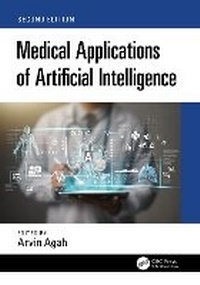
Medical Applications of Artificial Intelligence
2nd Edition
Will be published approx. on 16. November 2026
632 pages
E-Book
978-1-040-98719-3 (ISBN)
Description

This new edition examines the intersection of artificial intelligence and medicine, showcasing how AI techniques assist medical professionals by making healthcare more accurate, less expensive, more available, and more efficient. The book presents a holistic perspective on AI in medicine, from foundational principles to advanced applications.
Medical Applications of Artificial Intelligence, Second Edition delivers up-to-date coverage of diverse AI applications across healthcare domains including disease detection and diagnosis, medical imaging, surgery, drug development, healthcare administration, electronic health records, personalized medicine, telehealth, and patient monitoring. This edition provides updated coverage of AI applications in medicine, reflecting the significant advancements that have occurred in recent years. It incorporates the latest research and developments in clinical decision support systems, medical imaging analysis, and precision medicine approaches that have been further developed since the previous edition was published. It explains new AI techniques such as support vector machines, deep learning, and decision trees in accessible language, while providing extensive references for readers seeking deeper knowledge. It provides a broad international perspective on medical applications of artificial intelligence and emphasizes that these systems are designed to assist medical professionals-not replace them. This version also includes significantly expanded information on available resources on scientific journals, national and international conferences, and academic programs of study that are focused on applications of artificial intelligence to medicine.
This book is intended for those with expertise in artificial intelligence who are interested in applying their knowledge to medical domains, and to those with expertise in medicine who are interested in enhancing their medical efforts using AI.
Medical Applications of Artificial Intelligence, Second Edition delivers up-to-date coverage of diverse AI applications across healthcare domains including disease detection and diagnosis, medical imaging, surgery, drug development, healthcare administration, electronic health records, personalized medicine, telehealth, and patient monitoring. This edition provides updated coverage of AI applications in medicine, reflecting the significant advancements that have occurred in recent years. It incorporates the latest research and developments in clinical decision support systems, medical imaging analysis, and precision medicine approaches that have been further developed since the previous edition was published. It explains new AI techniques such as support vector machines, deep learning, and decision trees in accessible language, while providing extensive references for readers seeking deeper knowledge. It provides a broad international perspective on medical applications of artificial intelligence and emphasizes that these systems are designed to assist medical professionals-not replace them. This version also includes significantly expanded information on available resources on scientific journals, national and international conferences, and academic programs of study that are focused on applications of artificial intelligence to medicine.
This book is intended for those with expertise in artificial intelligence who are interested in applying their knowledge to medical domains, and to those with expertise in medicine who are interested in enhancing their medical efforts using AI.
More details
Edition
2nd edition
Language
English
Place of publication
London
United Kingdom
Publishing group
Taylor & Francis Ltd
Target group
College/higher education
Professional and scholarly
Product notice
Reflowable
Illustrations
33 Tables, black and white; 76 Line drawings, color; 13 Line drawings, black and white; 25 Halftones, color; 101 Illustrations, color; 13 Illustrations, black and white
ISBN-13
978-1-040-98719-3 (9781040987193)
Copyright in bibliographic data and cover images is held by Nielsen Book Services Limited or by the publishers or by their respective licensors: all rights reserved.
Schweitzer Classification
Other editions
Additional editions
Book
approx. 11/2026
2nd Edition
CRC Press
€197.50
Not yet published
Person
Dr. Arvin Agah is Charles E. & Mary J. Spahr Professor of Electrical Engineering and Computer Science at the University of Kansas, which he joined in 1997. He served as the Dean of Engineering from 2018 to 2024 and Associate Dean for Research and Graduate Programs from 2012 to 2018. His research interests include medical applications of artificial intelligence (AI), applied AI, and autonomous mobile robots. He has received multiple honors for his teaching excellence, including two university-wide awards.
Content
Chapter 1 Introduction to Medical Applications of Artificial Intelligence Chapter 2 Introduction to Machine Learning Chapter 3 Web-IntelliGenes: A reproducible, replicable, and transparent application of artificial intelligence and machine learning for predictive medicine Chapter 4 A Survey of Machine Learning Prediction of Hypoglycemia for Type 1 Diabetes Chapter 5 MicroRNA Target Prediction: 20+ Years and Two Strings Chapter 6 Lightweight classification of swallowing-respiratory coordination using Bayesian changepoint detection Chapter 7 Application of Reinforcement-Based Learning Feature Selection for
Early Detection of Alzheimer's Disease using Speech Chapter 8 The role of artificial intelligence in next generation drug discovery Chapter 9 Medical Applications of Artificial Intelligence Chapter 10 Multimodal AI in Precision Medicine: Integrating EHR, Imaging, and Omics Data Chapter 11 Artificial Intelligence in Non-small Cell Lung Cancer: Diagnosis, Prognosis, and Management Chapter 12 Multimodal Artificial Intelligence for Lung Cancer Screening: A Comprehensive Review of Deep Learning Approaches Chapter 13 Trans-amplifying (TA) mRNA Vaccines: A New Paradigm in Combating Infections and Cancers Chapter 14 Label Challenges in Breast Cancer AI: Noise, Bias, Uncertainty, and Limited Annotations Chapter 15 Health Digital Twin Applications: Disease Domains, Techniques, and Related Methods Chapter 16 Digital Health Programs for Sustainable Development: Insights from National and International Initiatives Chapter 17 Alzheimer's disease prediction using Brain MRI: Emphasis on Ensemble Learning Chapter 18 Learning-Based Image Registration Chapter 19 Representation Learning for ECG Data: Variational Autoencoders, Contrastive Learning, and Transformer Models Chapter 20 Artificial Intelligence in Aesthetic & Procedural Dermatology: Multimodal Imaging, Decision Support, and Outcome Optimization Chapter 21 Comparative Analysis of Linear and Nonlinear Stochastic Models for Real-Time Soft Tissue Characterisation Chapter 22 Artificial Intelligence and Computational Medicine: A Hands-on Approach Chapter 23 Artificial Intelligence in Modern Surgery: Clinical Applications, Education, and Health System Impact Chapter 24 How to get to True Robotic Surgery and Keep the Surgeon in the Loop : Cobotics, Autonomy and Artificial Intelligence Surgery Chapter 25 Importance of clinically adequate labelling in surgical phase detection of laparoscopic cholecystectomy procedures Chapter 26 Capturing Motion and AI in Medical Training, Rehabilitation, Remote Patient Monitoring, and the Diagnosis and Prognosis of Movement Disorders Chapter 27 Applications of Machine Learning and Artificial Intelligence in Personalized Gait Training After Stroke Chapter 28 A systematic review and meta-analysis of the evidence for generative AI chatbots for symptoms of anxiety, depression, and loneliness Chapter 29 Integrating Artificial Intelligence and Machine Learning into Palliative and End-of-Life Care Chapter 30 Resources on Medical Applications of Artificial Intelligence
Early Detection of Alzheimer's Disease using Speech Chapter 8 The role of artificial intelligence in next generation drug discovery Chapter 9 Medical Applications of Artificial Intelligence Chapter 10 Multimodal AI in Precision Medicine: Integrating EHR, Imaging, and Omics Data Chapter 11 Artificial Intelligence in Non-small Cell Lung Cancer: Diagnosis, Prognosis, and Management Chapter 12 Multimodal Artificial Intelligence for Lung Cancer Screening: A Comprehensive Review of Deep Learning Approaches Chapter 13 Trans-amplifying (TA) mRNA Vaccines: A New Paradigm in Combating Infections and Cancers Chapter 14 Label Challenges in Breast Cancer AI: Noise, Bias, Uncertainty, and Limited Annotations Chapter 15 Health Digital Twin Applications: Disease Domains, Techniques, and Related Methods Chapter 16 Digital Health Programs for Sustainable Development: Insights from National and International Initiatives Chapter 17 Alzheimer's disease prediction using Brain MRI: Emphasis on Ensemble Learning Chapter 18 Learning-Based Image Registration Chapter 19 Representation Learning for ECG Data: Variational Autoencoders, Contrastive Learning, and Transformer Models Chapter 20 Artificial Intelligence in Aesthetic & Procedural Dermatology: Multimodal Imaging, Decision Support, and Outcome Optimization Chapter 21 Comparative Analysis of Linear and Nonlinear Stochastic Models for Real-Time Soft Tissue Characterisation Chapter 22 Artificial Intelligence and Computational Medicine: A Hands-on Approach Chapter 23 Artificial Intelligence in Modern Surgery: Clinical Applications, Education, and Health System Impact Chapter 24 How to get to True Robotic Surgery and Keep the Surgeon in the Loop : Cobotics, Autonomy and Artificial Intelligence Surgery Chapter 25 Importance of clinically adequate labelling in surgical phase detection of laparoscopic cholecystectomy procedures Chapter 26 Capturing Motion and AI in Medical Training, Rehabilitation, Remote Patient Monitoring, and the Diagnosis and Prognosis of Movement Disorders Chapter 27 Applications of Machine Learning and Artificial Intelligence in Personalized Gait Training After Stroke Chapter 28 A systematic review and meta-analysis of the evidence for generative AI chatbots for symptoms of anxiety, depression, and loneliness Chapter 29 Integrating Artificial Intelligence and Machine Learning into Palliative and End-of-Life Care Chapter 30 Resources on Medical Applications of Artificial Intelligence
