

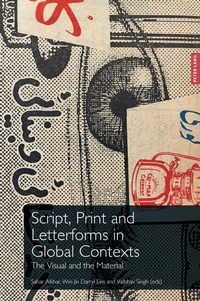
Script, Print and Letterforms in Global Contexts
Description

The global history of text-based communication constitutes a particularly exciting facet of material culture, given the myriad ways in which its production, transmission, and consumption has been - and continues to be - accomplished across cultural and political boundaries. However, a critical engagement with script and print outside the western world has remained relatively limited to summaries and generalisations, despite a burgeoning interest in the interrelated areas of printing, publishing, design, and type histories. The time is long overdue for these narratives relating to the material production of text to expand, and address the rich variation and particularity of global practices. Covering a variety of scripts and linguistic contexts, this volume explores the plurality of historical and contemporary engagements with, and interpretations of the printed and written word in various artefacts, printing technologies, and writing systems. Part of the Printing History and Culture series by the Centre for Printing History and Culture, this book presents critical perspectives and fresh approaches toward the study of the visual and material aspects of print in diverse linguistic environments - whether handwritten, lithographed, typographically printed, or digitally manifested.
More details
Other editions
Additional editions

Persons
Sahar Afshar is an independent type designer and researcher who divides her time between her practice, consultation, teaching and research, particularly in relation to the Arabic script and the various regions and cultures that use this writing system.
Wei Jin Darryl Lim is an independent book and print historian. His research remit focuses on the global and transregional networks of lithography and typography in the Malay world during the nineteenth and early-twentieth centuries.
Vaibhav Singh is an independent researcher, typographer, and type designer. Previously a Postdoctoral Fellow of the British Academy and chairman of the Printing Historical Society, he is the editor and publisher of Contextual Alternate, a journal of technology, design and history.
Content
Contents - List of Figures - List of Tables- Acknowledgement - Sahar Afshar, Wei Jin Darryl Lim and Vaibhav Singh: Introduction - Part I - Sahar Afshar: The Onset of Gurmukhi Printing in India - Jesús Barrientos Mora: Early Mexican Manuscripts and the Acquisition of Alphabetic Writing in Mesoamerica - Wei Jin Darryl Lim: Issues with Early Lithography in Batavia: Borrowed Presses and 'Soiled' Stones - Part II - Svenja Michel: Printed Hours: Networks of Printers, Devotion and the Repetition of Images in a Parisian Incunable - Eliza Deac: Shaping the Visual Identity of Modernist Poetry: The Role of the Typographical Layout in Symbolist and Avant-Garde Poems - Guglielmo Rossi: The Case for Collective Control: The Leveller Magazine and Publishing as a Prefigurative Political Form - Arina Stoenescu: A 'New' Socialist Polygraphic School: Typographic Education in Communist Romania (1948-1989) - Part III - Gerry Leonidas: Themes in the Globalisation of Typeface Design - Robin Jeffrey: Reflections on Studying the History of Printing in India - Notes on Contributions - Index
