

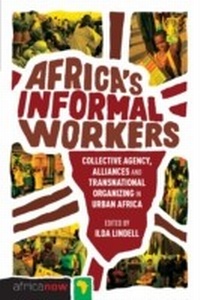
Africa's Informal Workers
Collective Agency, Alliances and Transnational Organizing in Urban Africa
Zed Books Ltd (Publisher)
1st Edition
Published on 4. April 2013
246 pages
978-1-84813-833-9 (ISBN)
Description

Africa's Informal Workers is a vigorous examination of the informalization and casualization of work, which is changing livelihoods in Africa and beyond.
Gathering cases from nine countries and cities across sub-Saharan Africa, and from a range of sectors, this volume goes beyond the usual focus on household 'coping strategies' and individual agency, addressing the growing number of collective organizations through which informal workers make themselves visible and articulate their demands and interests. The emerging picture is that of a highly diverse landscape of organized actors, providing grounds for tension but also opportunities for alliance. The collection examines attempts at organizing across the formal-informal work spheres, and explores the novel trend of transnational organizing by informal workers.
Part of the ground-breaking Africa Now series, Africa's Informal Workers is a timely exploration of deep, ongoing economic, political and social transformations.
Gathering cases from nine countries and cities across sub-Saharan Africa, and from a range of sectors, this volume goes beyond the usual focus on household 'coping strategies' and individual agency, addressing the growing number of collective organizations through which informal workers make themselves visible and articulate their demands and interests. The emerging picture is that of a highly diverse landscape of organized actors, providing grounds for tension but also opportunities for alliance. The collection examines attempts at organizing across the formal-informal work spheres, and explores the novel trend of transnational organizing by informal workers.
Part of the ground-breaking Africa Now series, Africa's Informal Workers is a timely exploration of deep, ongoing economic, political and social transformations.
Reviews / Votes
This collection, with its excellent editorial introduction, makes a groundbreaking contribution to understanding the ways in which informal workers are developing new forms of collective organisation for exercising voice and agency, illustrating both the scope for and constraints on their ability to exert political influence. * Carole Rakodi, The University of Birmingham * This cutting-edge volume is indispensable reading for urbanists, activists and policy makers. * Edgar Pieterse, University of Cape Town * This collection brings together empirical studies from varied contexts, based primarily in Africa, many by African scholars, allowing a crucial opportunity for new perceptions and comparisons, and for identifying key dynamics to track into the future. * Jane I. Guyer, Johns Hopkins University *More details
Series
Edition
1. Auflage
Language
English
Place of publication
United Kingdom
Publishing group
Bloomsbury Publishing PLC
Target group
College/higher education
Professional and scholarly
ISBN-13
978-1-84813-833-9 (9781848138339)
Copyright in bibliographic data and cover images is held by Nielsen Book Services Limited or by the publishers or by their respective licensors: all rights reserved.
Schweitzer Classification
Other editions
Additional editions
Africa's Informal Workers
Collective Agency, Alliances and Transnational Organizing in Urban Africa
Book
04/2010
Zed Books Ltd
€45.30
Shipment within 3-4 weeks
Persons
Ilda Lindell is a researcher at the Nordic Africa Institute and an associate professor of human geography at Stockholm University. She has authored book chapters and journal articles in Urban Studies, Habitat International, Geografiska Annaler and Third World Quarterly. She is also the author of Walking the Tight Rope (2002).
The Nordic Africa Institute (Nordiska Afrikainstitutet) is a center for research, documentation and information on modern Africa. Based in Uppsala, Sweden, the Institute is dedicated to providing timely, critical and alternative research and analysis of Africa and to co-operation with African researchers. As a hub and a meeting place for a growing field of research and analysis the Institute strives to put knowledge of African issues within reach for scholars, policy makers, politicians, media, students and the general public. The Institute is financed jointly by the Nordic countries (Denmark, Finland, Iceland, Norway and Sweden).
The Nordic Africa Institute (Nordiska Afrikainstitutet) is a center for research, documentation and information on modern Africa. Based in Uppsala, Sweden, the Institute is dedicated to providing timely, critical and alternative research and analysis of Africa and to co-operation with African researchers. As a hub and a meeting place for a growing field of research and analysis the Institute strives to put knowledge of African issues within reach for scholars, policy makers, politicians, media, students and the general public. The Institute is financed jointly by the Nordic countries (Denmark, Finland, Iceland, Norway and Sweden).
Content
1. The Changing Politics of Informality: Collective Organizing, Alliances and.Scales of Engagement - Ilda Lindell
Part I: The Political Dynamics of Collective Organizing
2. Seen But Not Heard: Urban Voice and.Citizenship for Street Traders - Alison Brown and Michal Lyons
3. The Politics of Vulnerability: Exit, Voice and.Capture in Three Nigerian Informal Manufacturing Clusters - Kate Meagher
4. Women Leaders and.the Sense of Power: Clientelism and.Citizenship at the Dantokpa Market in Cotonou, Benin - Ebbe Prag
Part II: Constructing Alliances: Organizing Across the Formal - Informal 'Divide'
5. Alliances Across The Formal-Informal Divide: South African Debates and.Nigerian Experiences - Gunilla Andrae and.Bjoern Beckman
6. Self-Organized Informal Workers and.Trade Union Initiatives in Malawi: Process, Challenges and Directions of Organizing the Informal Economy - Ignasio Malizani Jimu
7. Moments of Resistance: The Struggle Against Informalization in The City of Cape Town - David Christoffer Jordhus-Lier
8. The Possibilities for Collective Organization of Informal Port Workers in Tema, Ghana - Owusu Boampong
Part III: International Dimensions of Organizing
9. The 'China Challenge': The Global Dimensions of Activism and the Informal Economy in Dakar, Senegal - Suzanne Scheld
10. Passport Please: The Cross-Border Traders Association in Zambia - Wilma S. Nchito and.Karen Tranberg Hansen
Part I: The Political Dynamics of Collective Organizing
2. Seen But Not Heard: Urban Voice and.Citizenship for Street Traders - Alison Brown and Michal Lyons
3. The Politics of Vulnerability: Exit, Voice and.Capture in Three Nigerian Informal Manufacturing Clusters - Kate Meagher
4. Women Leaders and.the Sense of Power: Clientelism and.Citizenship at the Dantokpa Market in Cotonou, Benin - Ebbe Prag
Part II: Constructing Alliances: Organizing Across the Formal - Informal 'Divide'
5. Alliances Across The Formal-Informal Divide: South African Debates and.Nigerian Experiences - Gunilla Andrae and.Bjoern Beckman
6. Self-Organized Informal Workers and.Trade Union Initiatives in Malawi: Process, Challenges and Directions of Organizing the Informal Economy - Ignasio Malizani Jimu
7. Moments of Resistance: The Struggle Against Informalization in The City of Cape Town - David Christoffer Jordhus-Lier
8. The Possibilities for Collective Organization of Informal Port Workers in Tema, Ghana - Owusu Boampong
Part III: International Dimensions of Organizing
9. The 'China Challenge': The Global Dimensions of Activism and the Informal Economy in Dakar, Senegal - Suzanne Scheld
10. Passport Please: The Cross-Border Traders Association in Zambia - Wilma S. Nchito and.Karen Tranberg Hansen
