

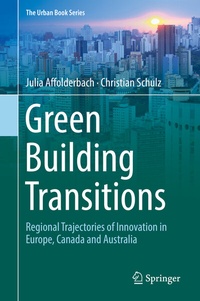
Green Building Transitions
Description

This volume analyzes sustainability-related innovations in the building sector and discusses how regional contexts articulate transition trajectories toward green building. It presents 'biographies' of drivers and processes of green building innovation in four case studies: Brisbane (AUS), Freiburg (GER), Luxembourg (LU), and Vancouver (CA). Two of them are relatively well known for their initiatives to mitigate climate change - particularly in the building sector, whereas the other two have only recently become more active in promoting green building. The volume places emphasis on development paths, learning processes, and innovations. The focus of the case studies is not restricted to purely technological aspects but also integrates regulatory, procedural, institutional, and other processes and routines and their influence on the variations of the building sector.
The diversity of the selected case studies offers the reader the opportunity to gain a thorough understanding of how sustainability developments have unfolded in different city regions. Case study-specific catalogues of transition paths provide insights to inform policy debates and planning processes. The catalogues identify crucial innovations (technological, regulatory, etc.) and explain the factors and circumstances that have led to their success and broader acceptance in Freiburg, Vancouver, Luxembourg, and Brisbane. With the help of a number of micro case studies within each of the four city regions, the case studies also offer ground for comparison and identification of differences.
The book represents the outcome of the GreenRegio project, which stands for 'Green building in regional strategies for sustainability: multi-actor governance and innovative building technologies in Europe, Australia, and Canada.' GreenRegio was a 3-year CORE-INTER research project funded by the National Research Fund Luxembourg (FNR) and the German Research Foundation (DFG).
Chapters 2, 3,10 are available open access under a Creative Commons Attribution 4.0 International License via link.springer.com.
More details
Other editions
Additional editions
Persons
Dr. Boris Braun is University professor for Human and Economic Geography at the University of Cologne.
Dr. Christian Schulz holds a professorship in European Sustainable Spatial Development and Analysis at the University of Luxembourg.
