

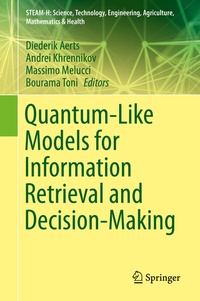
Quantum-Like Models for Information Retrieval and Decision-Making
Description

The aim of this Special Volume is to encourage scientists, especially the new generation (master and PhD students), working in computer science and related mathematical fields to explore novel possibilities based on the mathematical formalisms of quantum information and probability. The contributing authors, who hail from various countries, combine extensive quantum methods expertise with real-world experience in application of these methods to computer science. The problems consideredchiefly concern quantum information-probability based modeling in the following areas: information foraging; interactive quantum information access; deep convolutional neural networks; decision making; quantum dynamics; open quantum systems; and theory of contextual probability.
The book offers young scientists (students, PhD, postdocs) an essential introduction to applying the mathematical apparatus of quantum theory to computer science, information retrieval, and information processes.
More details
Other editions
Additional editions
Persons
Diederik Aerts is professor at the Vrije Universiteit Brussel (VUB) and founding director of the Leo Apostel Centre for Interdisciplinary Studies (CLEA). He is Editor-in-Chief of the international ISI and Springer journal Foundations of Science and president of the Centre for Quantum Social and Cognitive Science (IQSCS) at Leicester University (UK). He was the scientific and artistic coordinator of the Einstein meets Magritte conference in 1995, where the world's leading scientists and artists gathered to reflect about science, nature, human action and society. Diederik Aerts started his research with a focus on the foundations of quantum physics and, during the last two decades, also on cognitive science. In this respect, he is considered a pioneer of the research domain called quantum cognition.
Andrei Khrennikov is a Professor at the Linnaueus University and the Director of a multidisciplinary research center at this university, the International Center for Mathematical Modeling in Physics, Engineering, Economics, and Cognitive Science. He got his PhD from Moscow State University, Russia.Massimo Melucci is an Associate Professor at the University of Padova, Italy. He received his PhD in Computer Engineering from the same university. He has been coordinating the Innovative Training Network QUARTZ - Quantum Information Access and Retrieval Theory. Bourama Toni is a Full Professor and Chair of the Department of Mathematics at Howard University, Washington DC, USA. He holds a PhD in Mathematics from the University of Montreal, Canada.
