

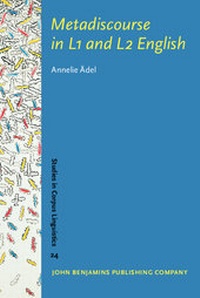
Metadiscourse in L1 and L2 English
1st Edition
Published on 12. September 2006
X, 243 pages
978-90-272-9329-9 (ISBN)
Description

The pervasive phenomenon of metadiscourse - commentary on the ongoing discourse - is beginning to take its rightful place among the major topics of discourse studies. This book makes simultaneous contributions to the theory of metadiscourse, corpus-based methods of studying such phenomena, and our knowledge of metadiscourse use in written English. After comprehensively reviewing previous research, it introduces a more rigorous and empirical approach to metadiscourse studies. Ädel presents a new model of metadiscourse based on Jakobson's functions of language, and other conceptual tools, including explicit features for defining metadiscourse, a taxonomy of the functions it serves, and maps of the boundaries between it and related phenomena. A large-scale study of writing by L1 and L2 university students is presented, in which the L2 speakers' overuse of metadiscourse strongly marks them as lacking in communicative competence. This work is of interest both to linguists and to educators concerned with writing in English.
More details
Other editions
Additional editions
Annelie AEdel
Metadiscourse in L1 and L2 English
Book
09/2006
John Benjamins Publishing Co
€116.60
Shipment within 10-15 days
Person
Content
- Metadiscourse in L1 and L2 English
- Editorial page
- Title page
- LCC data
- Table of contents
- Acknowledgements
- 1. Introduction
- 1.1. Background
- 1.2. Aims
- 1.3. Material
- 1.4. Method
- 1.5. Outline of the study
- 2. A model of metadiscourse
- 2.1. Introduction
- 2.2. Personal and impersonal types of metadiscourse
- 2.3. The present model
- 2.4. Definition of metadiscourse
- 2.4.1. Generalisations about metadiscourse
- 2.4.2. Features for identifying metadiscourse
- 2.5. Applying the features to personal metadiscourse
- 2.5.1. First person singular I
- 2.5.2. First person plural we
- 2.5.3. Second person you
- 2.6. Delimiting the categories
- 2.6.1. 'Metatext' and 'writer-reader interaction'
- 2.6.2. Stance markers
- 2.6.3. Participation
- 2.6.4. Connecting the categories
- 2.7. Conclusion
- 3. Personal metadiscourse
- 3.1. Introduction
- 3.2. Quantifying personal metadiscourse
- 3.3. Distribution of personal metadiscourse
- 3.4. The density of metadiscourse
- 3.5. The discourse functions of personal metadiscourse
- 3.5.1. Metatext
- 3.5.2. Writer-reader interaction
- 3.5.3. Distribution of discourse functions
- 3.6. Other references to the writer and reader
- 3.6.1. Oblique forms of I, we and you
- 3.6.2. Pronominal one
- 3.6.3. Nouns that refer to the writer and reader
- 3.7. The writer persona
- 3.7.1. Roles of the writer persona
- 3.7.2. The hermeneutics of the text made explicit
- 3.7.3. Tentativeness in the learner essays
- 3.8. Conclusion
- 4. Impersonal metadiscourse
- 4.1. Introduction
- 4.2. Distribution of impersonal metadiscourse
- 4.3. The discourse functions of impersonal metadiscourse
- 4.3.1. Phorics
- 4.3.2. References to the Text/Code
- 4.3.3. Code Glosses
- 4.3.4. Discourse Labels
- 4.4. Conclusion
- 5. The textual distribution of metadiscourse
- 5.1. Introduction
- 5.2. Textual distribution of personal metadiscourse
- 5.3. Textual distribution of impersonal metadiscourse
- 5.4. Textual distribution of questions
- 5.5. Textual distribution of exclamations
- 5.6. Conclusion
- 6. Possible causes of variation in metadiscourse use
- 6.1. Introduction
- 6.2. Genre comparability
- 6.3. Register awareness
- 6.4. Cultural conventions
- 6.5. Learner strategies
- 6.6. Conclusion
- 7. Theories of metadiscourse
- 7.1. Introduction
- 7.2. Metalanguage
- 7.2.1. Metalanguage versus object language
- 7.2.2. Use versus mention
- 7.2.3. On the meanings of metalanguage
- 7.2.4. Metatextual versus intertextual
- 7.3. Functional perspectives on language
- 7.3.1. The metalinguistic function
- 7.3.2. Reflexivity
- 7.4. Two approaches to metadiscourse
- 7.4.1. The broad approach
- 7.4.2. Stance
- 7.4.3. The narrow approach
- 7.5. Conclusion
- 8. Conclusions
- 8.1. Introduction
- 8.2. The theory of metadiscourse
- 8.3. Metadiscourse in corpus studies
- 8.4. The use of metadiscourse
- 8.5. Future research
- 8.6. Final remarks
- Appendix 1. Comparability of the corpora
- Appendix 2. The control corpus and the norm
- Appendix 3. Metadiscourse as non-propositional material?
- Appendix 4. Meta-terminology
- Notes
- References
- Author index
- Subject index
- The series Studies in Corpus Linguistics (SCL)
