

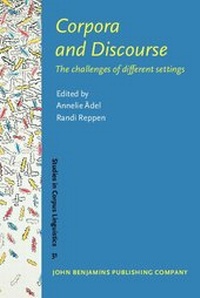
Corpora and Discourse
The challenges of different settings
1st Edition
Published on 26. June 2008
VI, 295 pages
978-90-272-9045-8 (ISBN)
Description

This book brings together contributions from a diverse collection of scholars who explore different ways of combining corpus linguistics and discourse analysis, studying discourse at the prosodic, lexical, and textual levels. Both spoken and written discourse are investigated in a variety of settings, including academia, the workplace, news, and entertainment. Not only does the volume offer a rich sample of English-language discourse from around the world, including international, learner, and non-standard varieties of English, but it also covers a range of topics and methods. This book will be of particular interest to researchers and students specializing in discourse studies, English linguistics, and corpus linguistics.
More details
Other editions
Additional editions
Book
06/2008
John Benjamins Publishing Co
€111.30
Shipment within 10-15 days
Persons
Content
- Corpora and Discourse
- Editorial page
- Title page
- LCC data
- Table of contents
- The challenges of different settings
- Corpus-linguistic studies of discourse
- Finding discourse-relevant data
- Overview of the chapters
- References
- Exploring discourse in academic settings
- `...post-colonialism, multi-culturalism, structuralism, feminism, post-modernism and so on and so forth'
- 1. Introduction: Vague categories
- 2. Previous research into vague categories
- 3. Classroom modes
- 4. Data and methodology
- 5. Analysis
- 5.1. Managerial mode
- 5.2. Materials mode
- 5.3. Skills and systems mode
- 5.4. Classroom context mode
- 6. Conclusions
- References
- Appendix Transcription conventions
- Emphatics in academic discourse
- 1. Introduction
- 2. Methods and material
- 2.1. Methodological preliminaries
- 2.2. Material
- 3. Results and discussion
- 3.1. Comparing frequencies: Keywords of economics and history
- 3.2. Ambiguity of functions: Focus on syntactic role/scope
- 3.3. Collocation and ``semantic preference''
- 3.4. Pragmatic and textual functions: Focus on significantly, invariably and undoubtedly
- 4. Conclusion
- References
- Interaction, identity and culture in academic writing
- 1. Introduction
- 2. Methodological approach
- 2.1. The SCEGAD corpus
- 2.2. Phenomena examined and statistical methods
- 3. Results
- 3.1. Person reference across languages and cultures
- 3.2. Person reference across disciplines
- 3.3. Person reference across genders and academic status levels
- 4. Person reference and discourse strategies
- 4.1. Managing complex persona with person reference
- 5. Conclusion
- References
- Exploring discourse in workplace settings
- ``Got a date or something?''
- 1. Introduction
- 2. Humour and the workplace setting
- 3. Data and methodology
- 3.1. Transcription issues
- 4. Discussion and results
- 4.1. Subversive humour
- 4.2. Reinforcing humour
- 5. Conclusion
- References
- Determining discourse-based moves in professional reports
- 1. Introduction
- 2. Corpus and coding
- 2.1. Description of corpus
- 2.2. Rationale and description of coding system
- 3. Analysis of selected items for the problem element within discourse-based moves
- 3.1. Analysis of `problem'/`problems'
- 3.2. Analysis of `impact'/`impacts'
- 4. Conclusion
- References
- Appendix 1: Coding scheme for professional reports
- //-& ONE country two SYStems //
- 1. Introduction
- 2. Word associations
- 3. Discourse intonation and word associations
- 4. Tone unit and prominence
- 5. Data of the study
- 6. Discussion of lexically-rich word associations
- 7. Discussion of distribution of prominence
- 8. Discussion of grammatically-rich word associations
- 9. Conclusions
- Acknowledgements
- References
- Appendix iConc© and Computer readable prosodic transcription conventions
- Exploring discourse in news and entertainment
- Who's speaking?
- Introduction
- Bias and newspaper reporting
- Evidentiality in language
- Research questions
- Methods
- Data collection
- Samples of the data
- Automated and manual data analysis
- Results and discussion
- Direct vs. indirect reported speech
- Sources cited in the corpus
- Sources cited in Sample B
- The use of nested evidentiality
- The use of unnamed sources
- Reporting words used to report speech events
- Conclusion
- References
- Television dialogue and natural conversation
- 1. Introduction
- 1.1. Television as a source of spoken data
- 2. Methodology
- 2.1. The Friends corpus: Settings and interactions
- 2.2. The conversation corpus: Settings and interactions
- 2.3. Data coding
- 3. Results
- 3.1. Multidimensional analysis: Similarities
- 3.2. Functional analysis of Friends
- 4. Conclusion
- References
- Appendix
- A corpus approach to discursive constructions of a hip-hop identity
- 1. Introduction
- 1.1. Hip-hop identity in message board discourse
- 2. Methodology
- 3. Openings and closings
- 3.1. Yo
- 3.2. Peace
- 4. Slang and taboo terms
- 4.1. Slang
- 4.2. Taboo terms
- 5. Verbal art
- 5.1. Non-standard orthography
- 5.2. Use of numbers
- 5.3. Word-final `a'
- 5.4. Word-final `z'
- 5.5. Use of special characters
- 6. Conclusion
- References
- Appendix A
- Exploring discourse through specific linguistic features
- The use of the it-cleft construction in 19th-century English
- 1. Introduction
- 2. It-clefts in Present-day English: Theory and frequency
- 3. Brief historical background on it-clefts
- 4. It-clefts in 19th-century English
- 5. It-clefts in 19th-century Trials
- 5.1. Structures of it-cleft constructions in 19th-century Trials
- 5.2. Extensions of the it-cleft pattern
- 5.3. Informational aspects of it-clefts in Trials
- 6. Conclusion
- References
- Place and time adverbials in native and non-native English student writing
- 1. Introduction
- 2. Previous work
- 3. Adverb selection, corpora and methodology
- 3.1. Functions of here
- 3.2. Functions of there
- 3.3. Functions of now
- 3.4. Functions of then
- 4. Results and discussion
- 4.1. The place adverb here
- 4.2. The place adverb there
- 4.3. Time adverb now
- 4.4. Time adverb then
- 5. Conclusion
- References
- Author index
- Corpus and tools index
- Subject index
- The series Studies in Corpus Linguistics
