

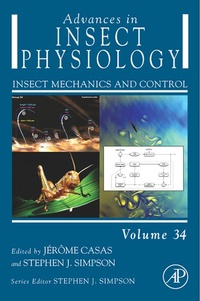
Advances in Insect Physiology
Insect Mechanics and Control
Academic Press
Published on 14. December 2007
396 pages
978-0-08-055645-1 (ISBN)
Description

Insects have much to offer when it comes to designing engineering solutions to problems, whether for robotics, aeronautics, computing or materials science. Insect Mechanics and Control, the first book ever published on this topic, bringing together world experts working at the interface between entomology, engineering and physics to showcase the exciting research in this rapidly growing field. The authors, applied mathematicians, physicists or quantitative biologists, provide coverage of their subjects in a way that uses the minimum necessary technical detail, making the subject accessible to biologists and their students who are not expert in the field. The book in turn provides a valuable compendium of biological information for physical scientists, thus promoting interchange between the biological and physical sciences.
- Covers important problems in mechanics and control, by reference to extraordinary and fascinating insect examples
- Written by experts, physicists, applied mathematicians and quantitative biologists
- Offers a biological inspiration to physical scientists, from MEMS design to robotics
- Provides a compelling example of integrative biology
More details
Other editions
Additional editions
Advances in Insect Physiology: Volume 34
Insect Mechanics and Control
Book
12/2007
Academic Press
€148.56
Withdrawn from sale
Persons
Content
- Cover
- Contents
- Contributors
- Introduction
- Chapter 1. Medium Flow-Sensing Hairs: Biomechanics and Models
- 1. Introduction: medium flow-sensing hairs in the animal kingdom
- 2. Hair motion physical-mathematical models
- 3. Parameter effects
- 4. Discussion
- 5. Bio-inspired artificial motion sensors
- Notation (dimensions in SI units)
- Acknowledgements
- References
- Appendix A. Determination of the frequency corresponding to the maximum slope of the maximum angular velocity of an oscillating hair
- Appendix B. Filiform hair response to a transient pulsating boundary layer flow
- Chapter 2. Smooth Attachment Devices in Insects: Functional Morphology and Biomechanics
- 1. Two functional types of insect attachment pads
- 2. Diversity of smooth attachment devices of insects
- 3. Material properties
- 4. Adhesive properties
- 5. Frictional properties
- 6. Fluid
- 7. Functional effects of smooth pads
- 8. Comparison to other animal groups
- 9. Biomimetic implications
- 10. Outlook
- Acknowledgements
- References
- Chapter 3. The Integument of Water-walking Arthropods: Form and Function
- 1. Introduction
- 2. Surface tension
- 3. Wetting
- 4. Insect cuticle
- 5. Function
- 6. Imaging techniques
- 7. Discussion
- Acknowledgements
- References
- Chapter 4. Mechanosensory Feedback in Walking: From Joint Control to Locomotor Patterns
- 1. Introduction
- 2. Mechanosensory feedback signals
- 3. The control of posture
- 4. Mechanosensory control of walking
- 5. Organization of neural networks controlling single-leg stepping
- 6 Specificity of sensory-motor influences
- 7. Mechanosensory signals in inter-leg coordination
- 8. Neural mechanisms underlying modifications in the locomotor output
- 9. Conclusions
- Acknowledgements
- References
- Chapter 5. Sensory Systems and Flight Stability: What do Insects Measure and Why?
- 1. Introduction
- 2. Background
- 3. Visual sensors
- 4. Airflow sensors
- 5. Inertial sensors
- 6. Wing-load sensors
- 7. Conclusions
- Acknowledgements
- References
- Chapter 6. The Biomechanics of Chewing and Plant Fracture: Mechanisms and Implications
- 1. Introduction
- 2. Accessing nutrients in plants
- 3. The mechanics of fracture
- 4. Morphology of mandibles and associated musculature
- 5. The kinetics of mandible movement
- 6. Neural control of mandibular movements
- 7. Costs of consuming tough diets
- 8. Conclusions
- Acknowledgements
- References
- Index
