

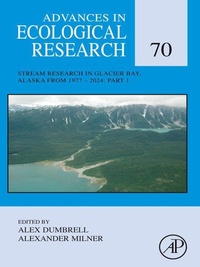
Advances in Ecological Research - Part 1
Elsevier (Publisher)
Published on 22. October 2024
318 pages
978-0-443-29733-5 (ISBN)
Description

Advances in Ecological Research, Volume 70 highlights new advances in the field, with this new volume presenting interesting chapters written by an international board of authors
- Provides the latest information on cancer research
- Offers outstanding and original reviews on a range of cancer research topics
- Serves as an indispensable reference for researchers and students alike
More details
Other editions
Additional editions
Alex Dumbrell | Alexander Milner
Advances in Ecological Research - Part 1: Volume 70
Book
10/2024
Academic Press
€187.25
Shipment within 15-20 days
Persons
Content
- Front Cover
- Series Page
- Advances in Ecological Research
- Copyright
- Contents
- Contributors
- Chapter One: Glacier Bay National Park, Alaska: A natural laboratory to study stream development and succession following deglaciation
- 1 Glacial history
- 2 Human settlements
- 3 Explorers and visitors
- 4 Succession
- 5 Primary successional stream studies
- 6 National Park Service
- 7 Previous river research
- 8 Outline of papers in the special issues vol 70 and 71
- Acknowledgments
- Funding
- References
- Chapter Two: The spatiotemporal dynamics of the physical habitat template at a watershed scale chronosequence in Glacier Bay, southeast Alaska
- 1 Introduction
- 1.1 Landscape ecology
- 1.2 Remote sensing
- 1.3 Scale and resolution
- 1.4 Physical habitat template (PHT,t) of a riverscape
- 2 Methods
- 2.1 Study area
- 2.2 DTM mapping and data analysis
- 2.3 Statistics
- 3 Results
- 4 Discussion
- 4.1 Eco-geomorphology
- 4.2 Framework for a remote sensed PHT at a point in time
- 4.3 Directional development of the PHT,t
- 5 Summary
- Acknowledgements
- Appendix 1 Watershed variables correlation table
- References
- Chapter Three: Role of riparian vegetation in colonization and succession of stream macroinvertebrates in Glacier Bay, Alaska
- 1 Introduction
- 2 Methods
- 2.1 Study site
- 2.2 ST versus main channel catkin packs
- 2.3 Caddisfly body size
- 2.4 Primary productivity
- 2.5 Juvenile fish
- 3 Results
- 3.1 Tributary fauna on catkins
- 3.2 Caddisfly growth experiments
- 3.3 Primary productivity
- 3.4 Juvenile fish
- 4 Discussion
- 4.1 Riparian vegetation
- 4.2 GPP
- Appendix
- References
- Chapter Four: Chironomidae (Diptera) community succession in streams across a 200 year gradient in Glacier Bay National Park, Alaska, USA
- 1 Introduction
- 2 Methods
- 2.1 Study site
- 2.2 Field and laboratory methods
- 3 Data analysis
- 4 Results
- 4.1 Stream habitat
- 4.2 Chironomidae community composition
- 4.3 Chironomidae community relationships with habitat variables
- 5 Discussion
- 6 Summary
- Acknowledgments
- Appendix
- References
- Chapter Five: Salmon lice (Lepeophtheirus salmonis) as a food source for juvenile salmonids in Glacier Bay, southeast Alaska
- 1 Introduction
- 2 Methods
- 2.1 Study area
- 3 Sample collection
- 4 Temperature and salinity measurements and pink salmon enumeration
- 5 Results
- 6 Discussion
- 7 Conclusion
- Acknowledgments
- References
- Chapter Six: Convergence of beta diversity in river macroinvertebrates following repeated summer floods
- 1 Introduction
- 2 Study area
- 3 Datasets and methods
- 4 Results
- 4.1 Community composition and summary metrics
- 5 Within site beta-diversity
- 6 Between river beta-diversity
- 7 Discussion
- 7.1 Short term impacts of the floods
- 7.2 Contrasting compositional response following the sequence of floods
- 7.3 Post-flood patterns of community change
- 8 Conclusion
- Acknowledgements
- Appendix 1
- References
- Back Cover
