

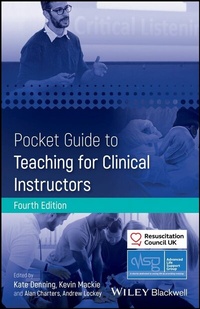
Pocket Guide to Teaching for Clinical Instructors
Description

New edition of the popular guide to the practical aspects of teaching and fundamental learning principles in clinical practice
Pocket Guide to Teaching for Clinical Instructors contains theoretical input on all the modalities of teaching and assessment required for life support training through the Advanced Life Support Group and Resuscitation Council UK blended learning approach. This guide does not attempt to provide a blueprint for teaching-rather, it gives advice about the basics, which can be adapted to your personality and creativity.
This Fourth Edition has been thoroughly revised and updated to reflect the latest in the evolution of education methods applicable to provider courses. The text is relevant to a 21st century audience and graphics have been introduced to make the materials more readable, applicable, and accessible.
Written by a team of highly experienced educators, Pocket Guide to Teaching for Clinical Instructors:
- Takes an evidence-based approach to how our brains manage and process information in order for learning to occur
- Provides a structured approach to teaching the different modalities used on the courses: lectures, skill stations, scenarios, workshops, debriefing as a learning conversation
- Explores neurodiversity, psychological safety, cognitive load, non-technical skills, and inclusive teaching
- Discusses blended learning, the wider role of the instructor and the variety of approaches to assessment
Pocket Guide to Teaching for Clinical Instructors is a concise, practical guide for anyone interested in teaching healthcare professionals in any context.
Advanced Life Support Group (ALSG), Manchester, UK. ALSG's medical education & training programs improve outcomes for people in life-threatening situations, anywhere along the health care pathway, anywhere in the world. As a charity, ALSG invests all profits in educational resources and partners with the most effective and respected organizations worldwide to develop exceptionally high-quality programs. ALSG education quality is verified, accredited, and internationally recognised as 'best in class'.
Resuscitation Council UK (RCUK) is the UK's leading authority on resuscitation practice and has a strong international reputation. RCUK develops the UK's evidence-based resuscitation guidelines, provides training and education for healthcare professionals and the public, and supports research to improve resuscitation techniques and outcomes. RCUK champions public awareness about the importance of CPR and defibrillator use and campaigns for policies and legislation that promote quality improvement initiatives to enhance resuscitation efforts and survival rates. RCUK is dedicated to ensuring that everyone in the country has the skills they need to save a life.
More details
Other editions
Additional editions
Persons
Advanced Life Support Group (ALSG), Manchester, UK. ALSG's medical education & training programs improve outcomes for people in life-threatening situations, anywhere along the health care pathway, anywhere in the world. As a charity, ALSG invests all profits in educational resources and partners with the most effective and respected organizations worldwide to develop exceptionally high-quality programs. ALSG education quality is verified, accredited, and internationally recognised as 'best in class'.
Resuscitation Council UK (RCUK) is the UK's leading authority on resuscitation practice and has a strong international reputation. RCUK develops the UK's evidence-based resuscitation guidelines, provides training and education for healthcare professionals and the public, and supports research to improve resuscitation techniques and outcomes. RCUK champions public awareness about the importance of CPR and defibrillator use and campaigns for policies and legislation that promote quality improvement initiatives to enhance resuscitation efforts and survival rates. RCUK is dedicated to ensuring that everyone in the country has the skills they need to save a life.
Content
Working Group vii
Contributors to the Fourth Edition ix
Foreword xi
Preface to the Fourth Edition xiii
Acknowledgments and dedication xv
1 Learning 1
2 Inclusive teaching 21
3 Facilitating learning 31
4 Facilitating workshops and small groups 39
5 Learning skills 53
6 Managing simulations 63
7 Psychological safety 77
8 Debriefing as a learning conversation 89
9 Assessing 101
10 Lectures and presentations 113
11 Blended learning 127
12 Non- technical skills 137
13 The wider role of the instructor 153
References and further reading 163
Index 173
How to use your textbook 179
Contributors to the first, second and third editions 181
